Balance Theory and Signed Graphs
The Structure and Dynamics of Valenced Networks
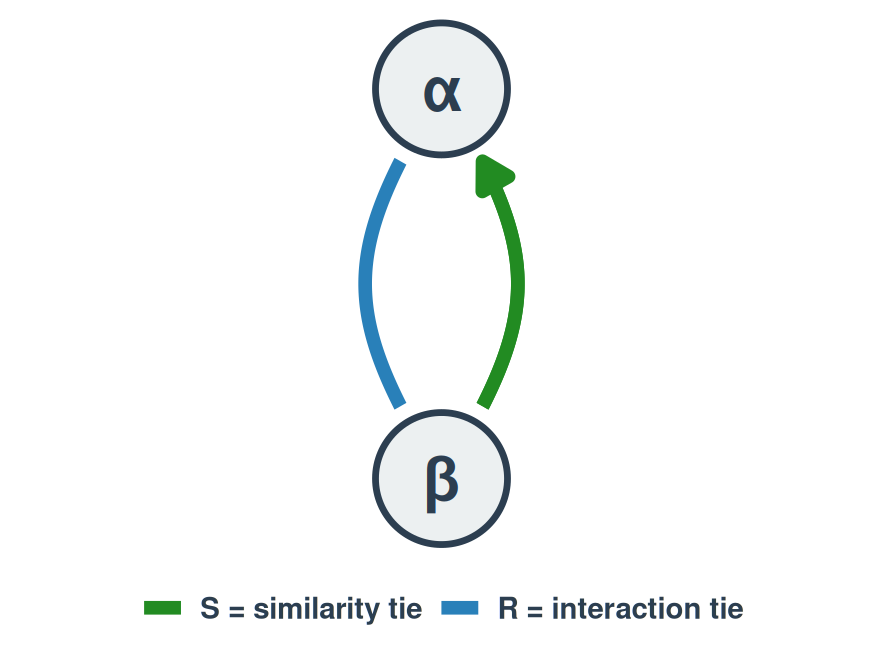
Dyadic Balance: Reading the Principle
- \(\alpha S \beta \rightarrow \alpha R \beta\) reads: “A tie of type \(S\) between \(\alpha\) and \(\beta\) leads to a tie of type \(R\) between \(\alpha\) and \(\beta\).”
- This applies to every combination of similarities and interactions.
- Examples:
- People tend to like the people they spend time with.
- People tend to help people who belong to the same groups as them.
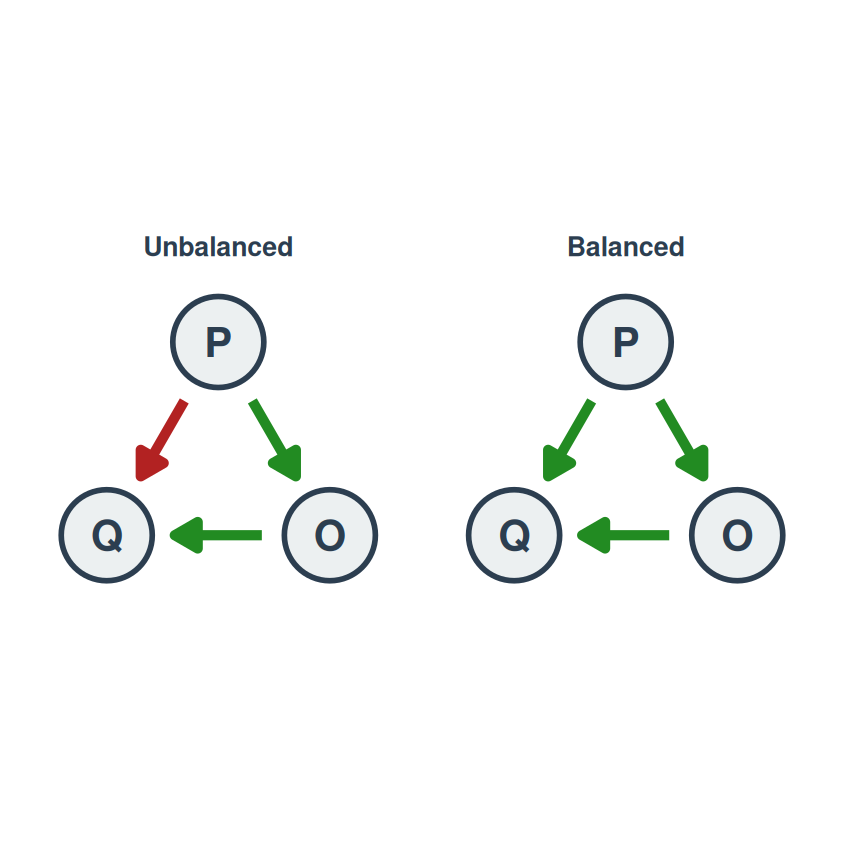
Worked Example: Spending Time and Liking
- Balanced: Simbi and Keryl spend time together and like each other.
- Similarity and interaction point the same way.
- Unbalanced: Simbi and Keryl spend time together, but the liking is one-sided.
- A similarity paired with a missing or hostile interaction creates tension.
- Balance theory predicts the tension gets resolved: the liking becomes mutual, or the time spent together dries up.
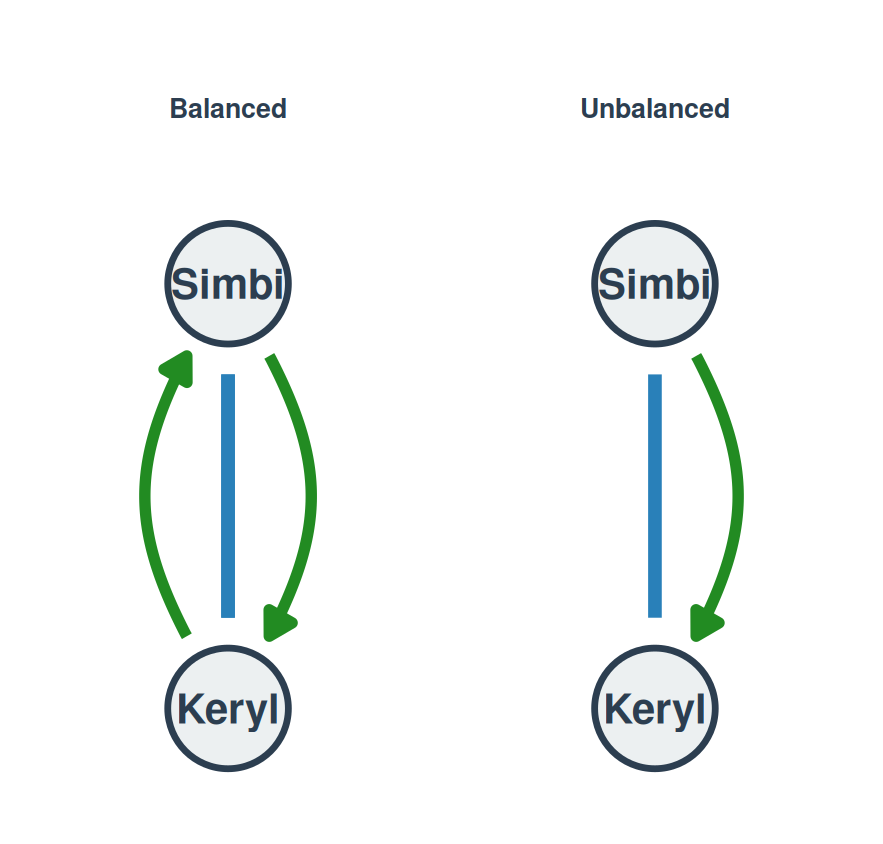
- Solid green: liking (directed). Blue: spend time with (symmetric).
Worked Example: Same Groups and Helping
- Balanced: Simbi and Keryl belong to the same groups and help each other.
- Unbalanced: They share group memberships, but the helping only flows one way.
- Same logic, different content: any symmetric similarity tie wants to be matched by reciprocal interaction ties.
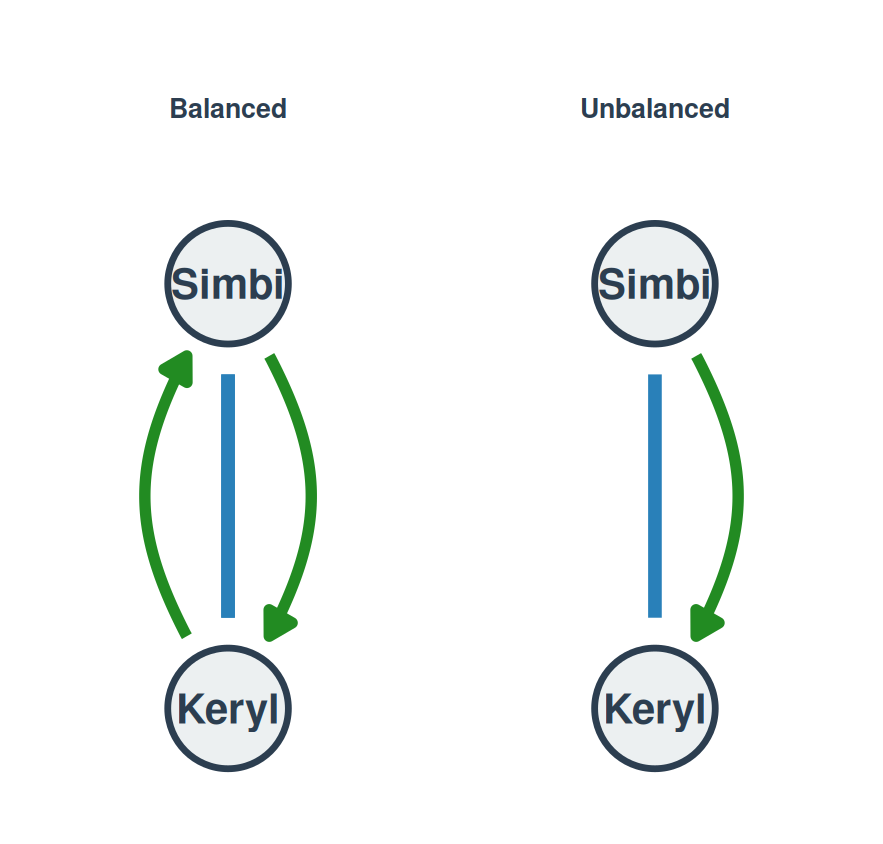
- Solid green: help (directed). Blue: same group (symmetric).
Signed Graphs
- Signed graphs are a special kind of graph featuring:
- One set of vertices \(V\).
- Two disjoint sets of edges:
- Positive links (\(E^+\)).
- Negative links (\(E^-\)).
- The graph is written \(G = \{V, E^+, E^-\}\).
- Two sets are disjoint when they don’t share any members (their intersection is the empty set \(\emptyset\)).
- Signed graphs can be either directed or undirected.
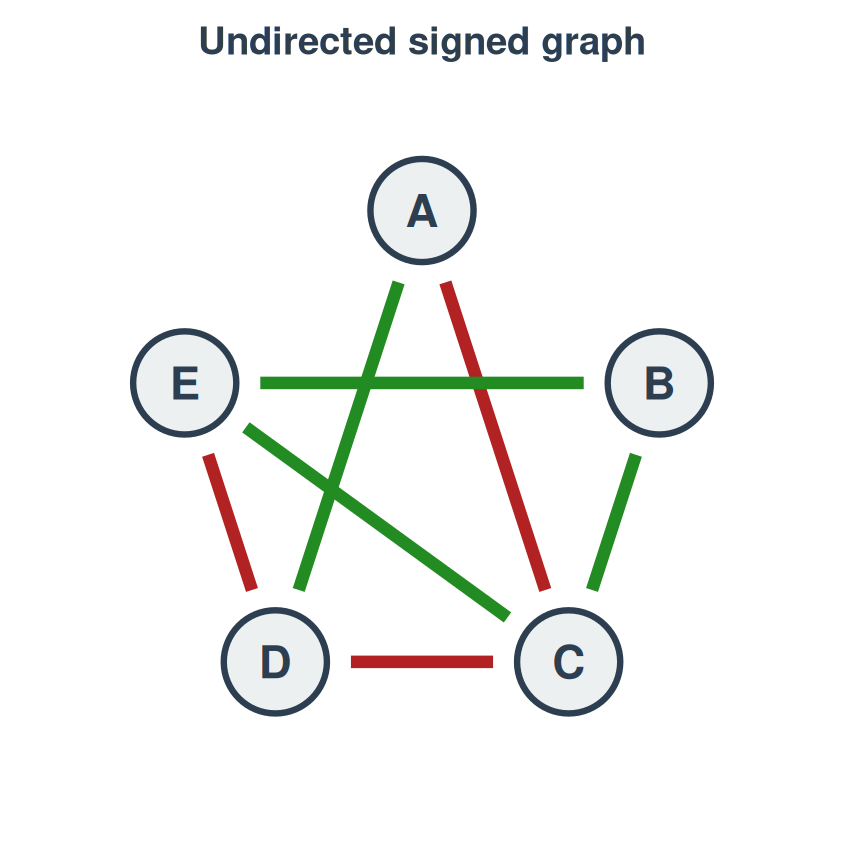
Building Block 1: A Person (P)
- The person (P).
- We “look” at the triad from this person’s point of view.
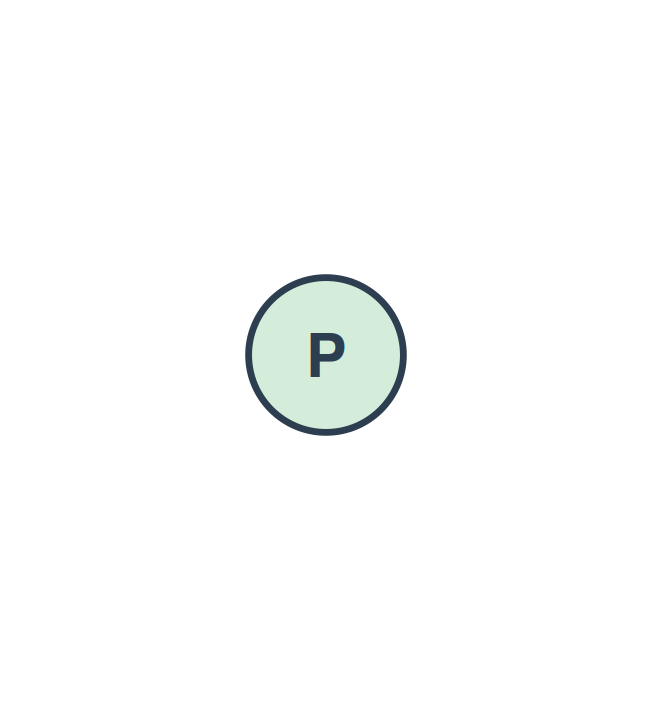
Building Block 2: An Object (O)
- An object (O) towards which the focal person has some kind of sentiment.
- The sentiment can be positive or negative.
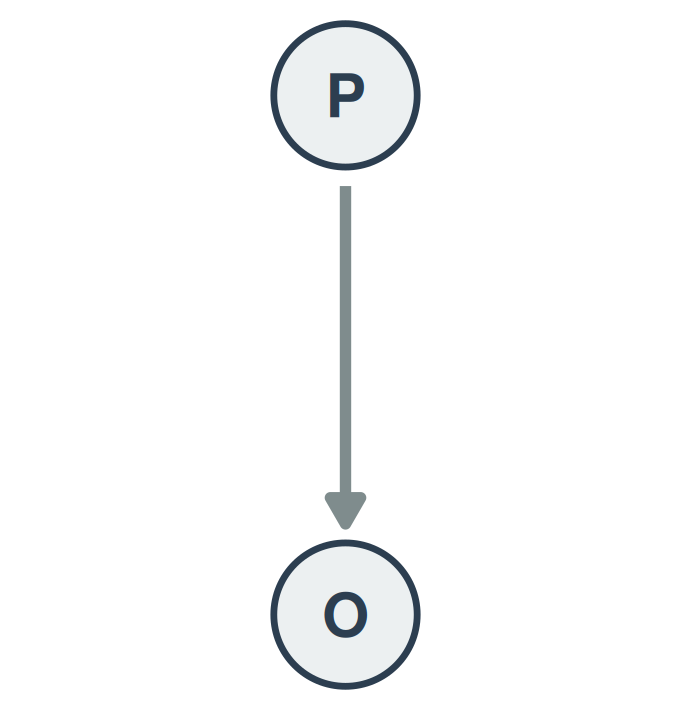
Building Block 3: A Third Party (Q)
- A third party (Q) towards which both the person and the other also have some kind of sentiment.
- Q does not have to be a real person! It could be any object.
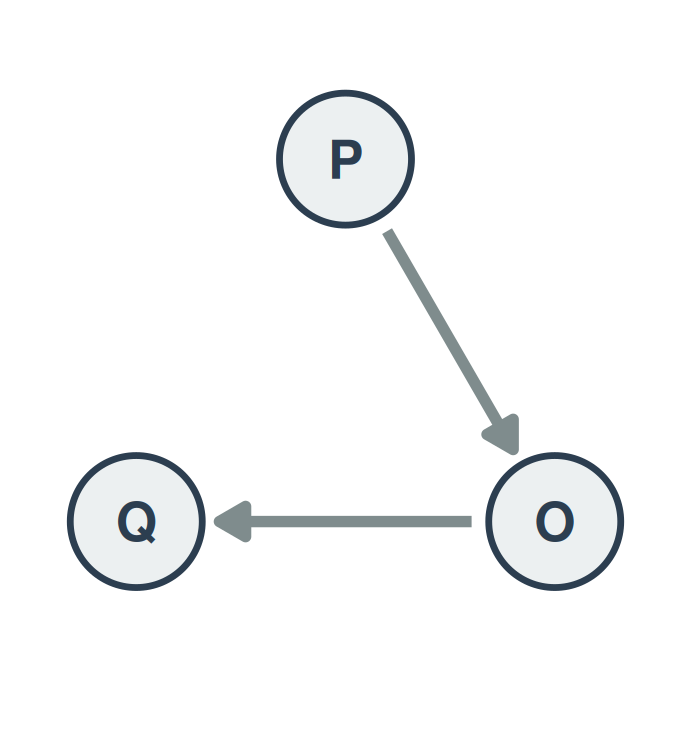
Building Block 4: Directed Signed Edges
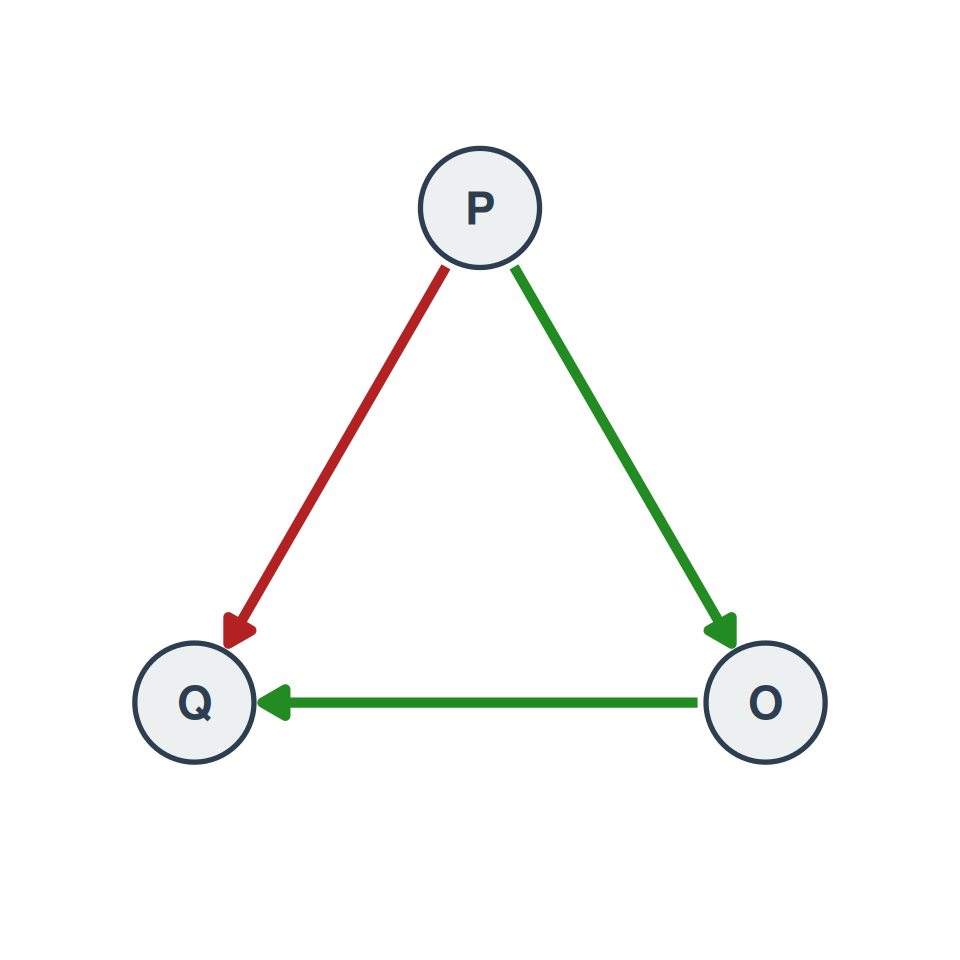
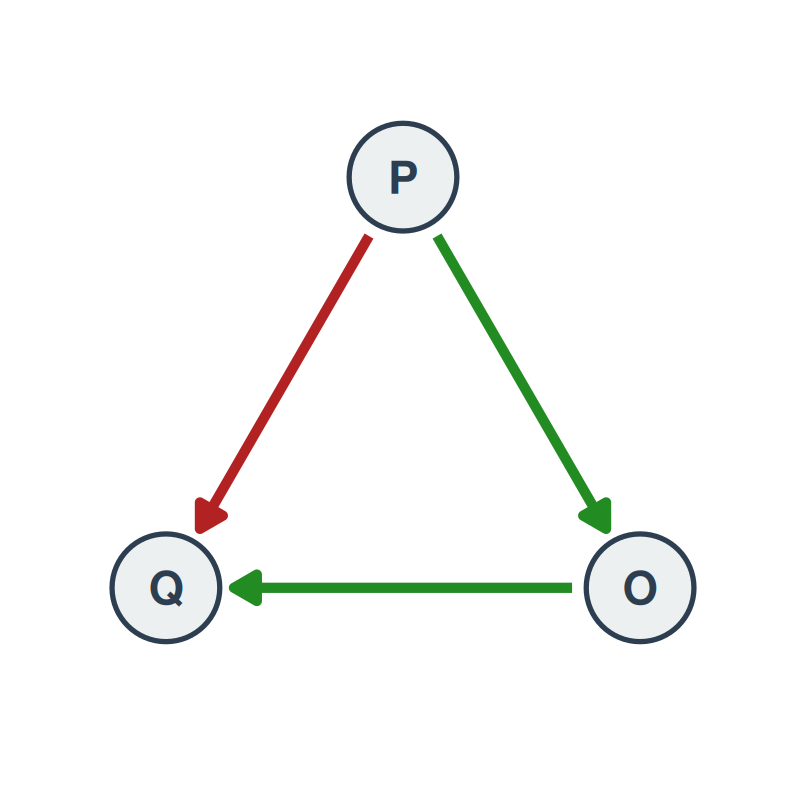
- A set of directed signed edges indicating positive (solid green) or negative (dashed red) sentiments:
- From P to O.
- From P to Q.
- From O to Q.
- This configuration reads: Person (P) likes Other (O); Other (O) likes the third party (Q); but Person (P) dislikes the third party.
The Triad in Everyday Terms
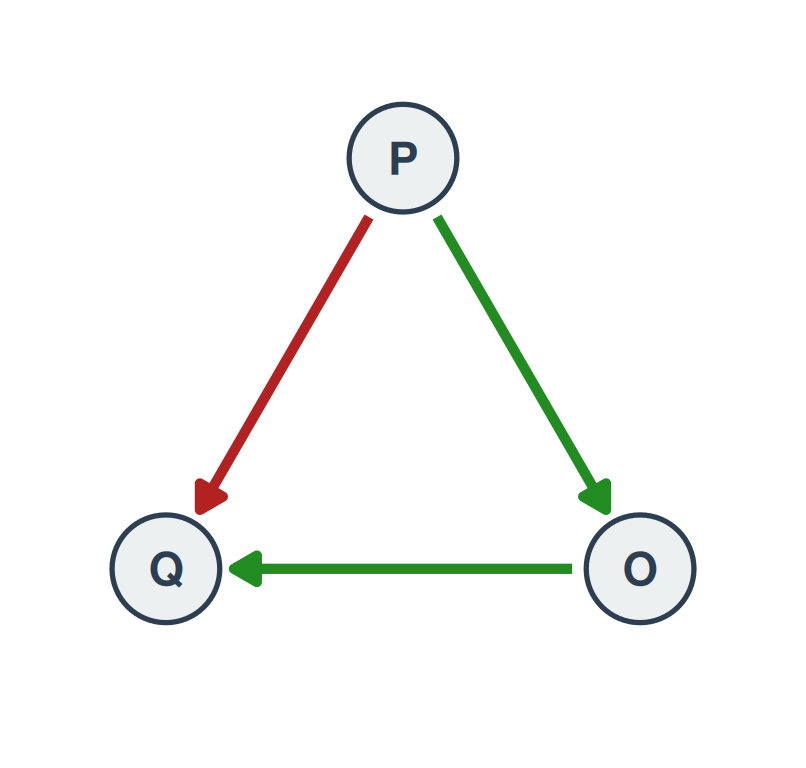
- Sounds dicey!
- You (P) have a friend (O) who likes another classmate (Q) whom you dislike.
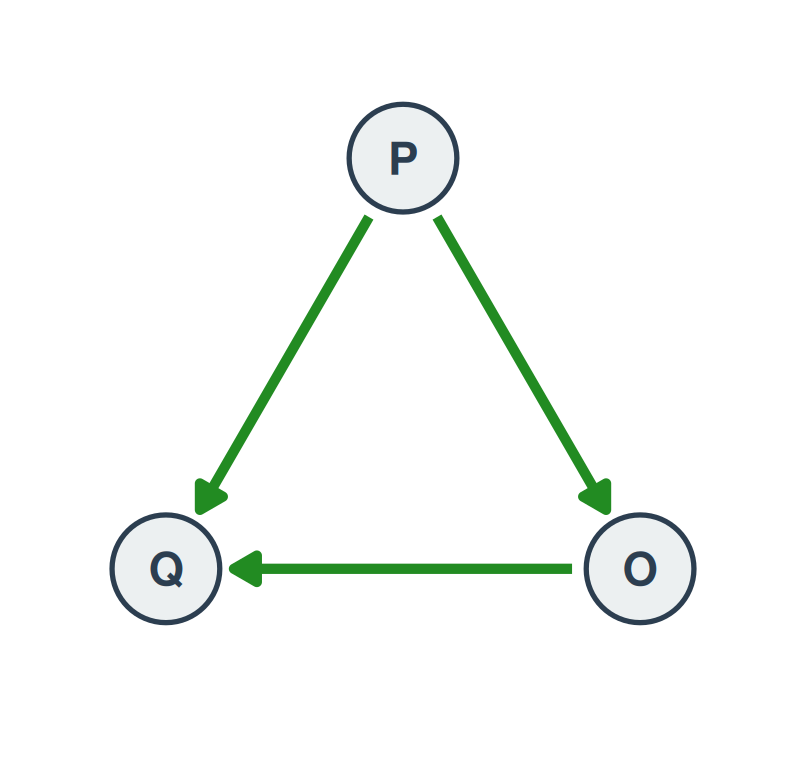
- Everything’s fine!
- You (P) have a friend (O) who likes another classmate (Q) whom you also like.
The Triad in Everyday Terms (continued)
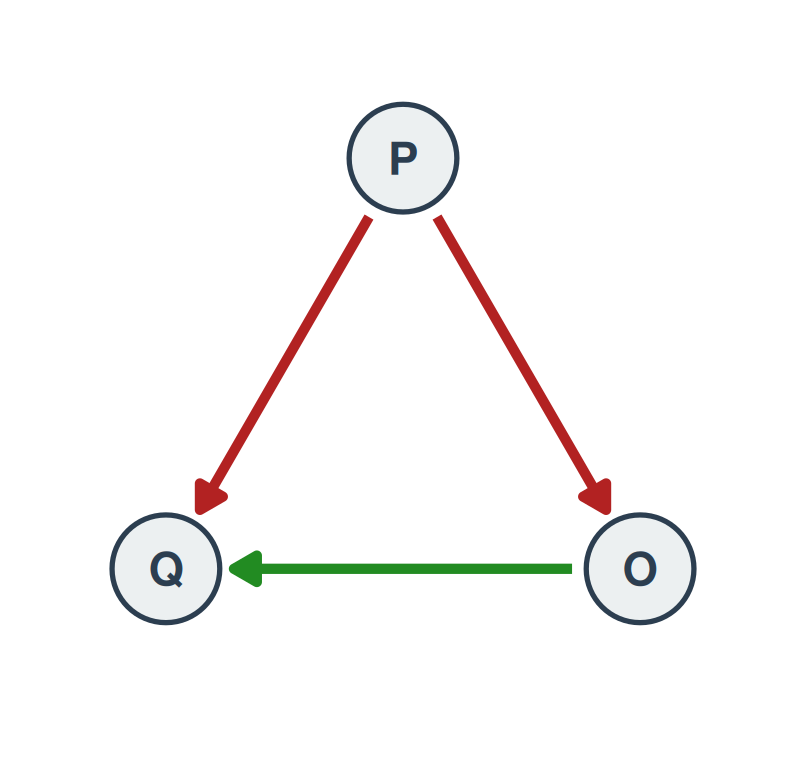
- Seems fine?
- You (P) have an enemy (O) who likes another classmate (Q) whom you also dislike.
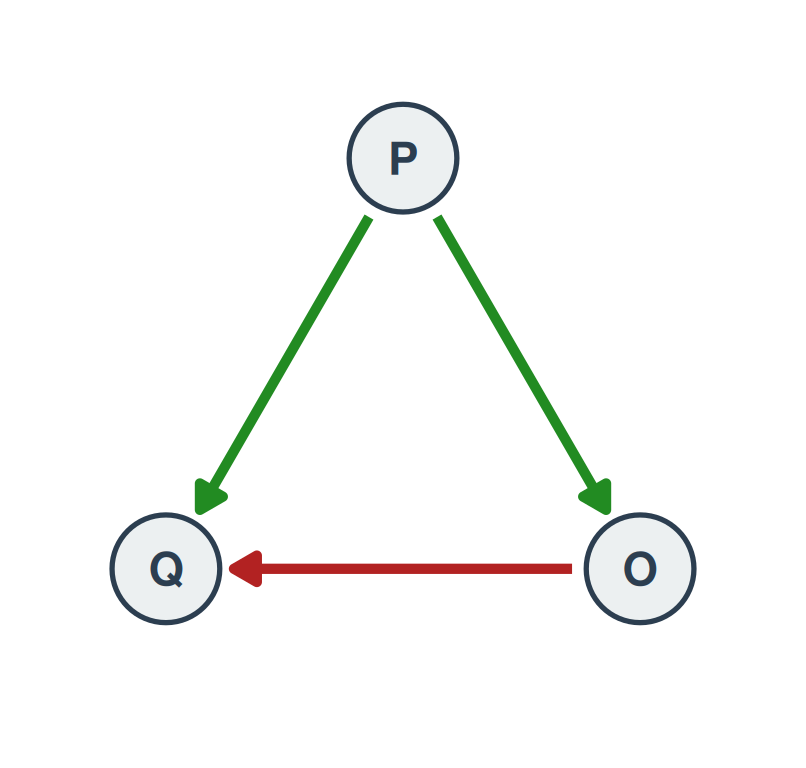
- Trouble in paradise!
- You (P) love Marvel movies (Q), but your long-time partner O (whom you like, duh!) hates them.
Balanced Configurations
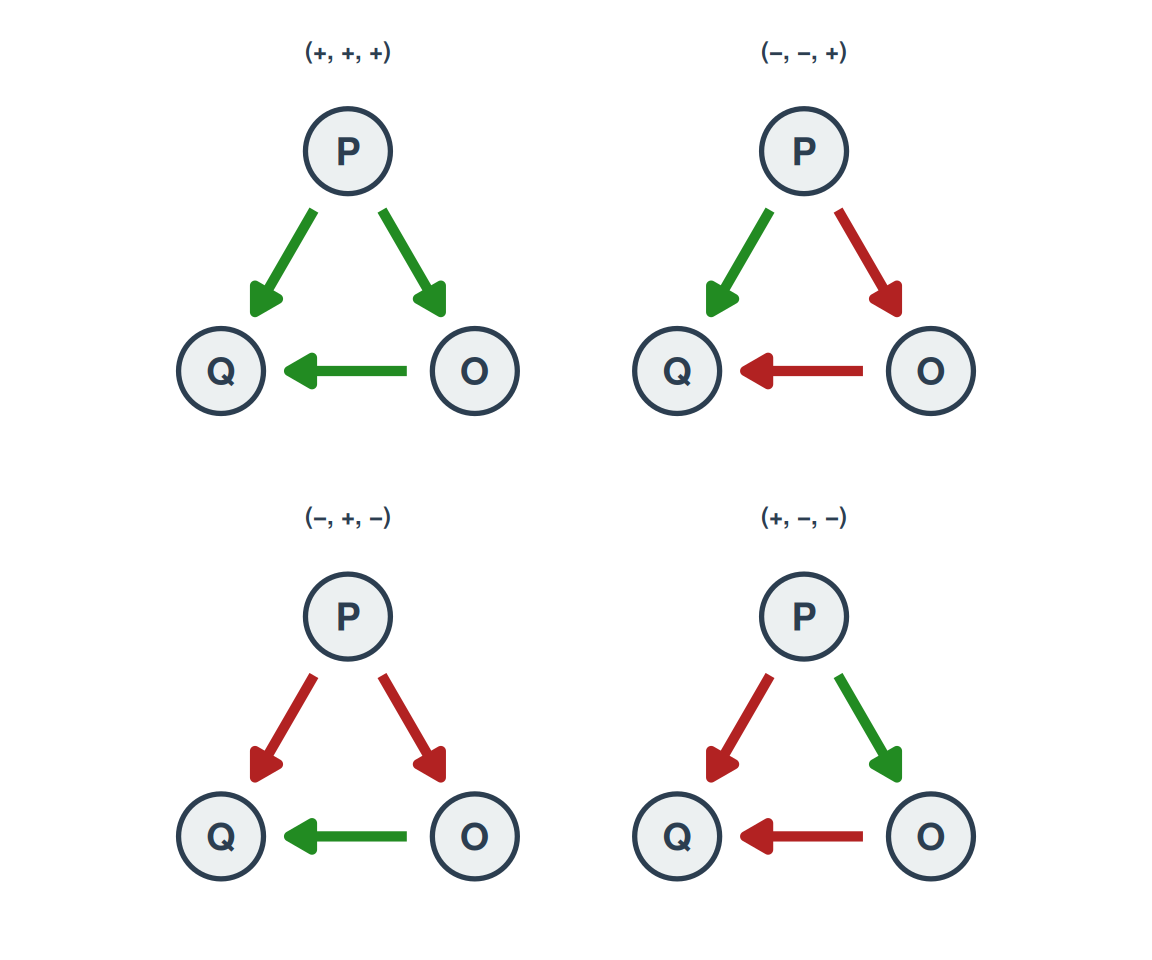
- In each balanced configuration, the sentiments cohere.
- “A friend of a friend is a friend.”
- “An enemy of an enemy is a friend.”
- “A friend of an enemy is an enemy.”
- “An enemy of a friend is an enemy.”
Unbalanced Configurations
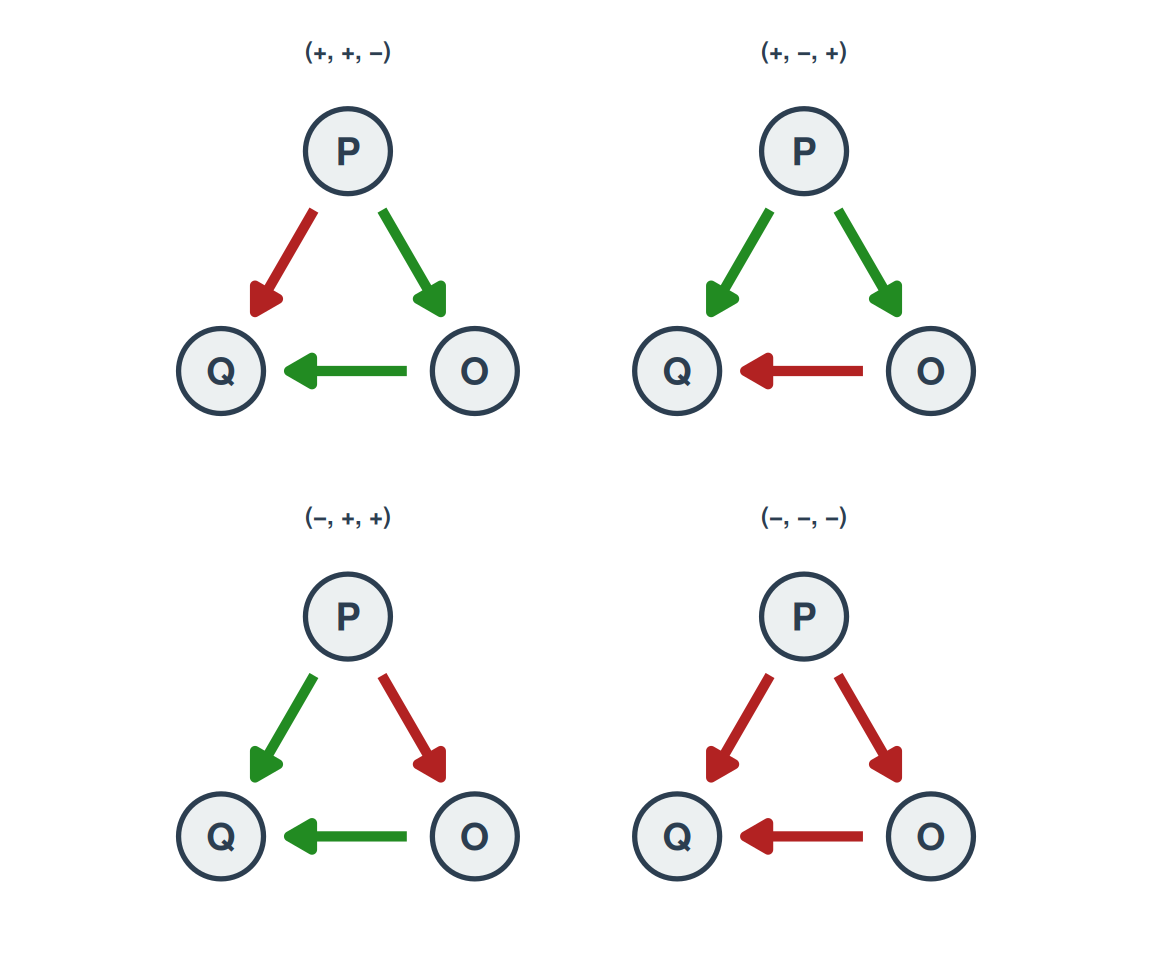
- In each unbalanced configuration, the sentiments collide.
- “A friend of my friend is my enemy.”
- “An enemy of a friend is a friend.”
- “A friend of an enemy is a friend.”
- “An enemy of my enemy is also my enemy.”
The Undirected Case: Four Configurations
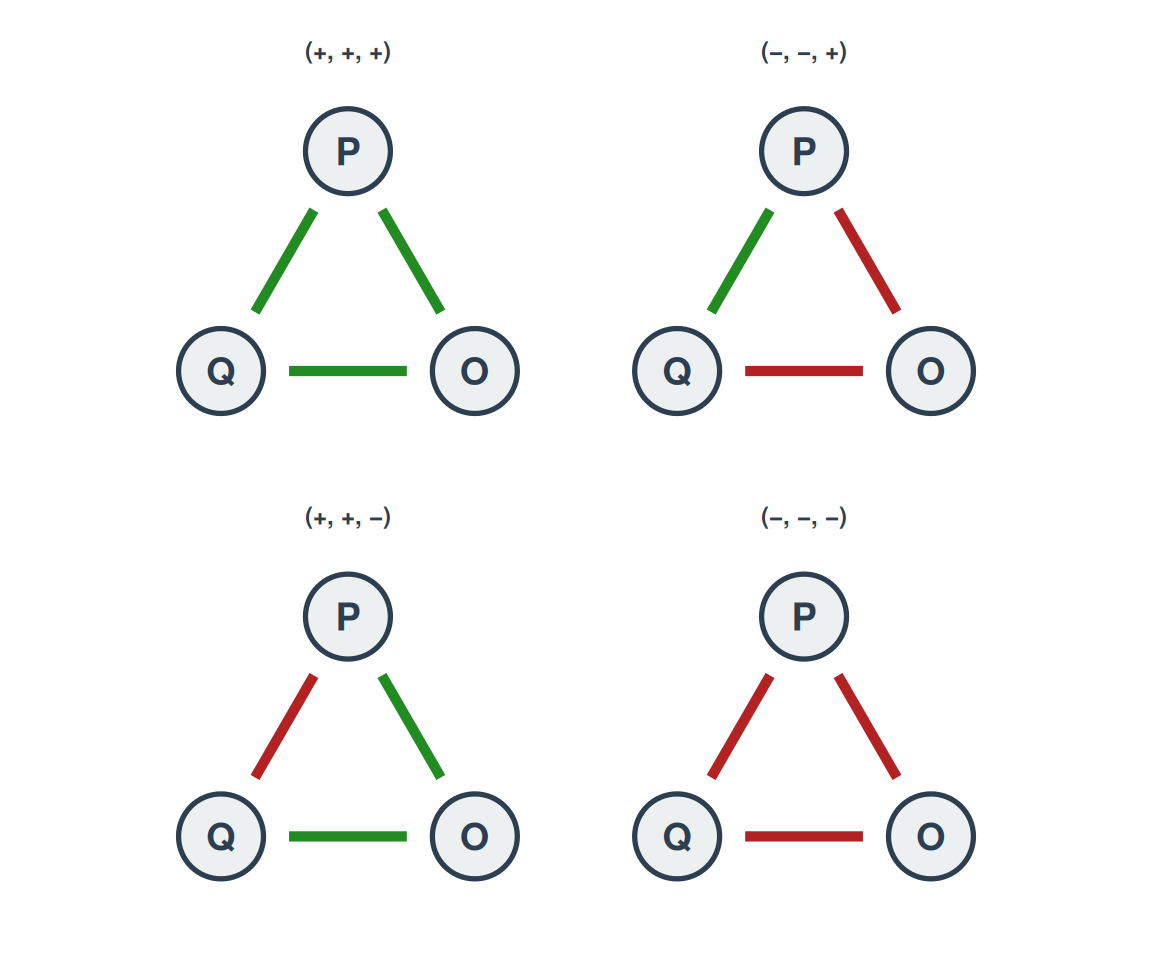
- Drop the arrowheads, so each pair has a single tie, and the count halves: eight → four configurations.
- Two are balanced: all positive, or two negatives (top row).
- Two are unbalanced: one negative, or all three negative (bottom row).
- The rule is unchanged: an even number of negative ties (zero or two) is balanced.
Tension and Change
- The basic idea is that unbalanced configurations will tend to transition to balanced configurations.
- Unbalanced configurations produce tension in P, leading them to change their sentiments toward O or Q to generate balance.
- Balanced configurations are stable equilibrium states.
Unbalanced Triads Have a Negative Product
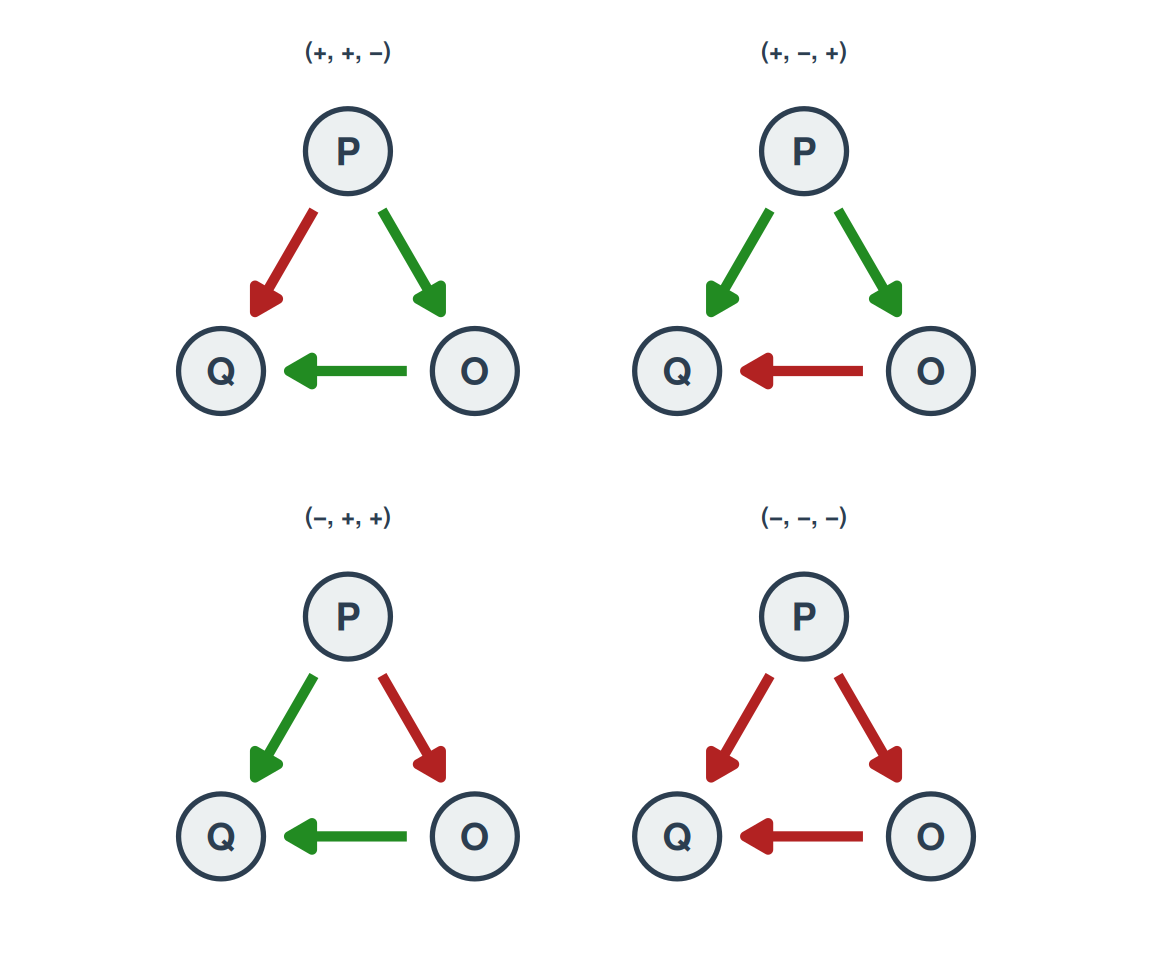
- If you multiply the signs of the edges of each unbalanced triad, you get a negative number. Try it!
- \((+1_{PO}) \times (+1_{OQ}) \times (-1_{PQ}) = -1_{POQ}\)
- \((+1_{PO}) \times (-1_{OQ}) \times (+1_{PQ}) = -1_{POQ}\)
- \((-1_{PO}) \times (+1_{OQ}) \times (+1_{PQ}) = -1_{POQ}\)
- \((-1_{PO}) \times (-1_{OQ}) \times (-1_{PQ}) = -1_{POQ}\)
Balanced Triads Have a Positive Product
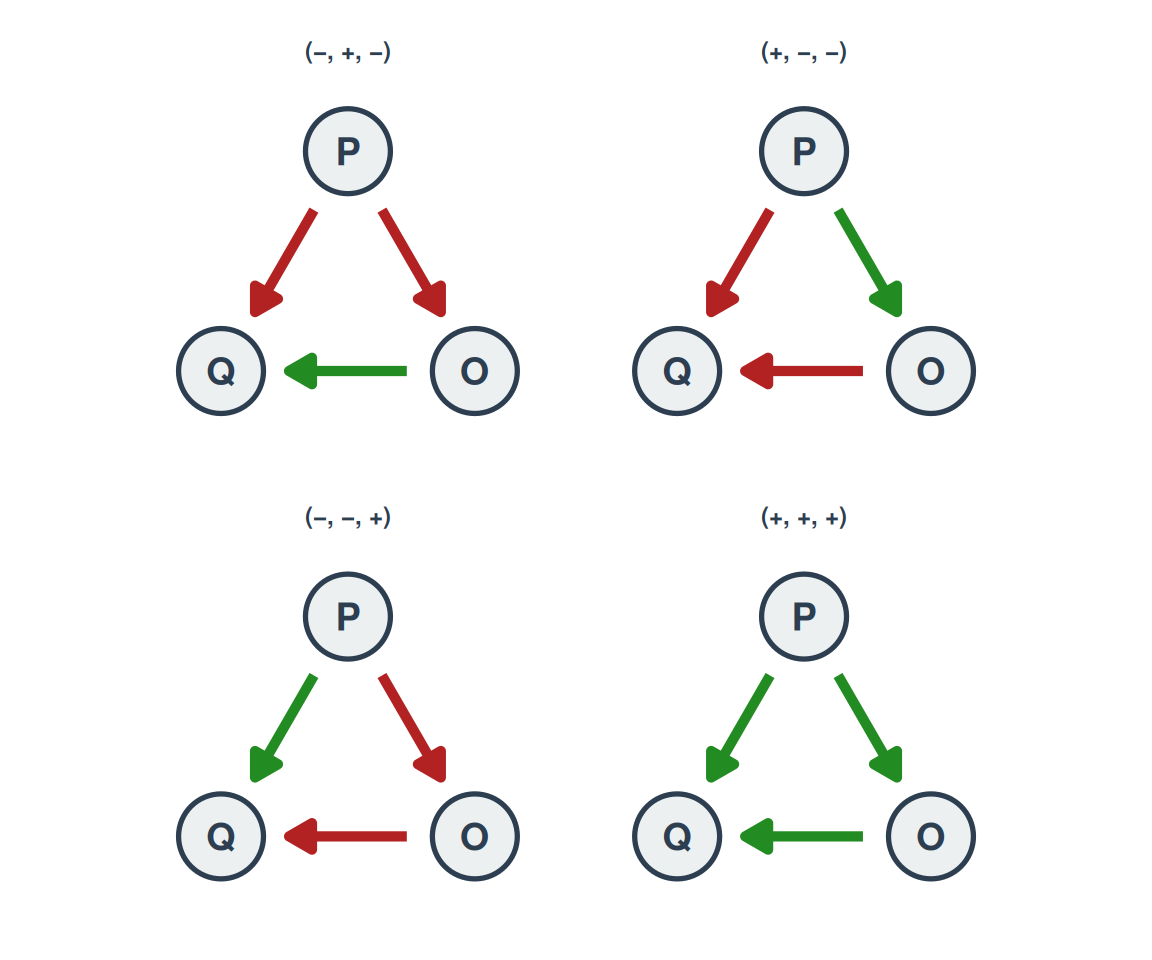
- Conversely, if you multiply the signs of the edges of each balanced triad, you get a positive number.
- \((-1_{PO}) \times (+1_{OQ}) \times (-1_{PQ}) = +1_{POQ}\)
- \((+1_{PO}) \times (-1_{OQ}) \times (-1_{PQ}) = +1_{POQ}\)
- \((-1_{PO}) \times (-1_{OQ}) \times (+1_{PQ}) = +1_{POQ}\)
- \((+1_{PO}) \times (+1_{OQ}) \times (+1_{PQ}) = +1_{POQ}\)
Cross-Pressure
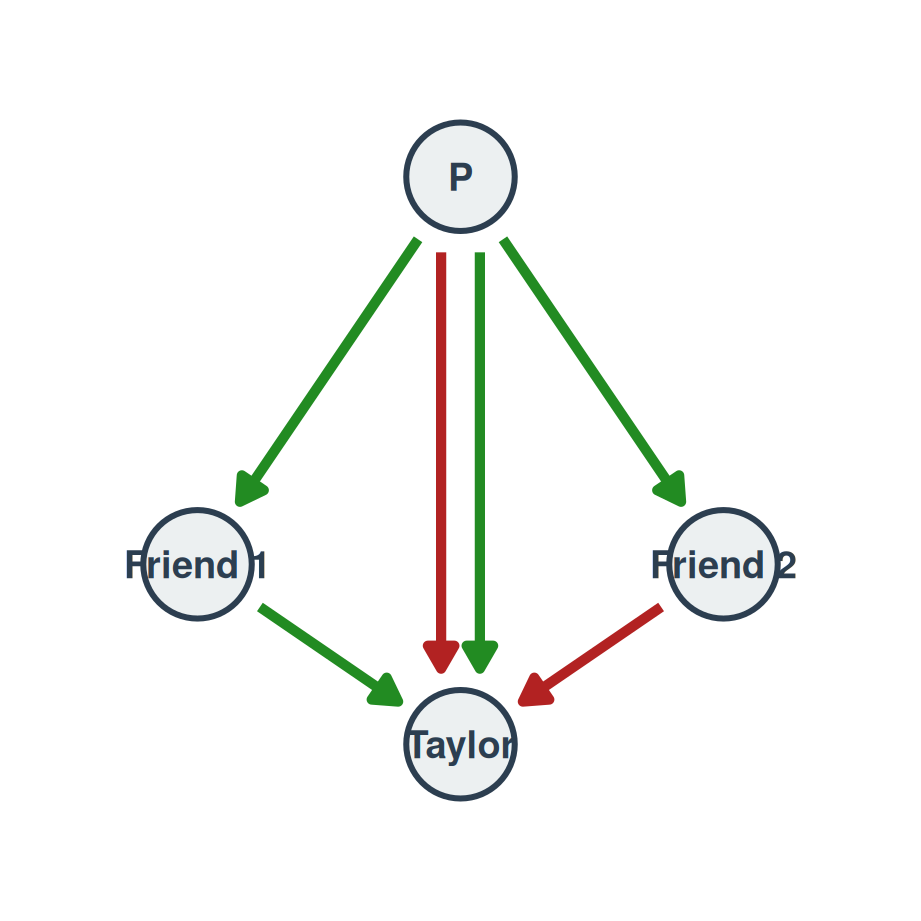
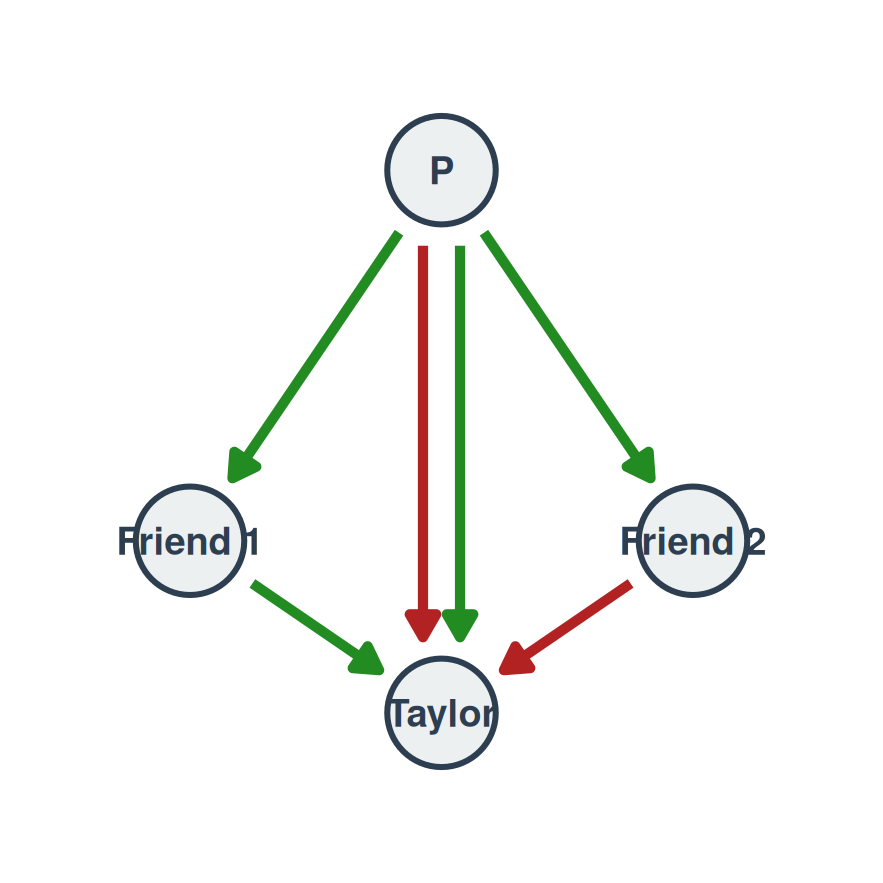
- Because we have multiple social relations, we are sometimes caught between worlds.
- This is called cross-pressure.
- Example: having two friends with different attitudes towards the same object.
- Balance theory predicts that P will have an ambivalent attitude toward the object.
Resolving Cross-Pressure
- To achieve balance and remove the ambivalence, P can:
- Change their own attitude toward Friend 1 or Friend 2.
- Convince either Friend 1 or Friend 2 to change their attitude toward the object.
- The same tension-and-resolution logic that works triad by triad also works for whole networks. That is where we go next.
Rotating the “You” Position
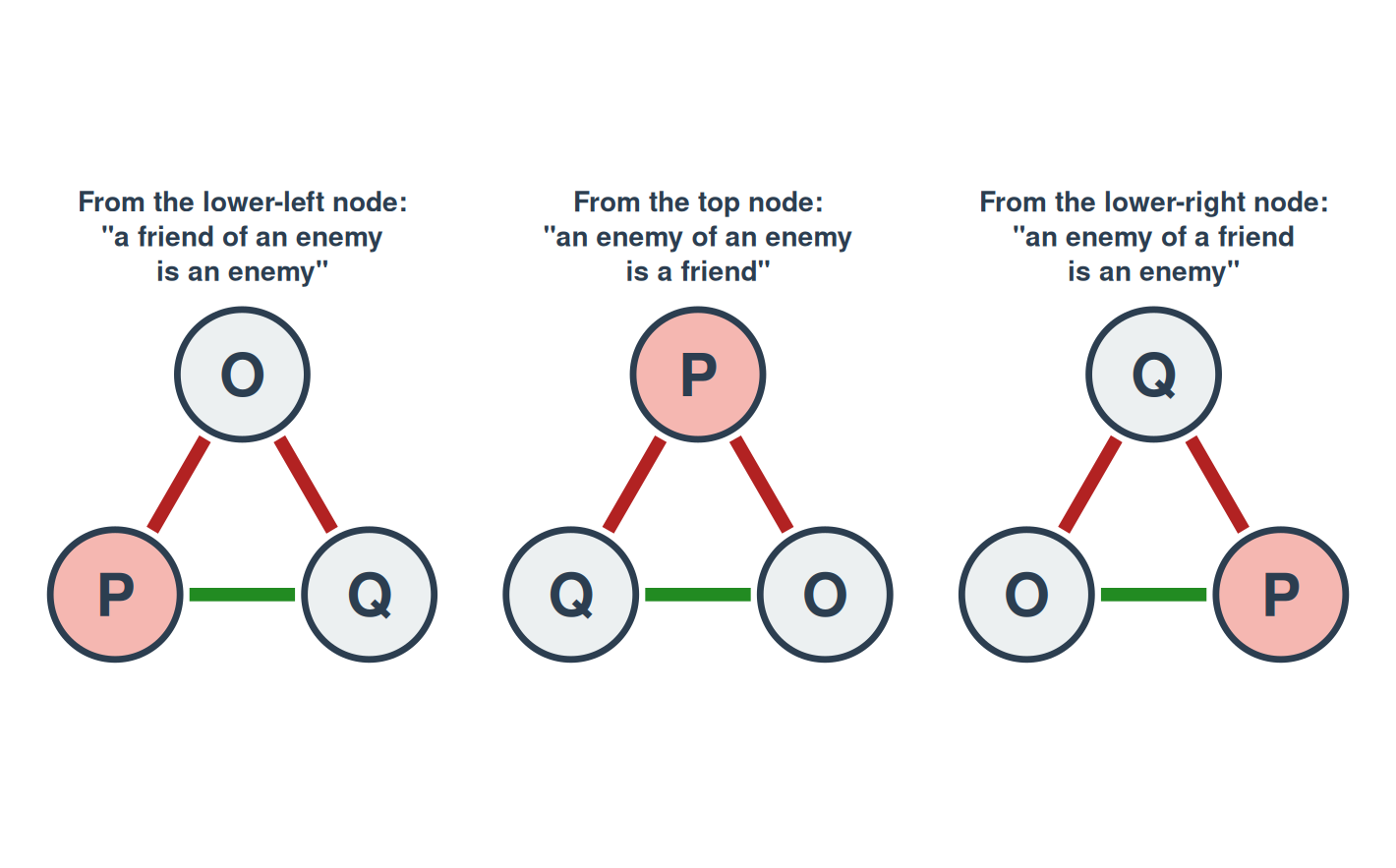
Balance as a Triad-Level Property, Regardless of Perspective
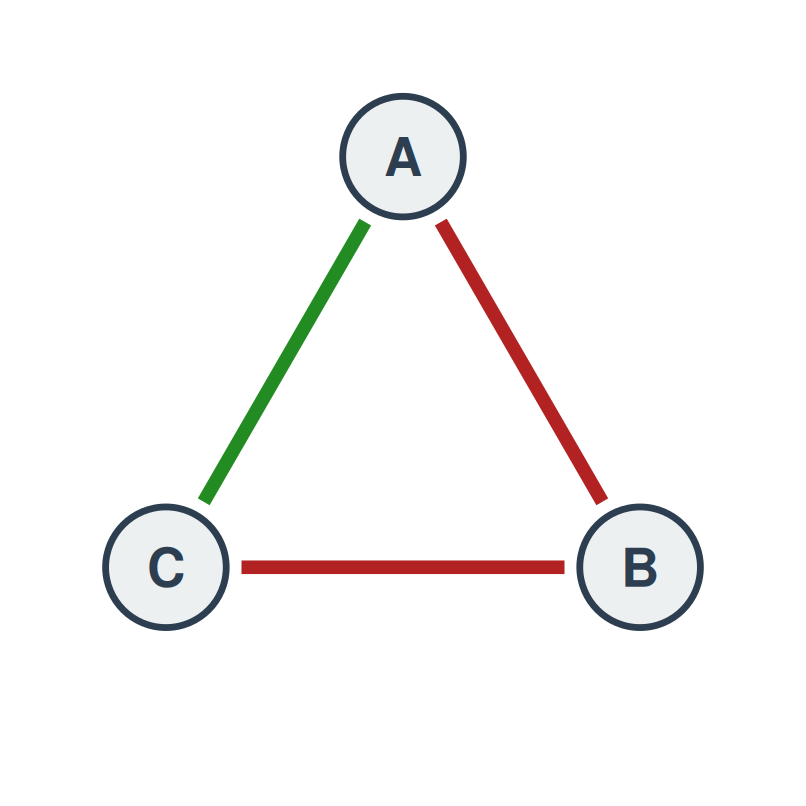
- This means we can define balance as a triad-level property regardless of “perspective.”
- For node A: “friends of enemies are enemies.”
- For nodes B and C: “enemies of friends are enemies.”
- The triad is balanced for everyone!
A Signed Graph with Named Edge Sets
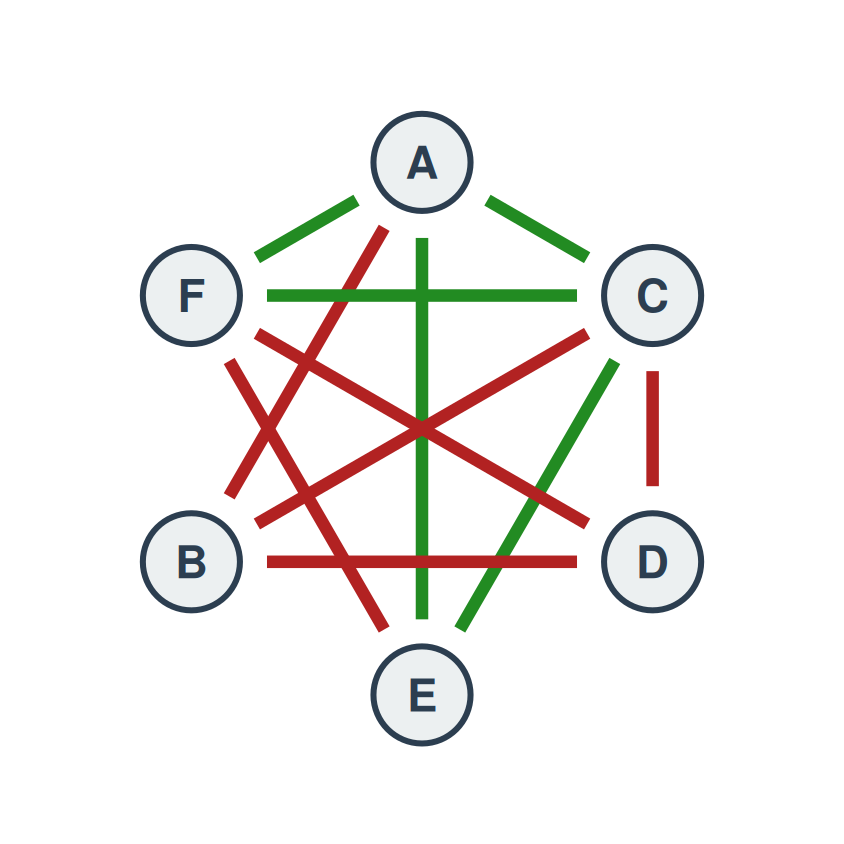
- Here is a signed graph with its edge sets named explicitly:
- One set of vertices \(V = \{A, B, C, D, E, F\}\), so \(|V| = 6\).
- Positive links: \(E^+ = \{AC, AE, AF, CF, CE\}\), so \(|E^+| = 5\).
- Negative links: \(E^- = \{AB, BC, BD, CD, DF, EF\}\), so \(|E^-| = 6\).
- The graph is \(G = \{V, E^+, E^-\}\).
Building Its Adjacency Matrix, Step 1
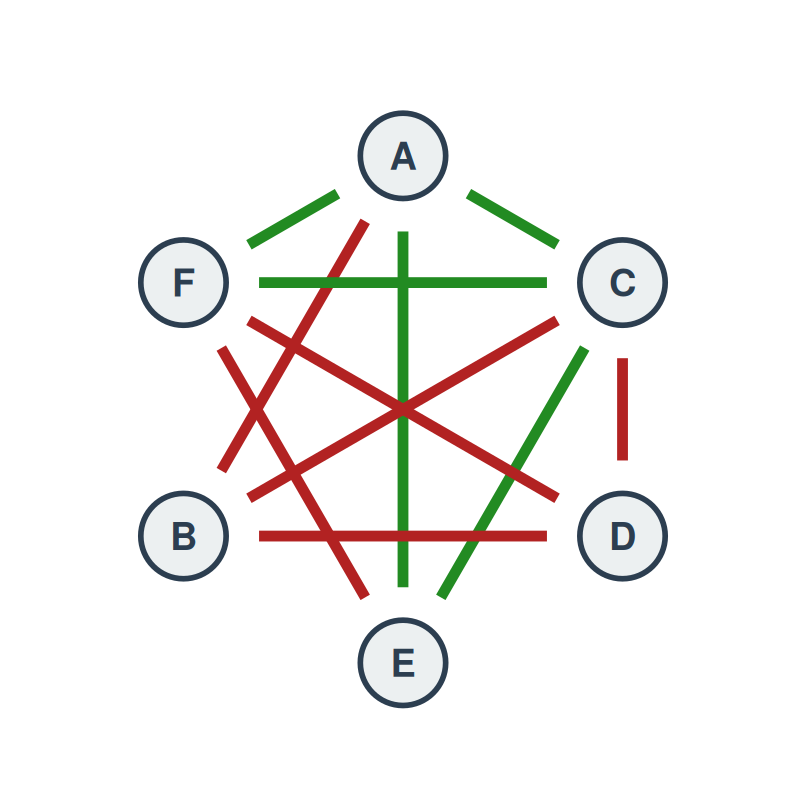
- The adjacency matrix of a signed graph works just like an ordinary adjacency matrix, except each entry records the sign of the tie.
- Step 1: draw the empty grid with
--on the diagonal.
| A | B | C | D | E | F | |
|---|---|---|---|---|---|---|
| A | -- | |||||
| B | -- | |||||
| C | -- | |||||
| D | -- | |||||
| E | -- | |||||
| F | -- |
Building Its Adjacency Matrix, Step 2
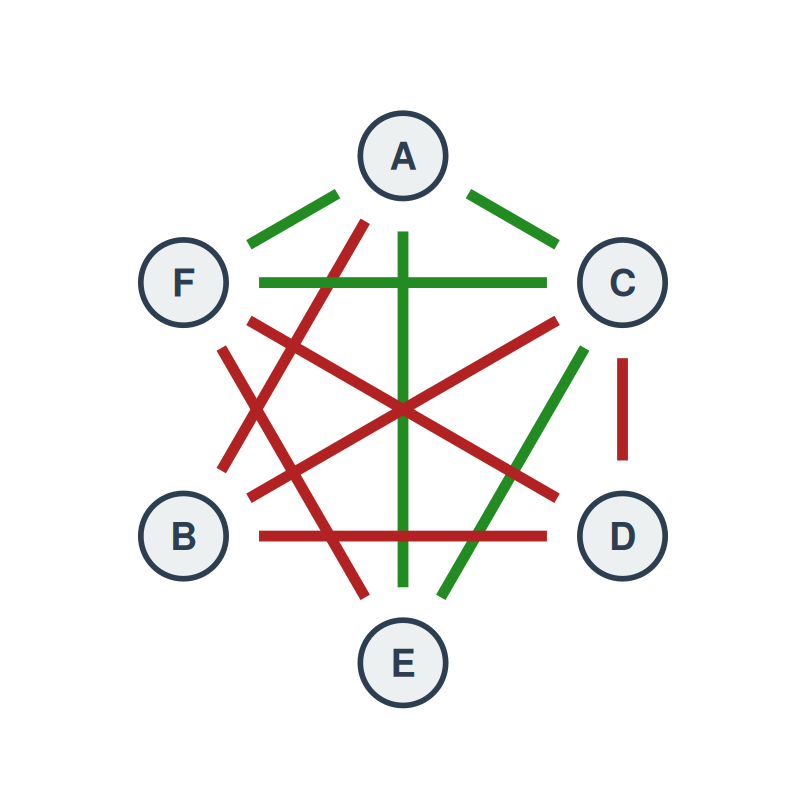
- Step 2: put a 1 where nodes are linked by a positive line.
| A | B | C | D | E | F | |
|---|---|---|---|---|---|---|
| A | -- | 1 | 1 | 1 | ||
| B | -- | |||||
| C | 1 | -- | 1 | 1 | ||
| D | -- | |||||
| E | 1 | 1 | -- | |||
| F | 1 | 1 | -- |
Building Its Adjacency Matrix, Step 3
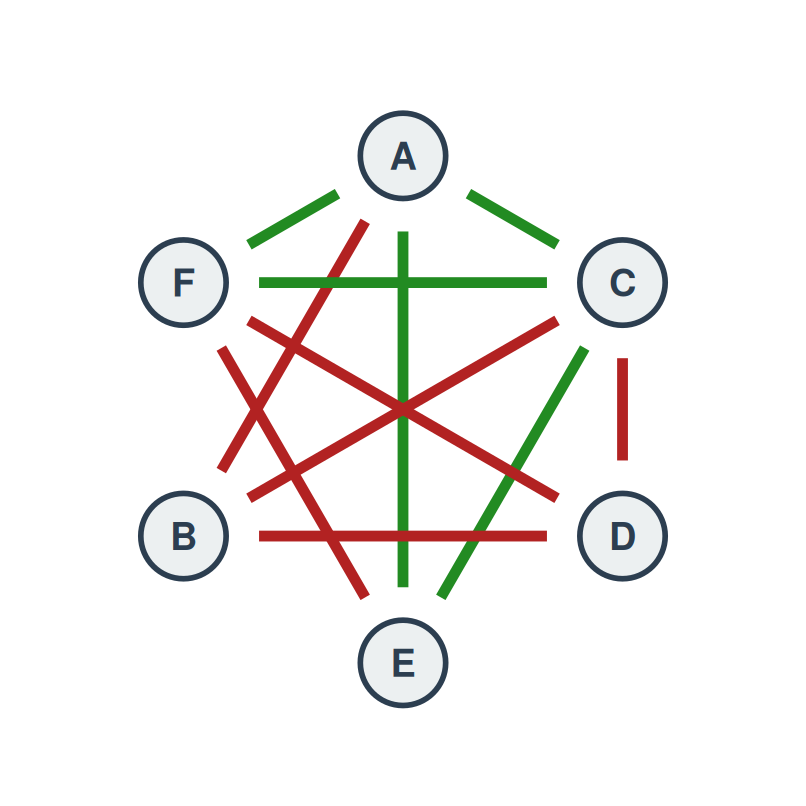
- Step 3: put a −1 where nodes are linked by a negative line, and a 0 where nodes are not adjacent.
| A | B | C | D | E | F | |
|---|---|---|---|---|---|---|
| A | -- | -1 | 1 | 0 | 1 | 1 |
| B | -1 | -- | -1 | -1 | 0 | 0 |
| C | 1 | -1 | -- | -1 | 1 | 1 |
| D | 0 | -1 | -1 | -- | 0 | -1 |
| E | 1 | 0 | 1 | 0 | -- | -1 |
| F | 1 | 0 | 1 | -1 | -1 | -- |
Structural Balance Applies to Complete Signed Graphs
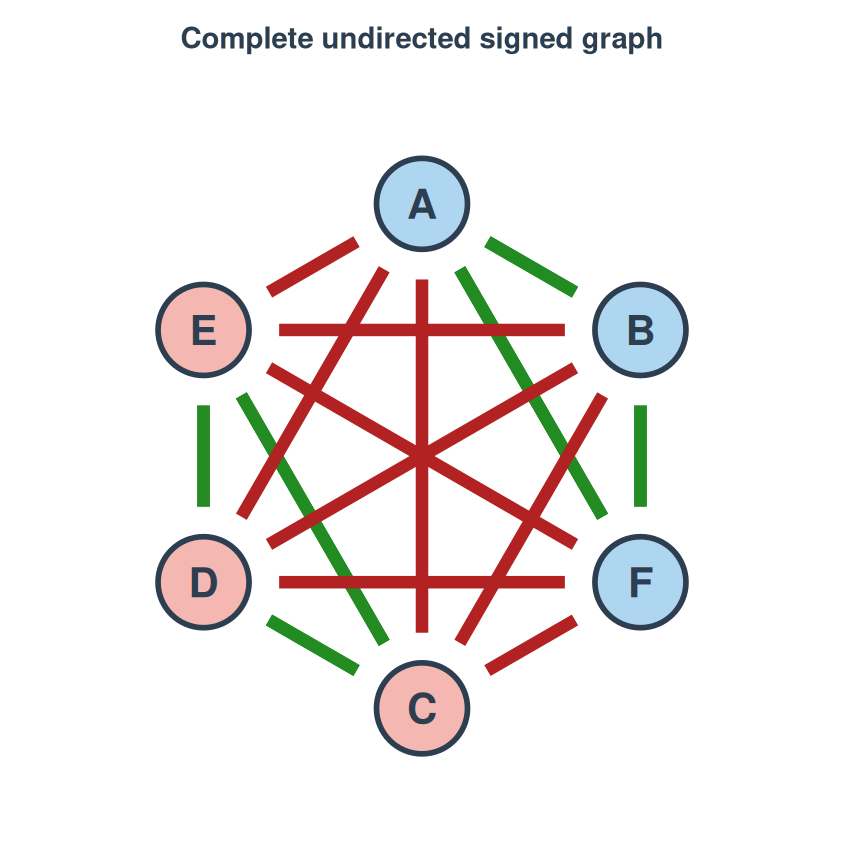
- Structural Balance Theory applies to complete signed graphs.
- A complete signed graph is a graph in which every node is connected to every other by either a positive line or a negative line.
- No zeros anywhere off the diagonal.
Checking the Complete Graph, Triad by Triad
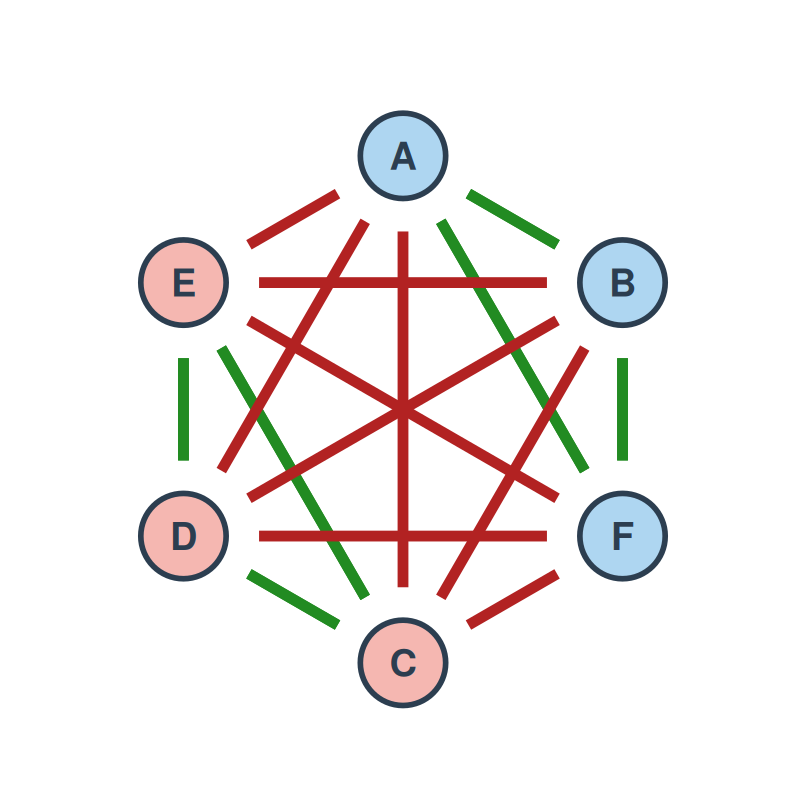
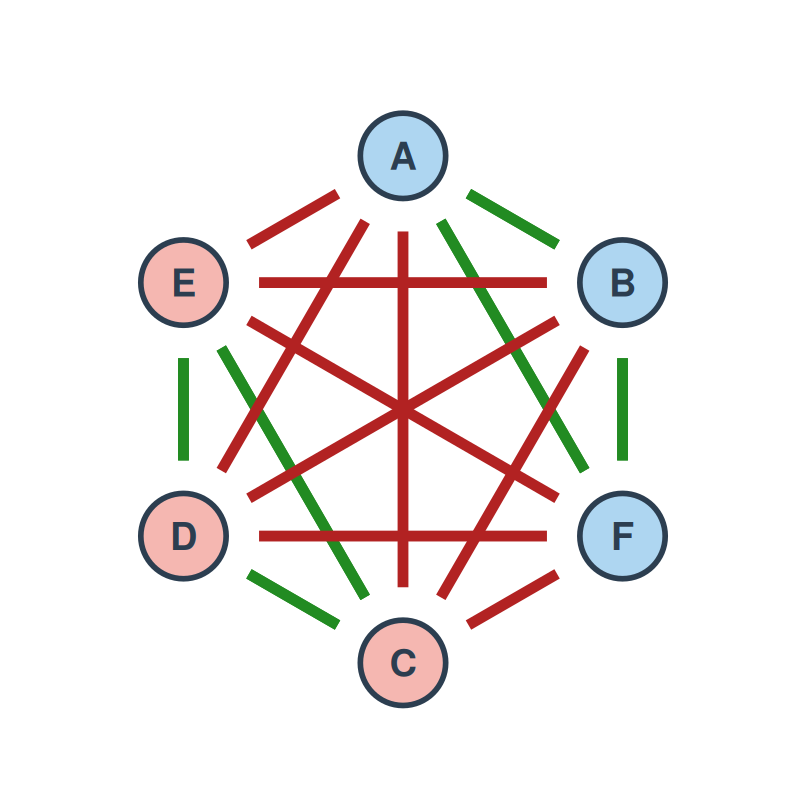
- ABF triad: three positive links. Balanced!
- ABC triad: one positive (A–B), two negative. Balanced!
- CDF triad: C–D positive, C–F and D–F negative. Balanced!
- BEF triad: B–F positive, B–E and E–F negative. Balanced!
- ACE triad: A–C and A–E negative, C–E positive. Balanced!
- And so on for all the triads. Every one checks out.
The Fundamental Theorem of Structural Balance
- The fundamental theorem of structural balance was discovered by the mathematicians Dorwin Cartwright and Frank Harary in 1956.
- It states that when a graph is balanced, it can be split into two groups such that there are:
- Only positive links within groups.
- Only negative links between groups.
- Balance is not necessarily good! Structural balance is equivalent to perfect group polarization.
Structural Balance in Everyday Life: Balanced Triads
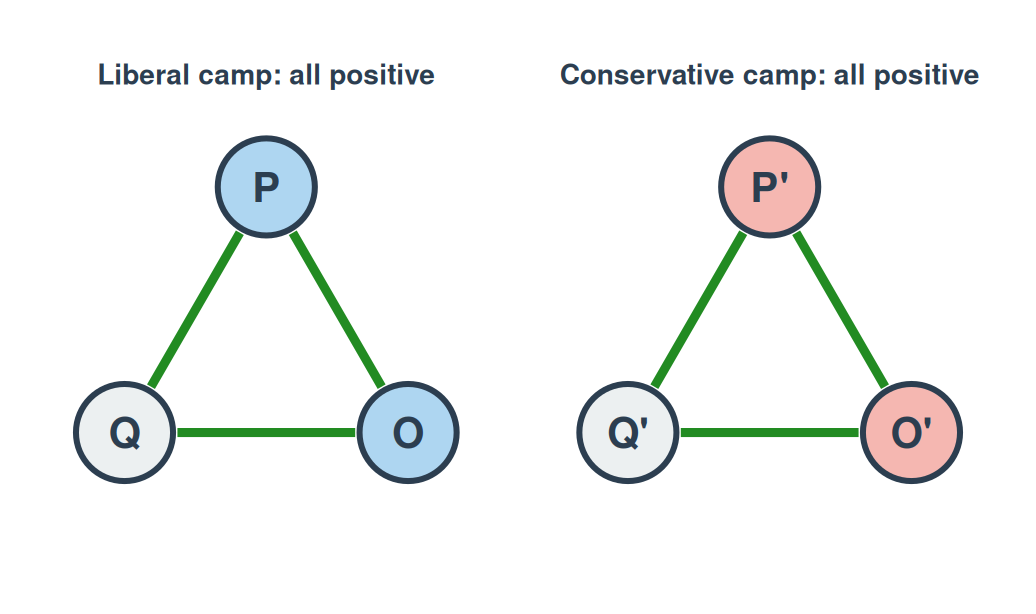
- Think of retweeting on social media as a signed tie.
- P (a liberal retweeter), O (a liberal tweeter), Q (a liberal tweet):
- All sentiments positive. A balanced triad.
- P’ (a conservative retweeter), O’ (a conservative tweeter), Q’ (a conservative tweet):
- Also all positive. Another balanced triad.
Structural Balance in Everyday Life: The Cross-Camp Triad
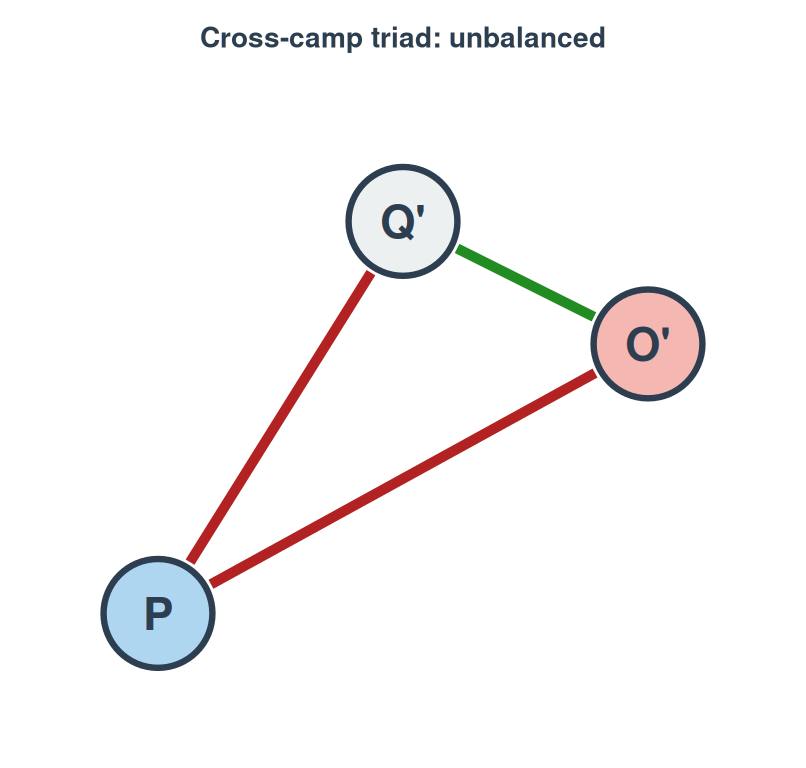
- P (a liberal retweeter) meets O’ (a conservative tweeter) and Q’ (a conservative tweet):
- P disparages both: two negative ties.
- But O’ endorses Q’: one positive tie.
- An unbalanced triad (one negative).
- Balance pushes P away from the conservative camp: liberal accounts retweet liberal content and disparage conservative content (and vice versa).
- Balance at the triad level aggregates into echo chambers at the network level.
Adding New Nodes Preserves the Polarization Pattern
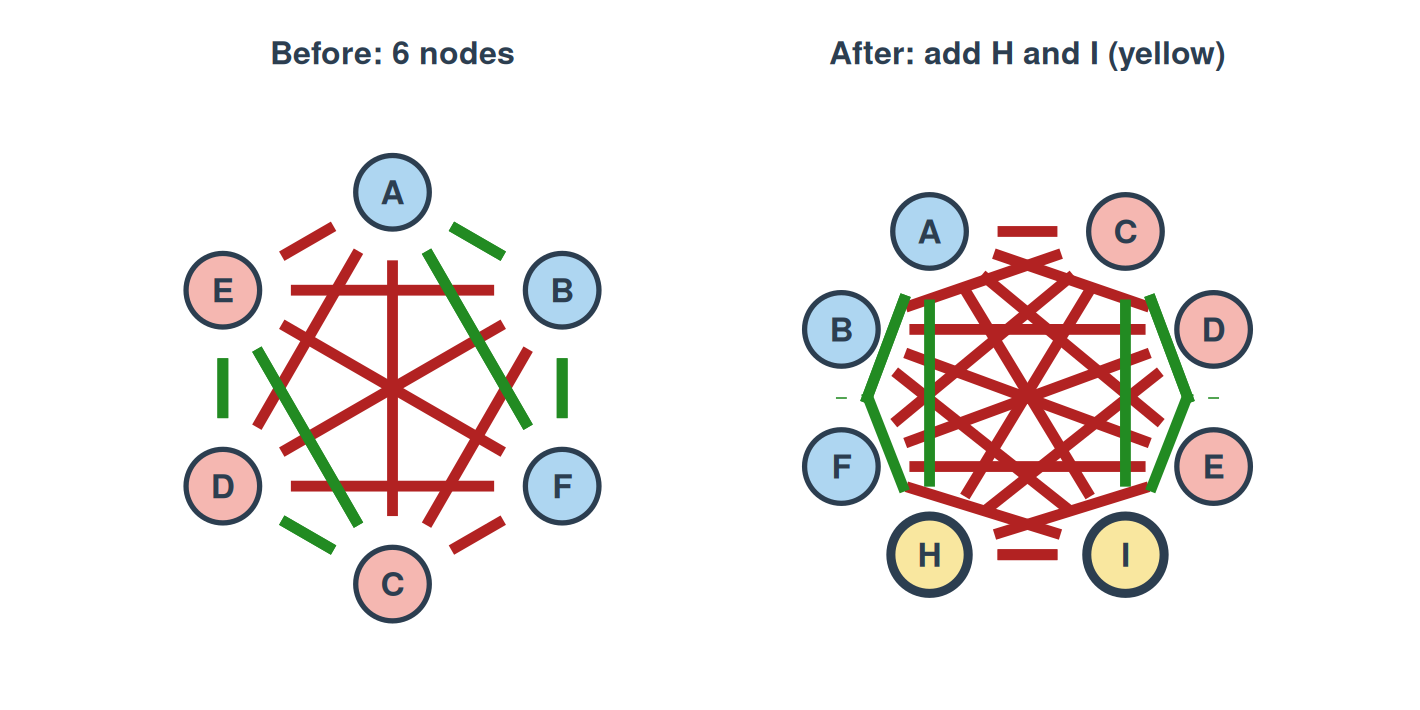
- Adding new nodes does not change the polarization pattern, as long as their relationships to every other node are balanced.
- New nodes H and I (yellow) join.
- I makes friends with C, D, and E; H makes friends with A, B, and F.
- Then they balance out the rest of the relationships with the other side. Still polarized!
Properties of Balanced Signed Graphs
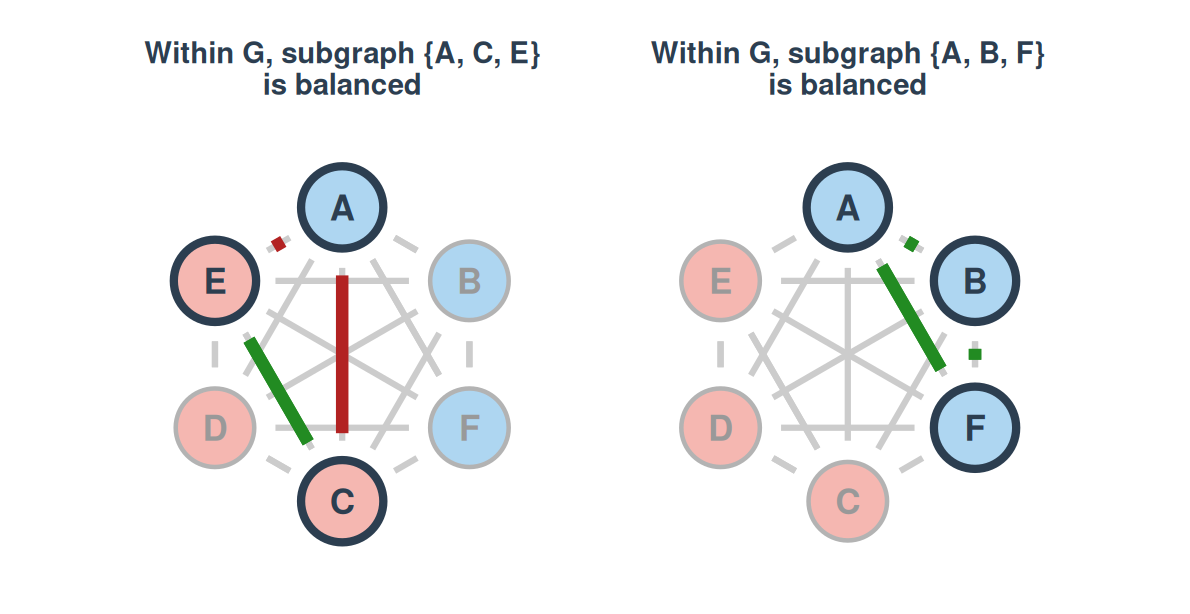
- Balanced signed graphs have some interesting properties. If a graph \(G\) is balanced:
- Any subgraph of \(G\) is also balanced.
- All paths between the same pair of nodes have the same sign as the link between them.
- Cycles of any length are always positive (an even number of negative edges).
- Each panel below shows the full graph \(G\); the highlighted triad is the subgraph being checked.
The Sign of a Path: Nodes in Different Clusters
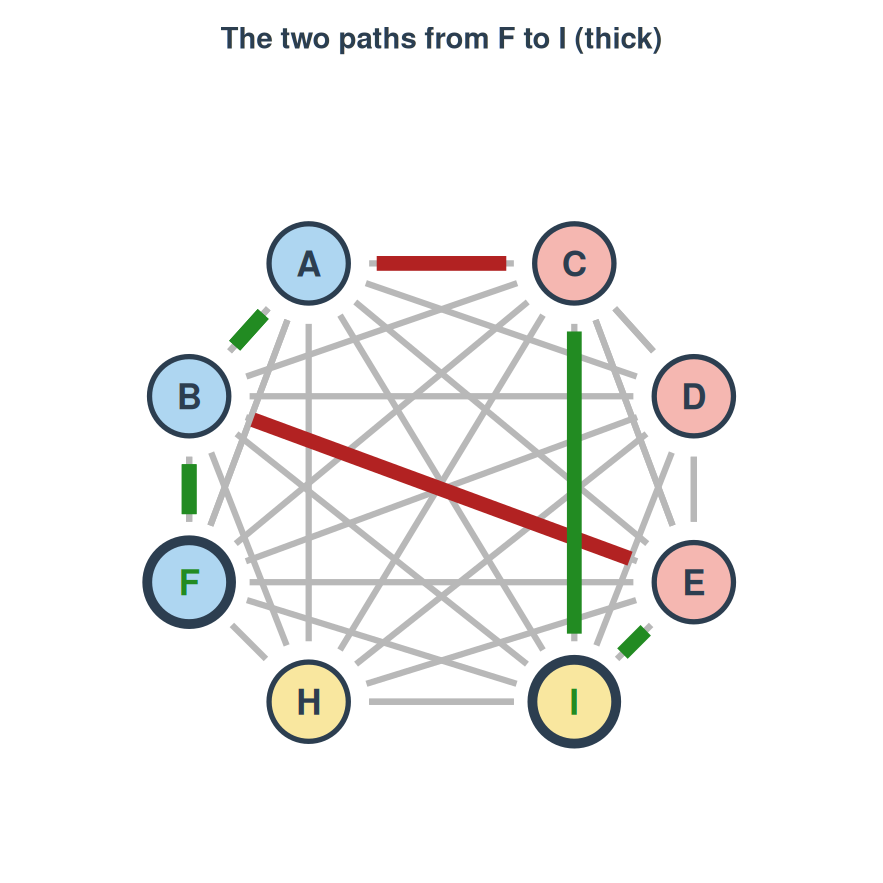
- The sign of a path is the product of the signs of its edges.
- \(F\) and \(I\) sit on opposite sides, so their direct tie is negative.
- Tracing both routes between them, every path multiplies out to −1:
| Path | Signs along the path | Product |
|---|---|---|
| F–B–A–C–I | (+1) × (+1) × (−1) × (+1) | −1 |
| F–B–E–I | (+1) × (−1) × (+1) | −1 |
- An odd number of negative edges along the path means a negative path.
The Sign of a Path: Nodes in the Same Cluster
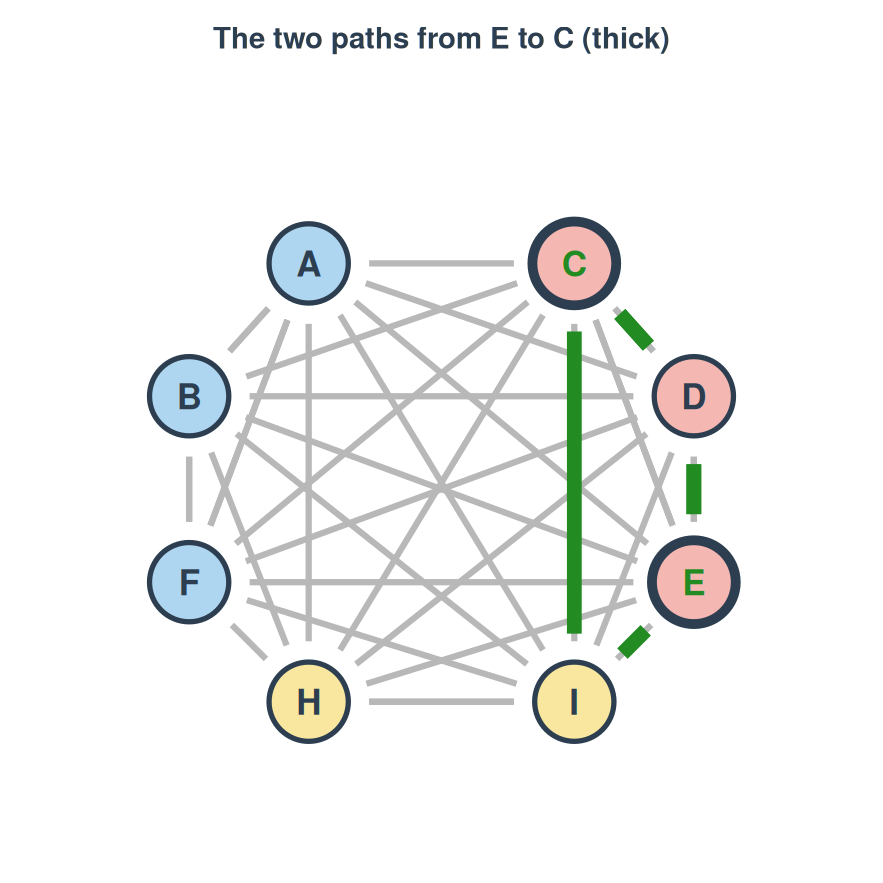
- Now contrast \(E\) and \(C\), who sit on the same side, so their direct tie is positive.
- Tracing both routes between them, every path multiplies out to +1:
| Path | Signs along the path | Product |
|---|---|---|
| E–I–C | (+1) × (+1) | +1 |
| E–D–C | (+1) × (+1) | +1 |
- An even number of negative edges (zero here) means a positive path.
- Either way, every path between a pair of nodes carries the same sign as their direct tie — a hallmark of balance.
Cycles Are Always Positive
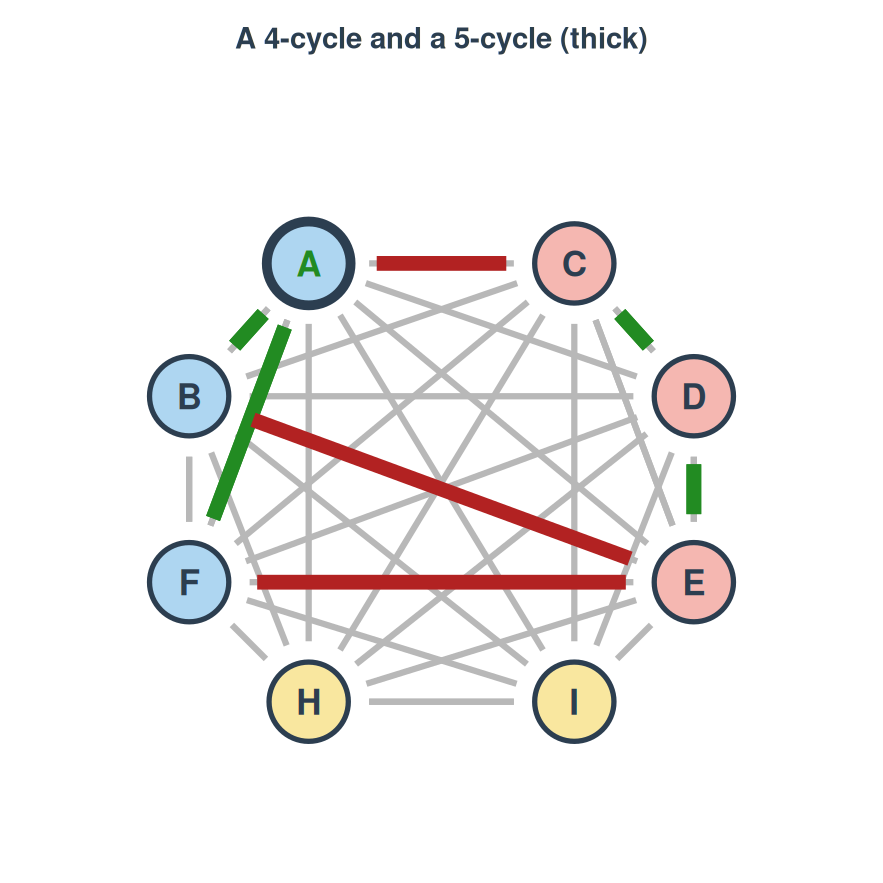
- A cycle is a path that starts and ends at the same node.
- In a balanced signed graph, cycles of any length are always positive — they contain an even number of negative edges (zero or two).
- Each cycle below is written as a closed walk, beginning and ending at \(A\):
| Cycle | Signs along the cycle | Product |
|---|---|---|
| A–B–E–F–A | (+1) × (−1) × (−1) × (+1) | +1 |
| A–C–D–E–B–A | (−1) × (+1) × (+1) × (−1) × (+1) | +1 |
- Both cycles have exactly two negative edges — an even count — so both multiply out to \(+1\).
The Three Allowed Triads
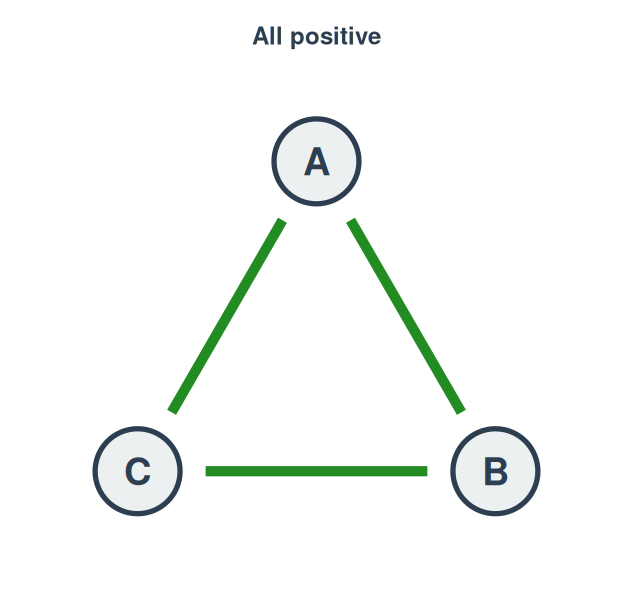
- All positive: three mutual friends — one cluster.
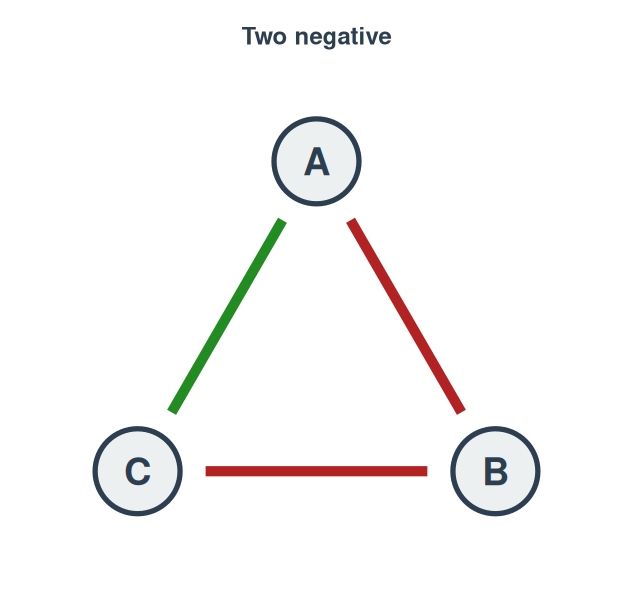
- Two negative: A and B like each other, both dislike C — two clusters, C alone.
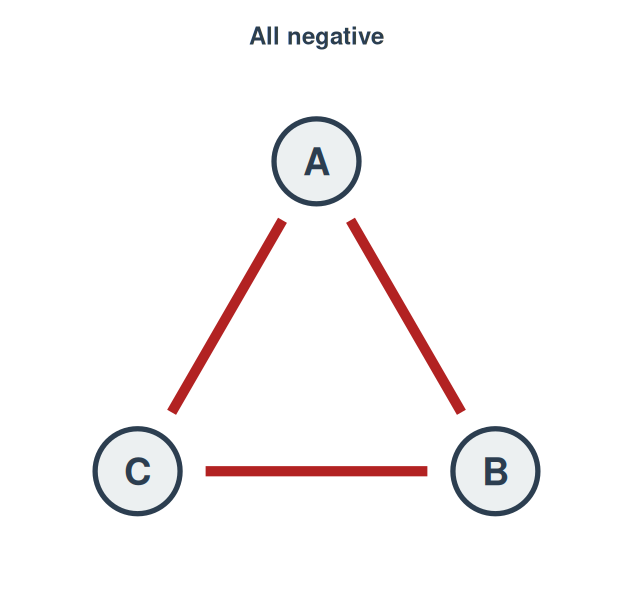
- All negative: three mutual enemies — each sits in its own cluster.
- In every allowed triad, negative ties (solid red) cross between clusters; positive ties stay within.
Building a Clusterable Network, Step 1: Positive Links Within Clusters
- Suppose we build a network whose triangles come in only three types:
- All-positive triads (everybody inside a cluster likes everybody else in it).
- Two-negative triads (two cluster-mates against an outsider).
- All-negative triads (one node from each of three clusters).
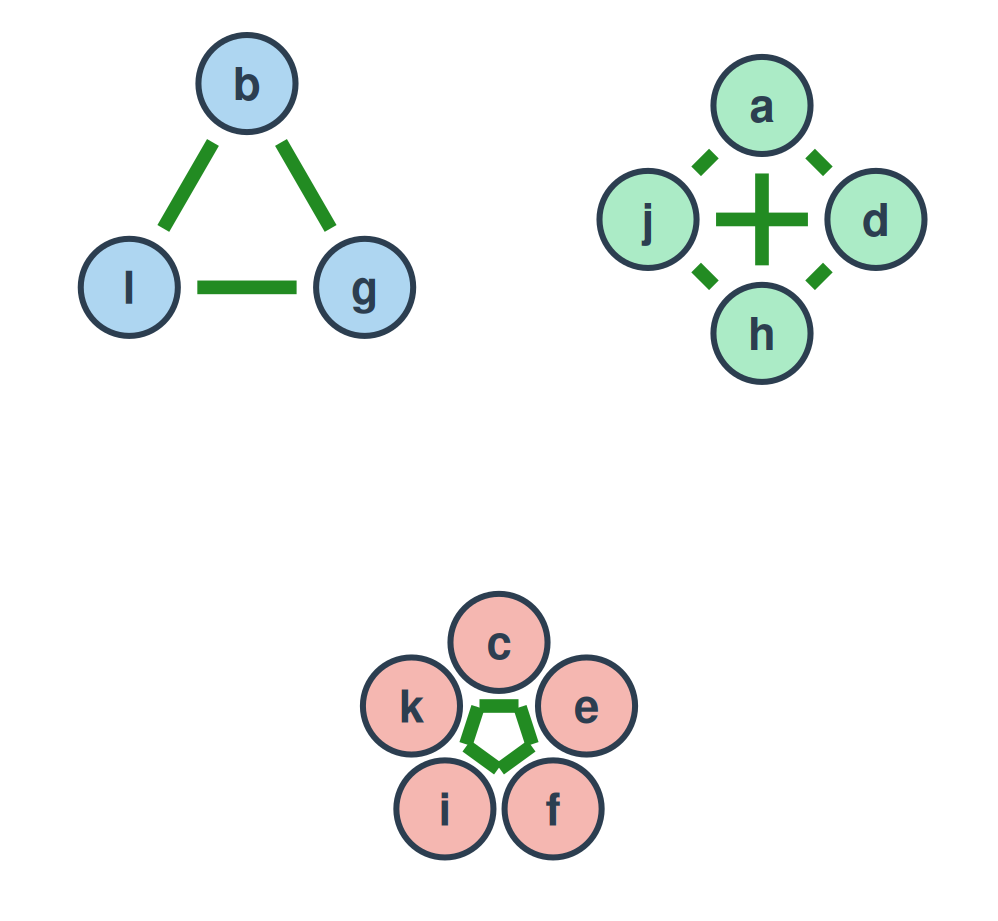
- Step 1: draw the positive links inside each of three clusters: \(\{b, g, l\}\), \(\{a, d, h, j\}\), and \(\{c, e, f, i, k\}\) — clusters can be any size.
Building a Clusterable Network, Step 2: Negative Links Between Clusters
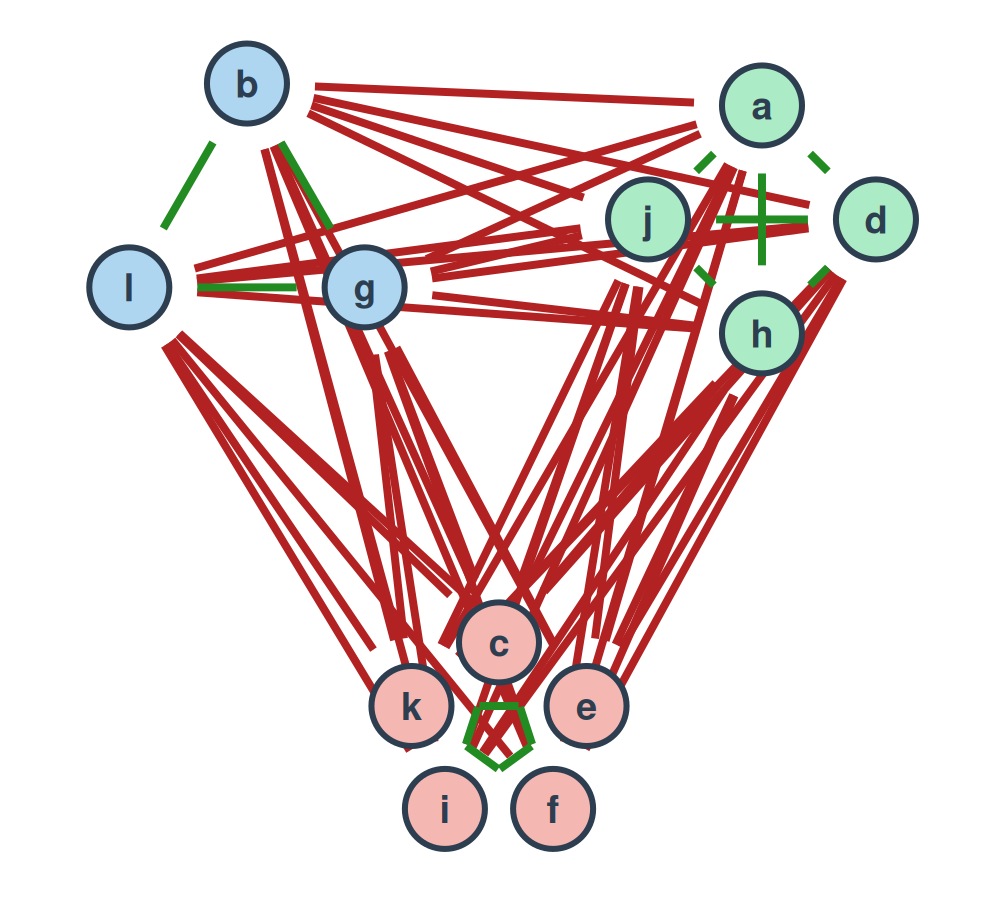
- Step 2: connect every pair of nodes in different clusters with a negative link.
- Every cluster is now a positive island in a sea of negatives.
- The graph is complete: every pair of nodes is tied, positively or negatively.
Davis Shows That the Graph Has Three Clusters
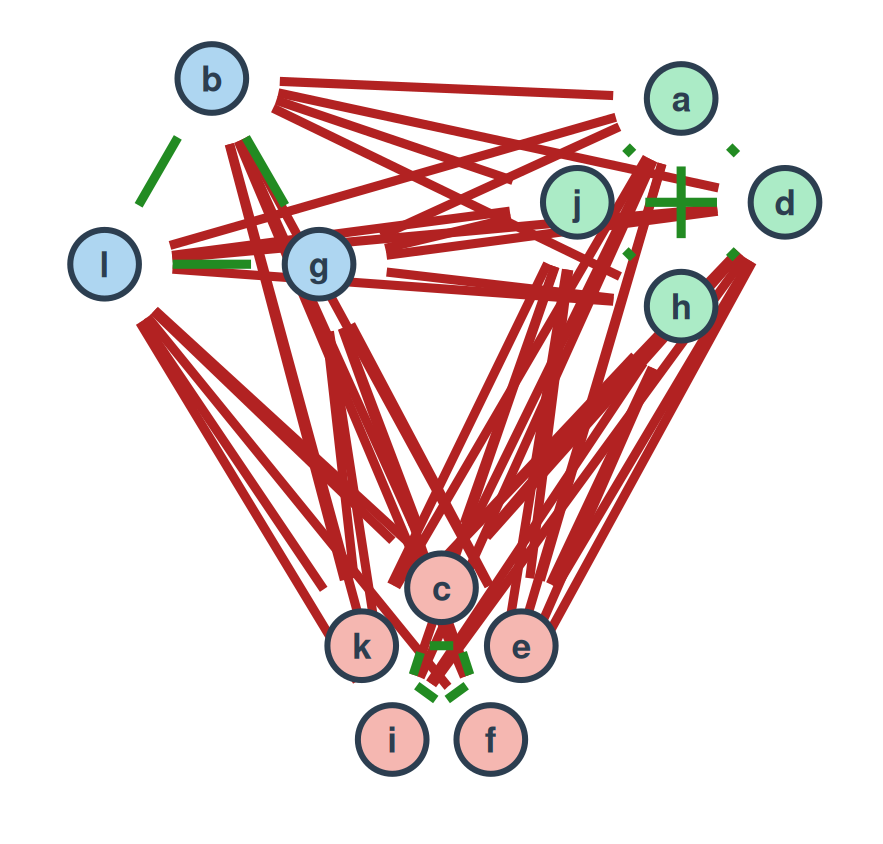
- Davis shows that the nodes partition into three clusters:
- Cluster 1: \(\{b, g, l\}\) — three nodes
- Cluster 2: \(\{a, d, h, j\}\) — four nodes
- Cluster 3: \(\{c, e, f, i, k\}\) — five nodes
- Clusters can be any size; positive links run within clusters, negative links between them.
- The all-negative triads (like \(\{a, b, c\}\), one node from each cluster) are what keep this from being strictly balanced — but it is perfectly clusterable.