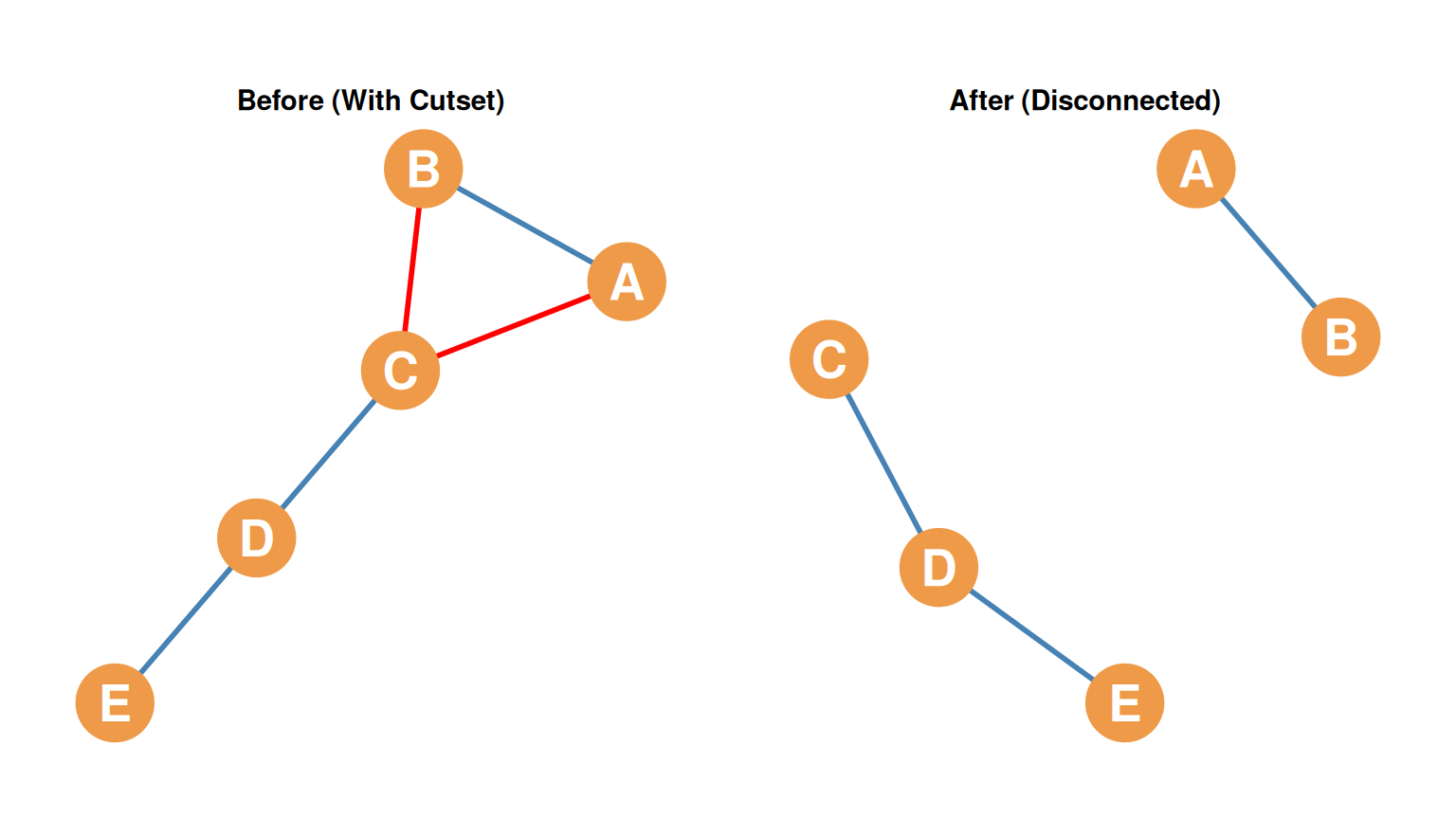
Graph Theory: Cutsets, Bridges & Robustness
The Basics of Social Network Analysis
Bridges: A Cutset of Size 1
- Bridge:
- A single edge whose removal disconnects the graph (so \(\lambda(G) = 1\)).
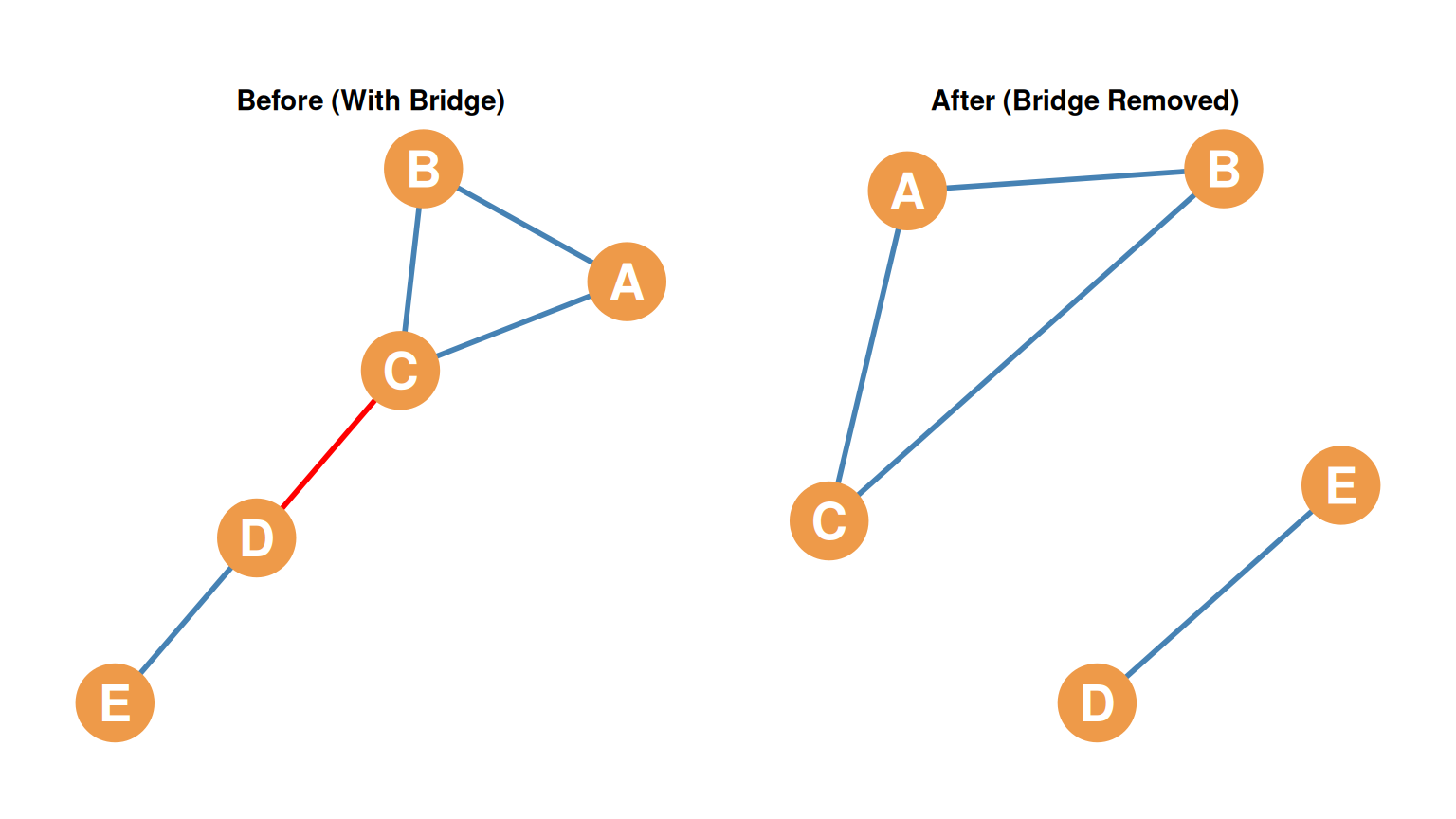
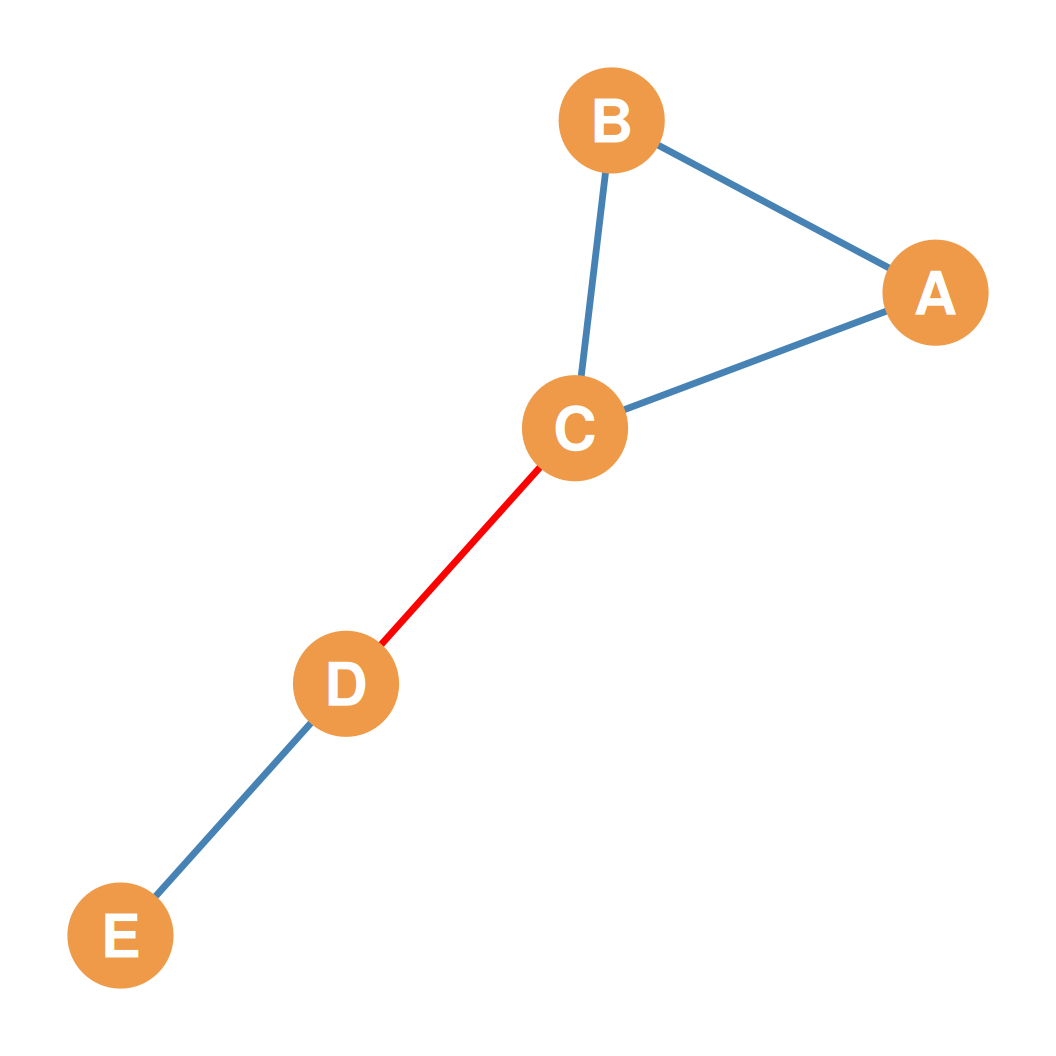
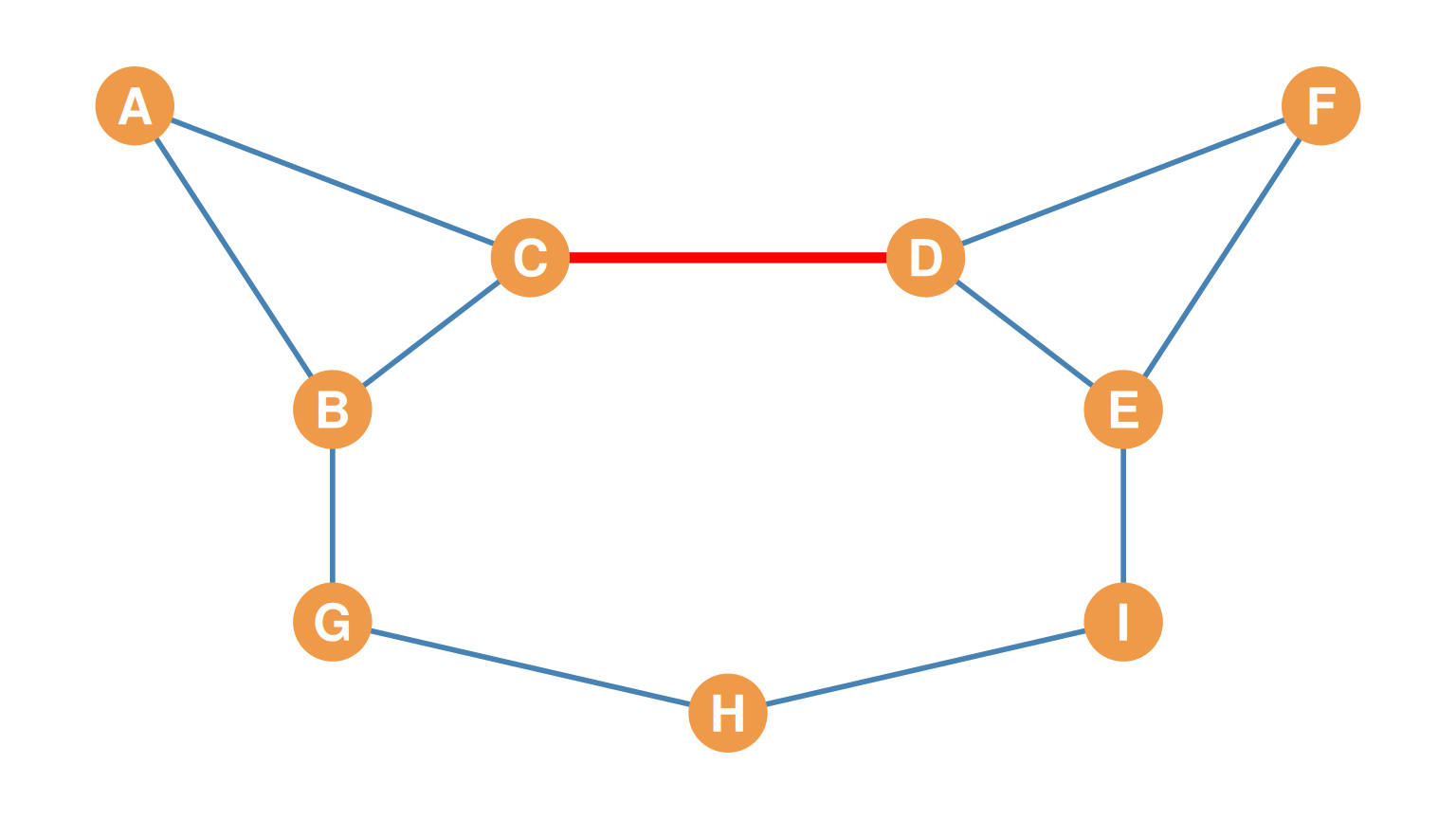
- In our graph on the right, the edge C-D is highlighted in red.
- Removing edge C-D completely disconnects \(\{A, B, C\}\) from \(\{D, E\}\).
- Bridges represent the most critical, yet vulnerable transmission links in any network.
Special Properties of Bridges
- In a connected graph, a bridge (such as the red C-D edge on the right) possesses two interesting mathematical properties (Buckley and Harary 1990):
- 1. The No-Cycle Rule:
- A bridge never lies on any cycle of the graph.
- If it did, removing it would still leave the rest of the cycle intact, failing to disconnect the graph.
- 2. The Intermediation Bottleneck:
- The bridge is an edge on every path connecting at least one pair of nodes (e.g., any node in \(\{A, B, C\}\) to any node in \(\{D, E\}\)).
- Every packet of information flowing between these clusters must pass through this single bottleneck.
Local Bridge: A Visual Example
- Let’s look at the edge C-D highlighted in red:
- It connects the left cluster \(\{A, B, C\}\) to the right cluster \(\{D, E, F\}\).
- Is it a bridge? No. If removed, the graph remains connected via the bottom path (\(B-G-H-I-E\)).
- Is it a local bridge? Yes!
- Observed distance: \(d(C, D) = 1\).
- If removed, the distance increases to: \[d(C, D) = 6 \quad (C-B-G-H-I-E-D)\]
Articulation Nodes: A Visual Example
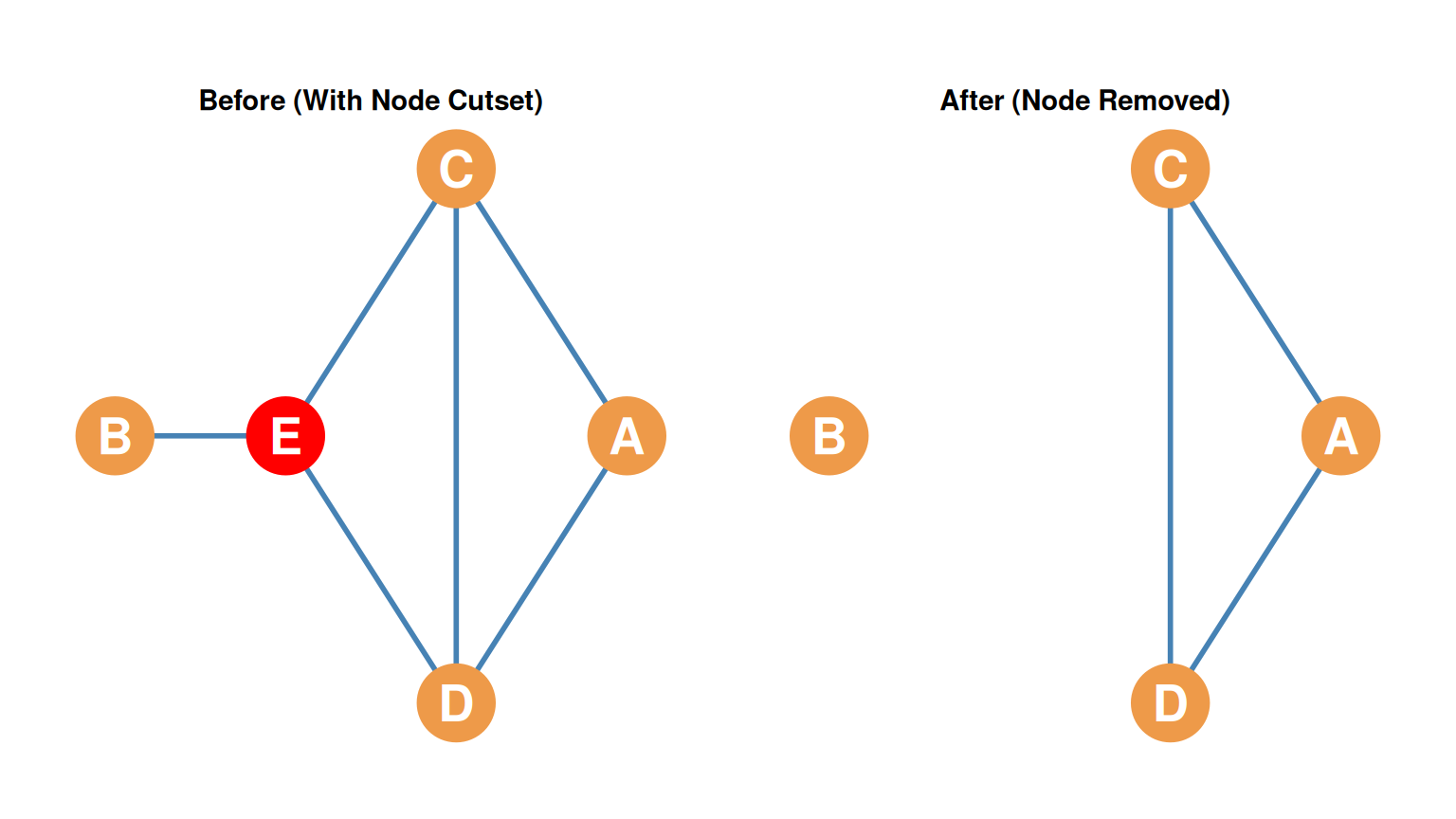
- In our house graph on the right, node E is highlighted in red.
- Removing node E:
- Removes all of its incident edges: \(B-E, E-C, E-D\).
- Completely disconnects node \(B\) from the rest of the network.
- This is a node cutset of size 1 (Node \(E\) is an articulation node).
Special Properties of Articulation Nodes
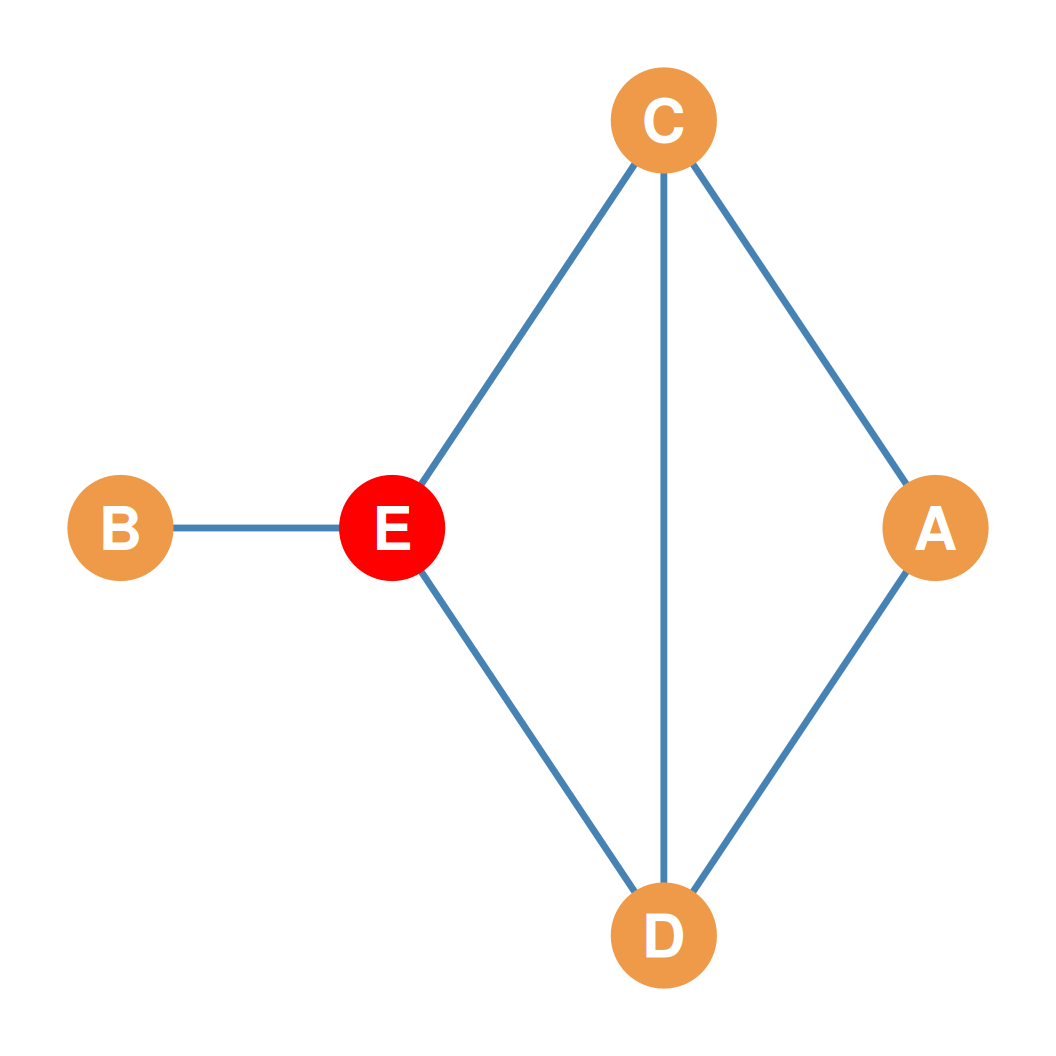
- An articulation node (or cutpoint, such as E on the right) has unique properties mirroring those of bridges:
- 1. Node Equivalent of a Bridge:
- A single actor upon whom the entire connectivity of the network depends (\(\kappa(G) = 1\)).
- 2. The Path Intermediator:
- It stands as an inner node on every single path connecting some node \(v\) to the rest of the network (e.g., node \(E\) is on every path connecting \(B\) to \(\{A, C, D\}\)).
- 3. The End-Node Rule:
- A node of degree \(1\) (an end-node, like \(B\)) can never be an articulation node; removing it always leaves the remaining graph connected.
Node Cutset: An Edge Cutset Comparison
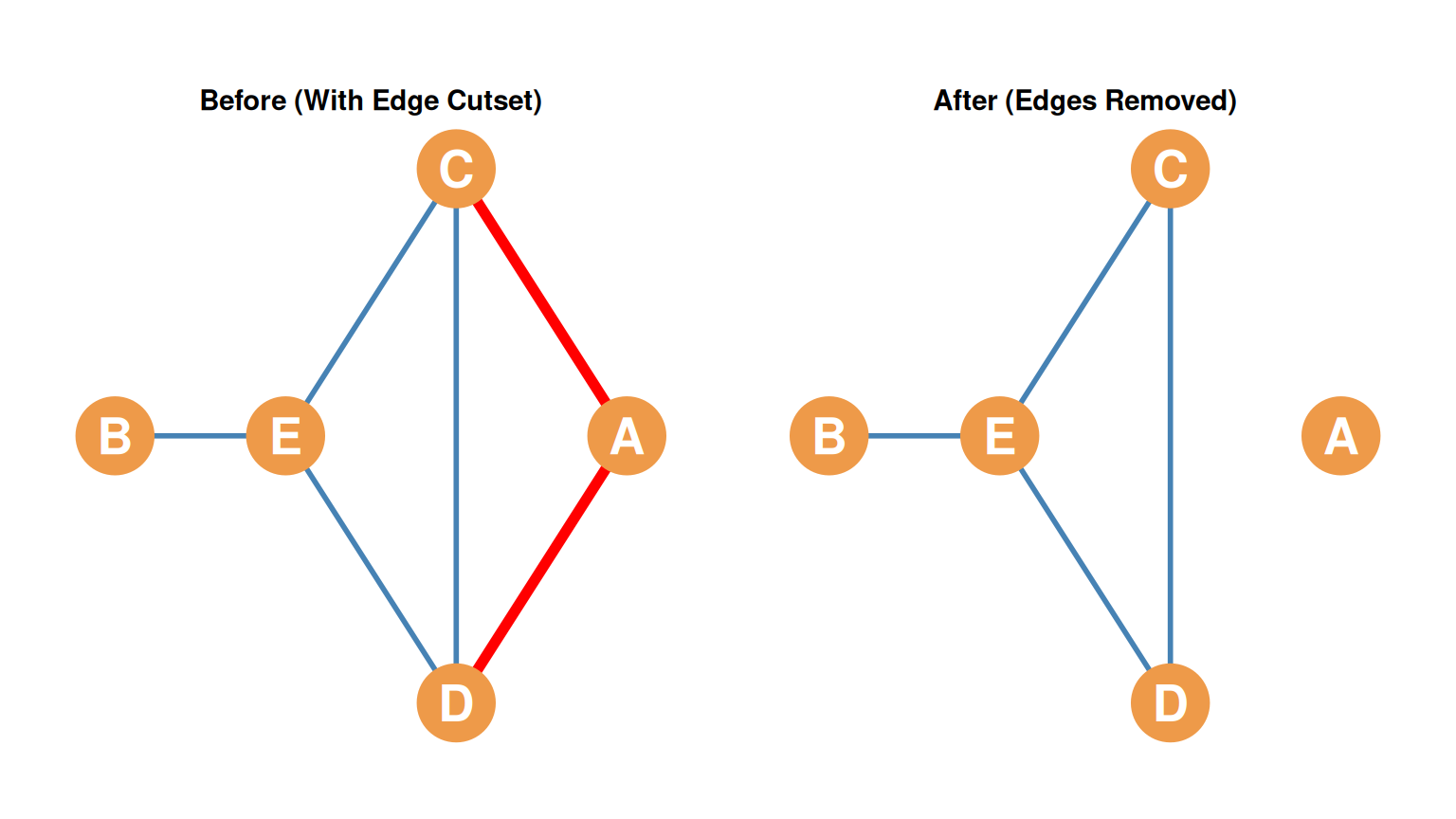
- Let’s look at node \(A\) in our house graph on the right.
- Separating \(A\) with an edge cutset requires removing 2 edges: \(C-A\) and \(D-A\) (red).
- Removing nodes can be more economical: deleting the single node \(E\) destroys three edges at once (\(B-E\), \(E-C\), \(E-D\)) and disconnects node \(B\) from the rest of the network.
- Key insight: Node removals are doubly destructive — a node “takes its links with it,” so one node removal can do the work of several edge removals.
1-Connectivity: A Visual Example
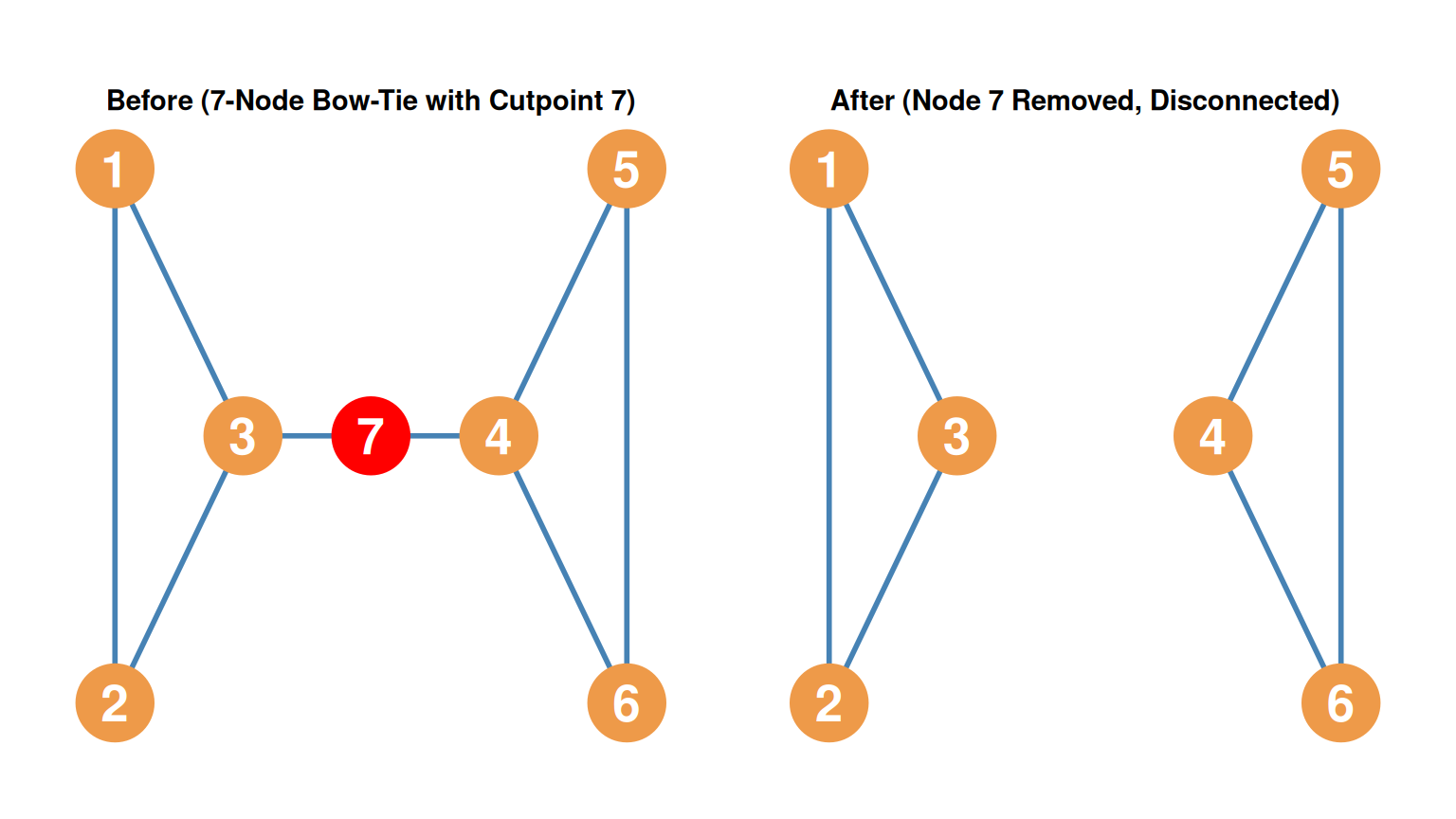
- 1-Connected Graph:
- A graph where removing exactly 1 node can disconnect the network.
- Before (Left):
- A 7-node symmetric bow-tie graph, with the central bridge node (node 7) highlighted in red.
- After (Right):
- The central node 7 is removed, leaving two completely separate connected components (triangles).
2-Connectivity: A Visual Example
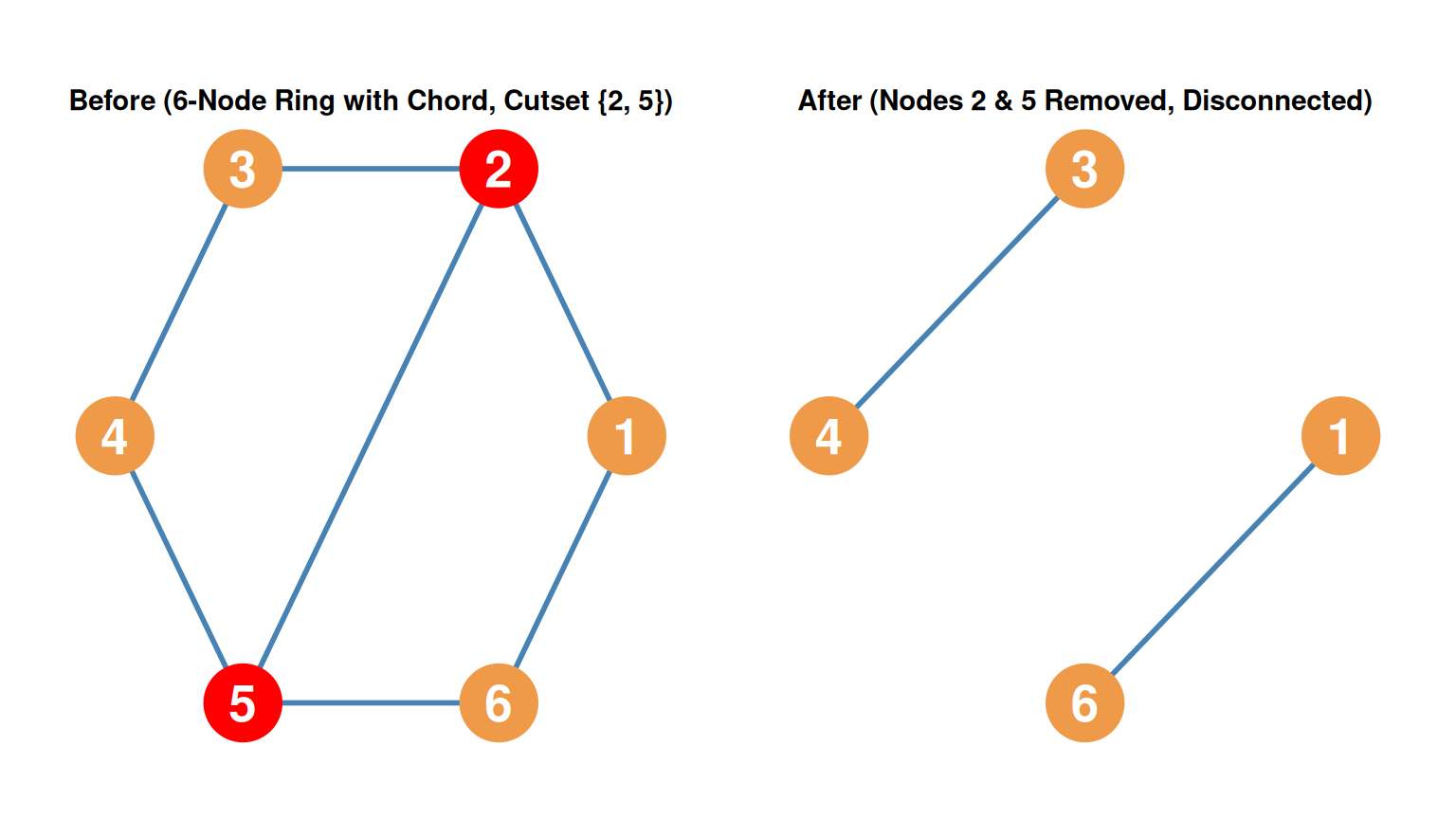
- 2-Connected Graph:
- A graph where it requires removing at least 2 nodes to disconnect it.
- Before (Left):
- A 6-node cycle with a diagonal chord (edge 2-5), with nodes 2 and 5 highlighted in red.
- After (Right):
- Removing nodes 2 and 5 leaves the graph split into two disconnected components: {1, 6} and {3, 4}.
3-Connectivity: A Visual Example
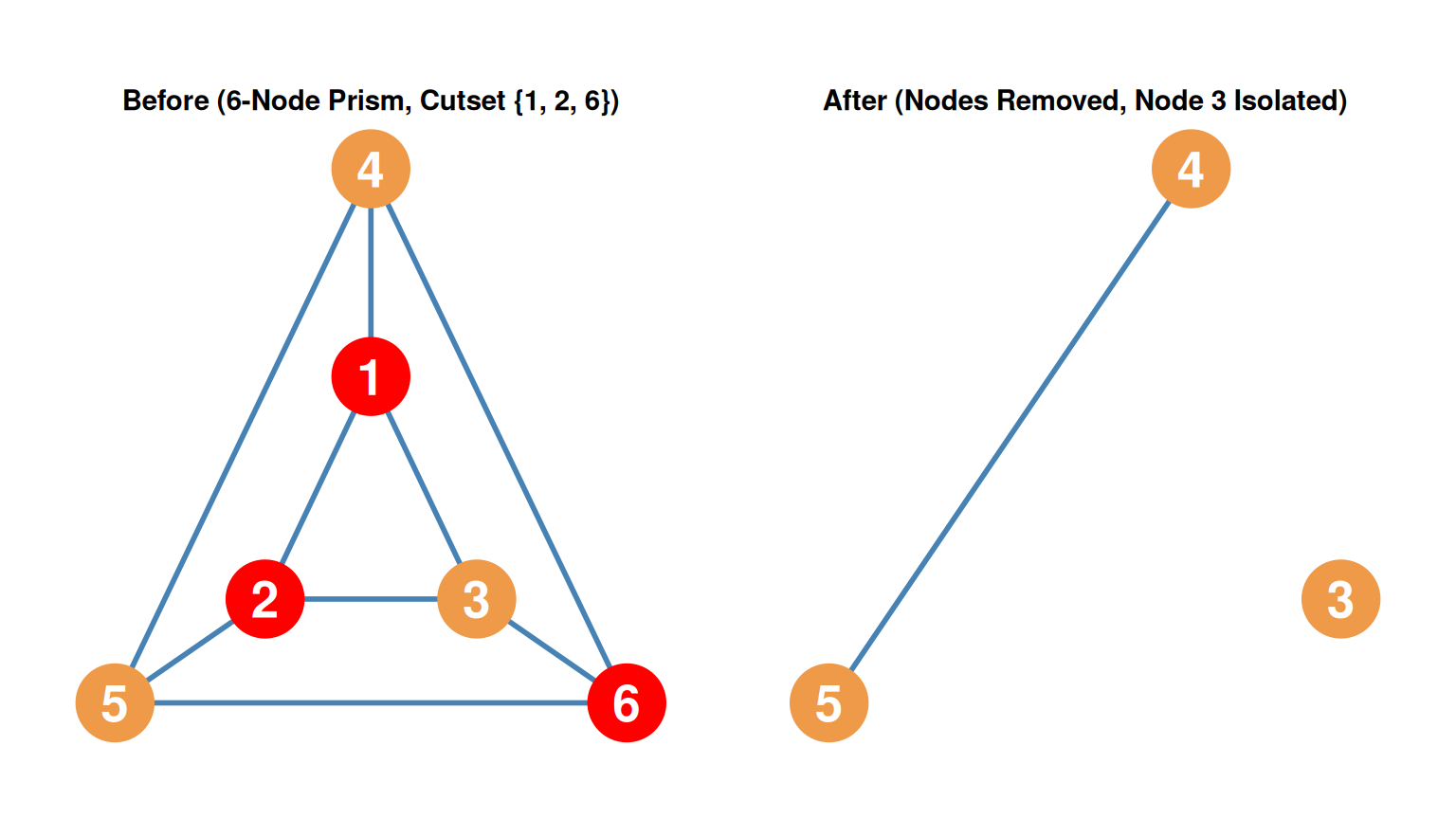
- 3-Connected Graph:
- A graph where it requires removing at least 3 nodes to disconnect it.
- Before (Left):
- A 3-regular 6-node prism graph (two concentric triangles), with nodes 1, 2, and 6 highlighted in red.
- After (Right):
- Removing nodes 1, 2, and 6 leaves the single edge 4-5 and completely isolates node 3 (disconnected).
The Connectivity Inequality
- For any undirected graph \(G\), node-connectivity (\(\kappa\)), edge-connectivity (\(\lambda\)), and minimum degree (\(\delta\)) obey a fundamental structural hierarchy: \[\kappa(G) \le \lambda(G) \le \delta(G)\]
- A Strict Inequality Example (\(1 < 2 < 3\)):
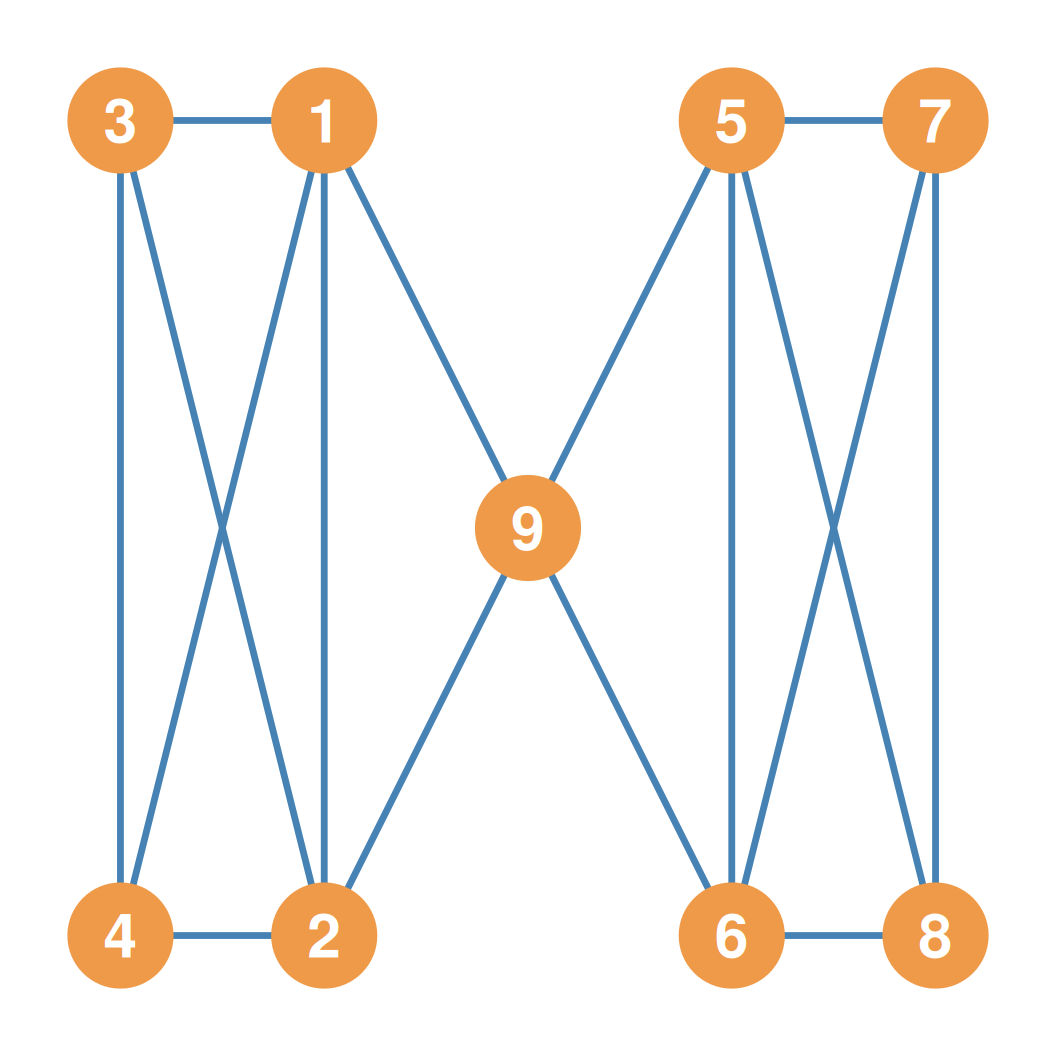
- In our 9-node “double-clique” graph on the right:
- Minimum Degree (\(\delta = 3\)): The least connected nodes (\(3, 4, 7, 8\)) have exactly 3 edges.
- Edge-Connectivity (\(\lambda = 2\)): Removing \(\{1-9, 2-9\}\) separates the left clique from the waist. No single bridge exists.
- Node-Connectivity (\(\kappa = 1\)): Removing the central cutpoint (node 9) completely disconnects the graph.
- In our 9-node “double-clique” graph on the right: