Graph Theory
The Basics of Social Network Analysis
What is a Graph? (An Example) (1)
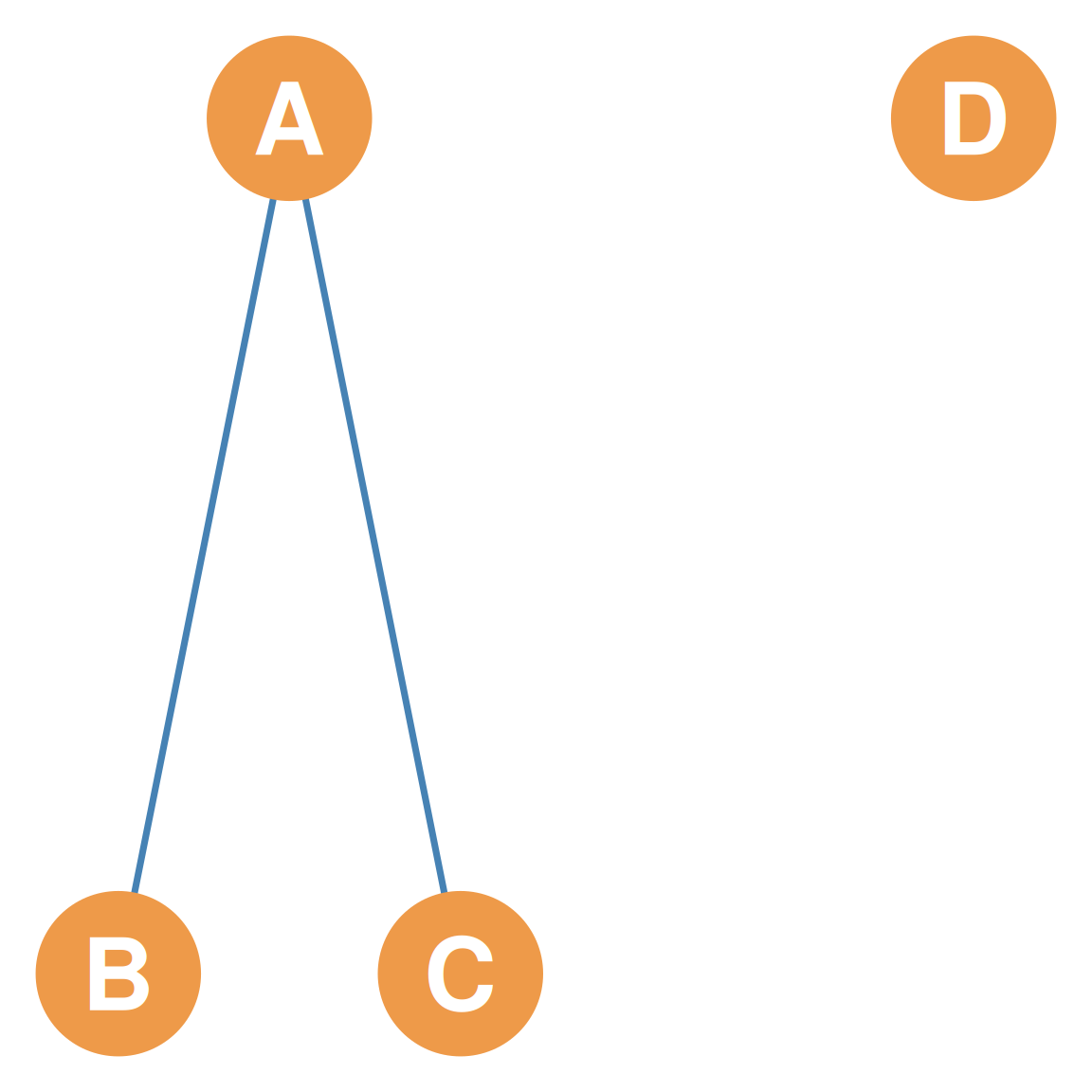
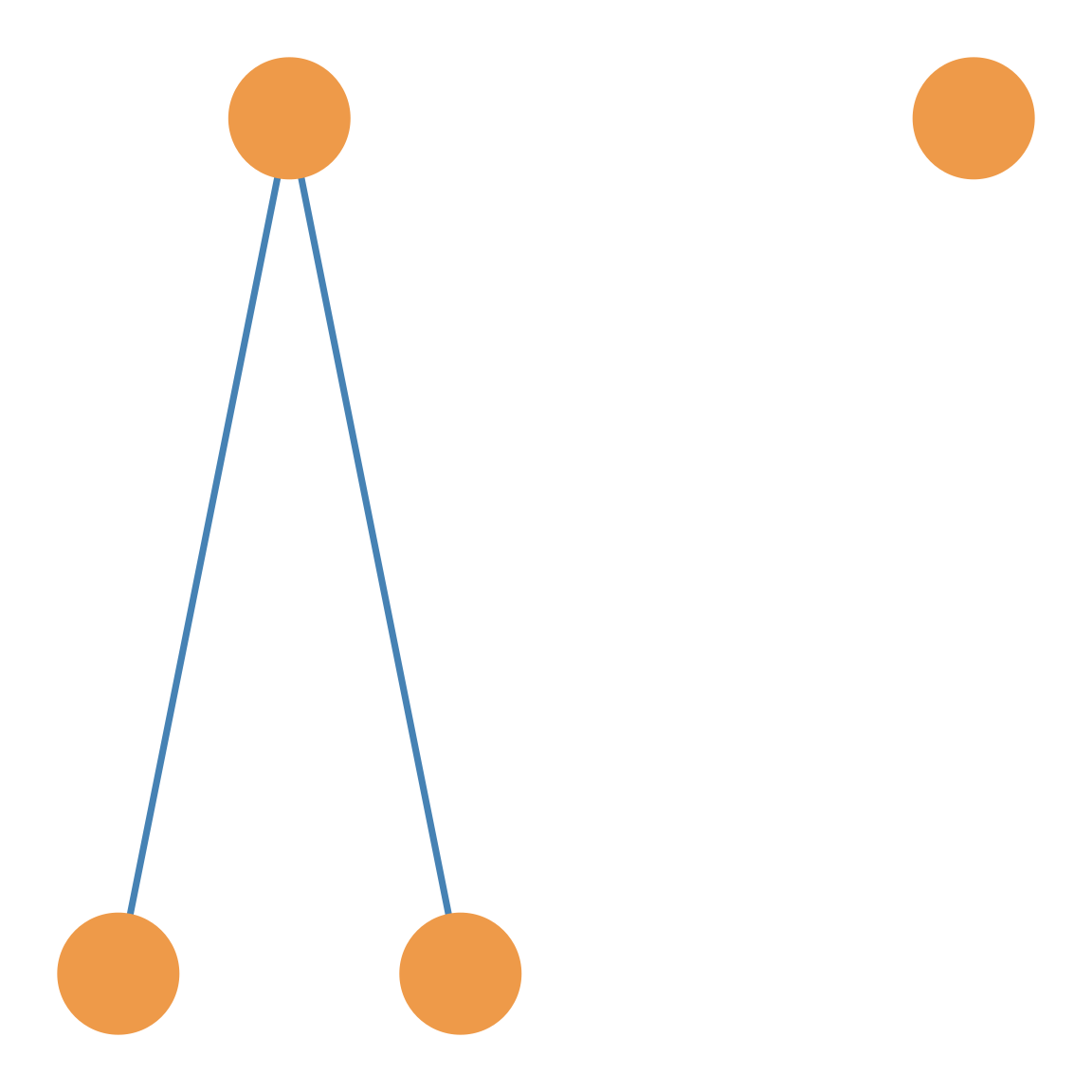
- Let’s define a graph \(G\) with 4 nodes (\(A, B, C, D\)) and 2 edges (\(AB, AC\)):
- \(V = \{A, B, C, D\}\)
- \(E = \{AB, AC\}\)
- \(G = \{V, E\}\)
What is a Graph? (An Example) (2)
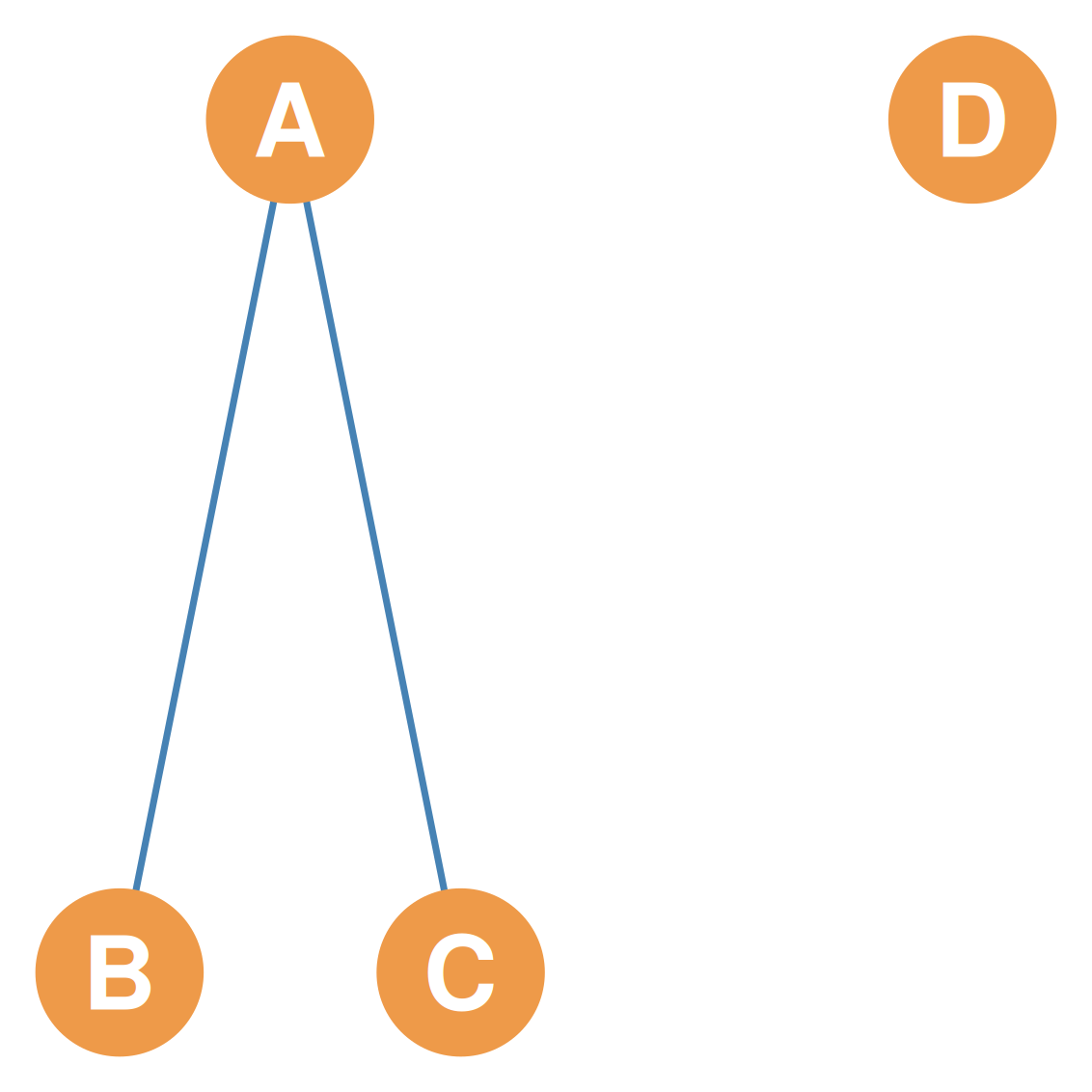
- For the graph \(G = \{V, E\}\):
- The cardinality (number of members in a set \(S\)) is denoted by \(|S|\):
- Vertex set cardinality: \(|V| = n = 4\)
- Edge set cardinality: \(|E| = m = 2\)
What is a Graph? (An Example) (3)
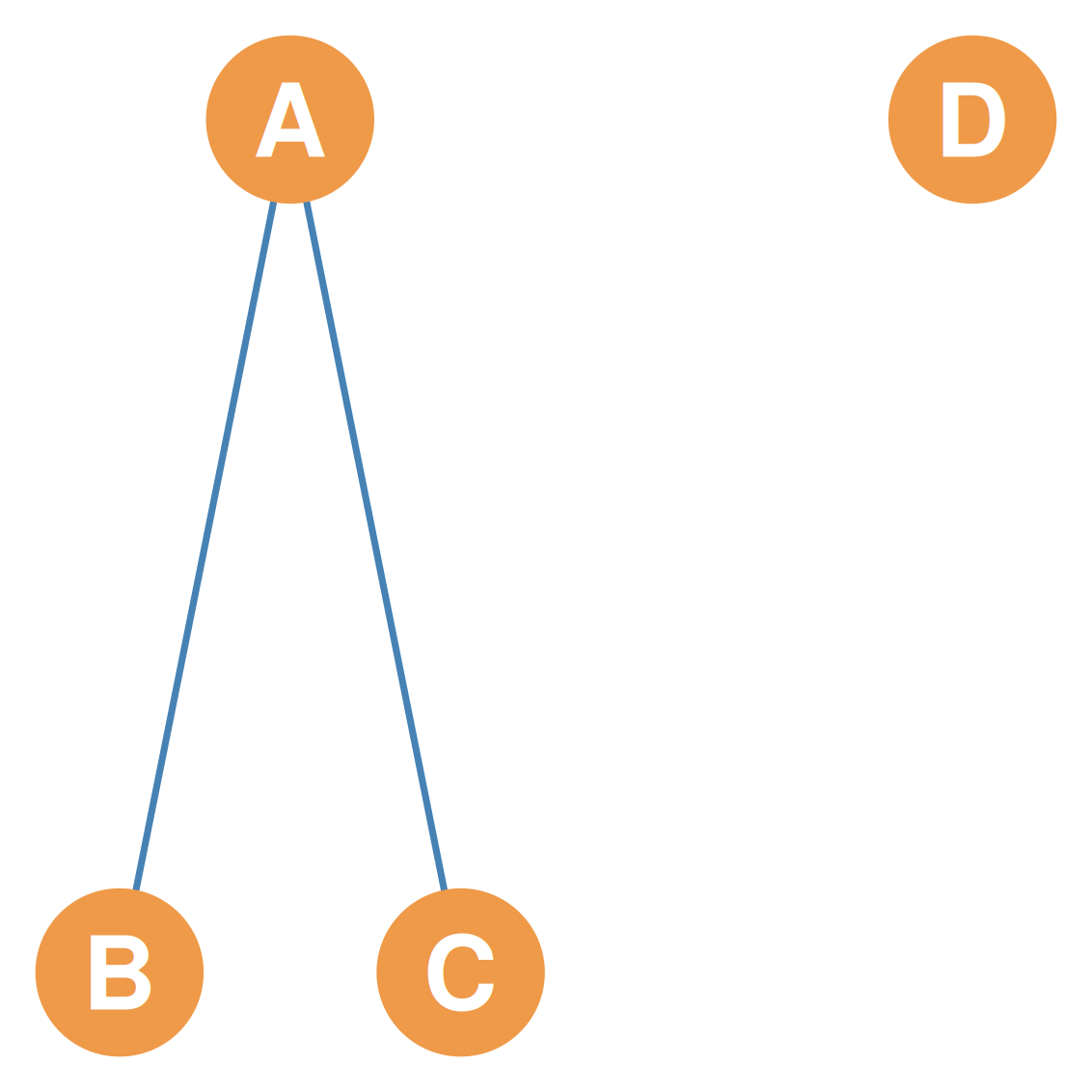
- This graph can be represented by the signature \(G(n, m) = G(4, 2)\)
- Note the lack of edges:
- No edge between \(B\) and \(C\) means no relationship between them.
- Node \(D\) is not connected to any other node.
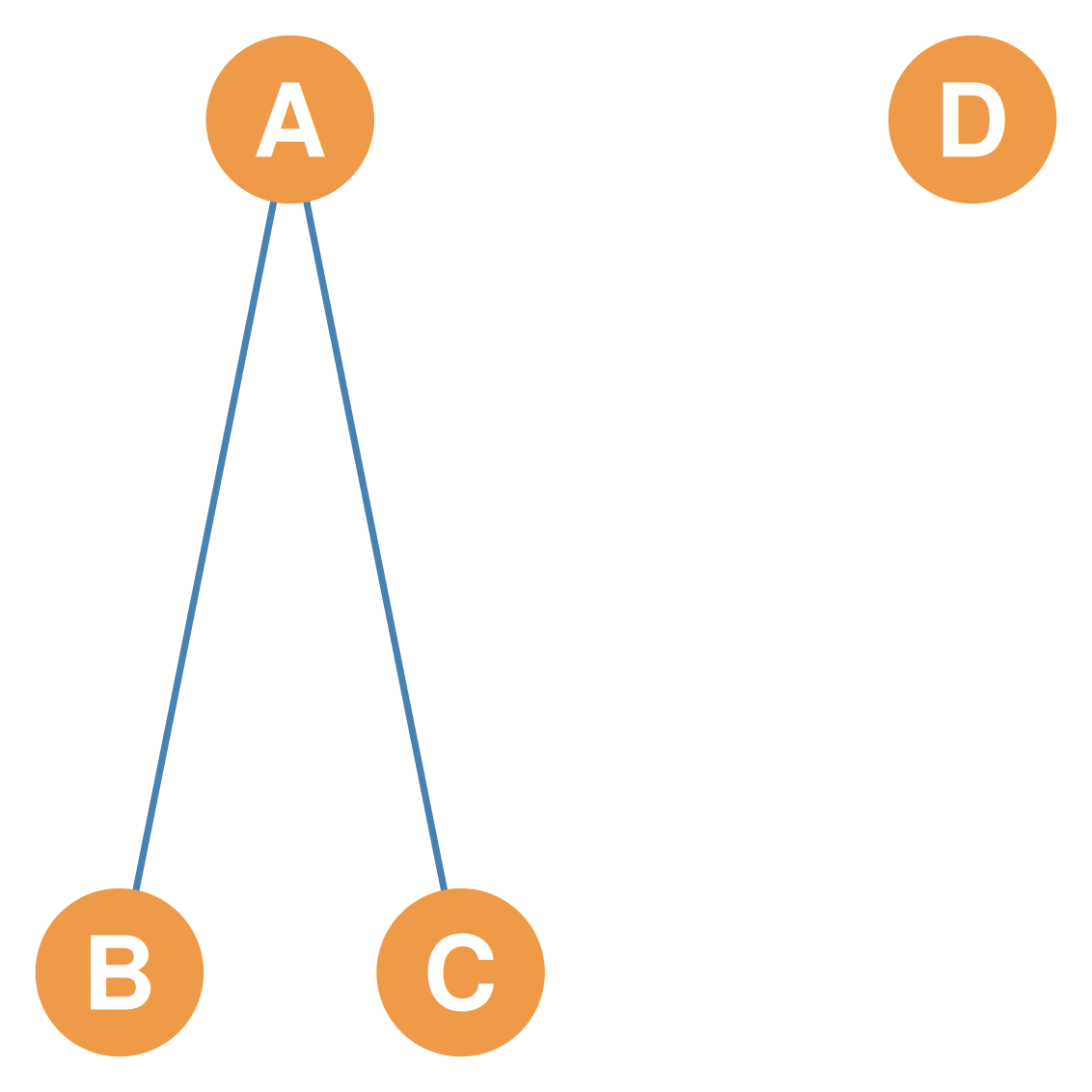
G(4, 2) Variation 1
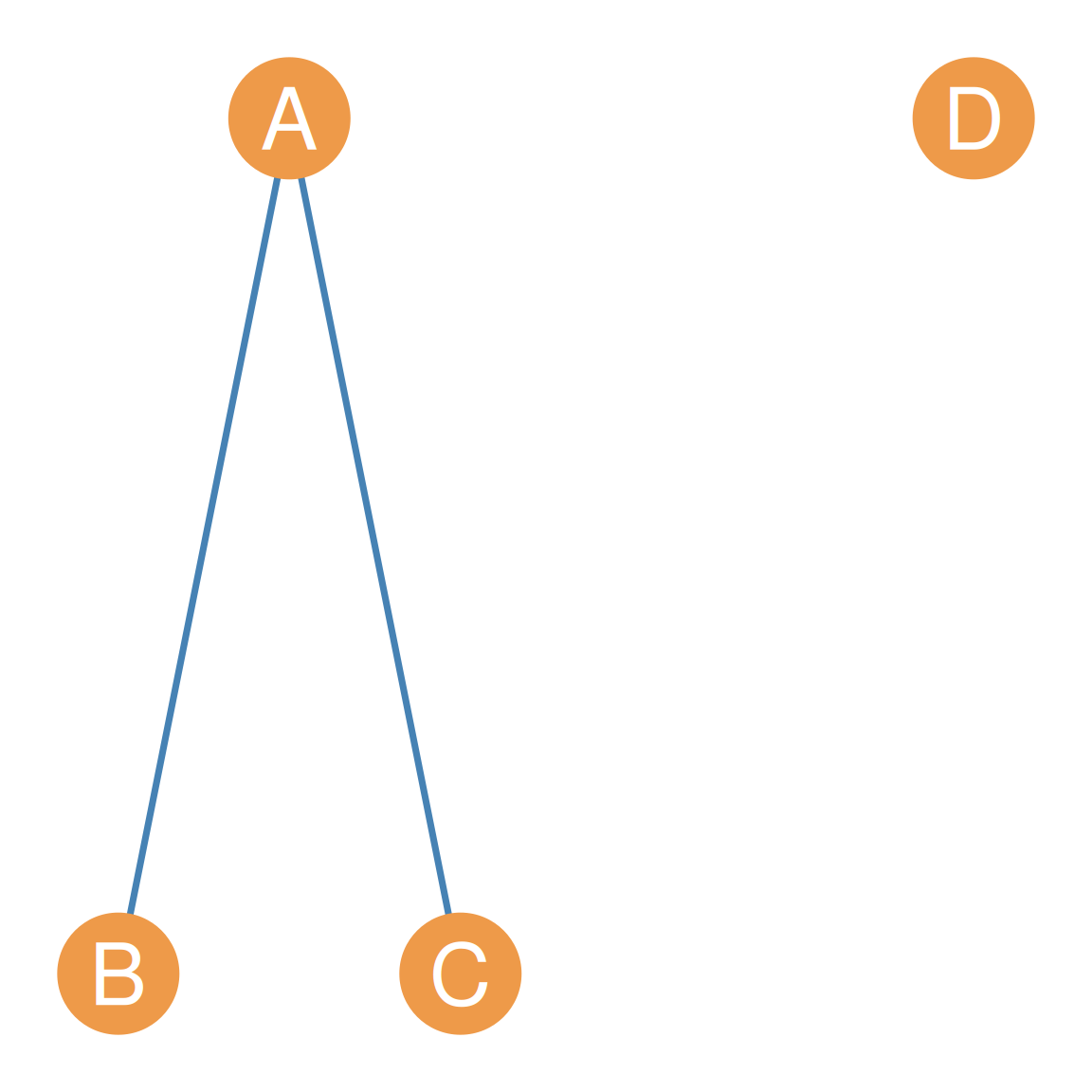
G(4, 2) Variation 2
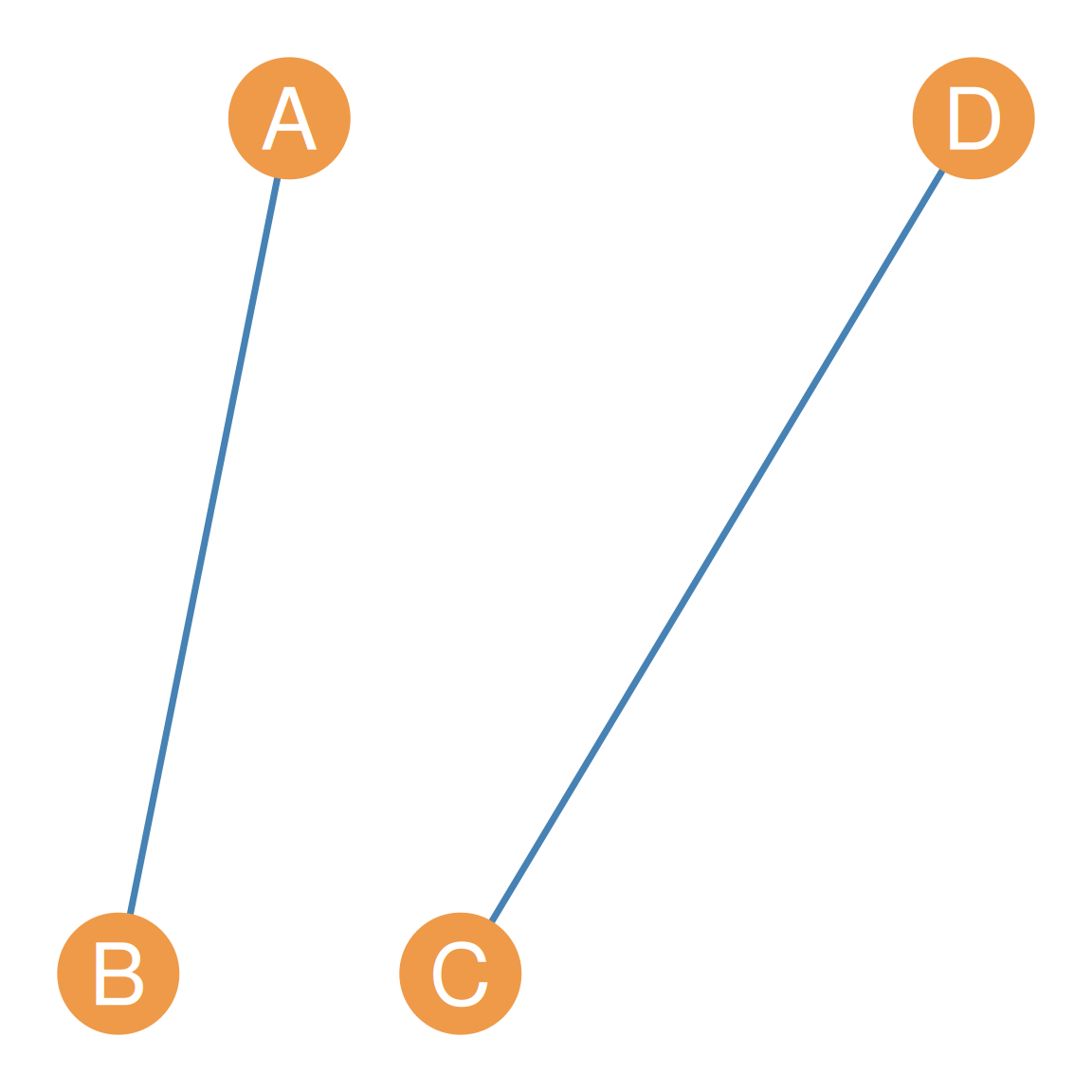
G(4, 2) Variation 3
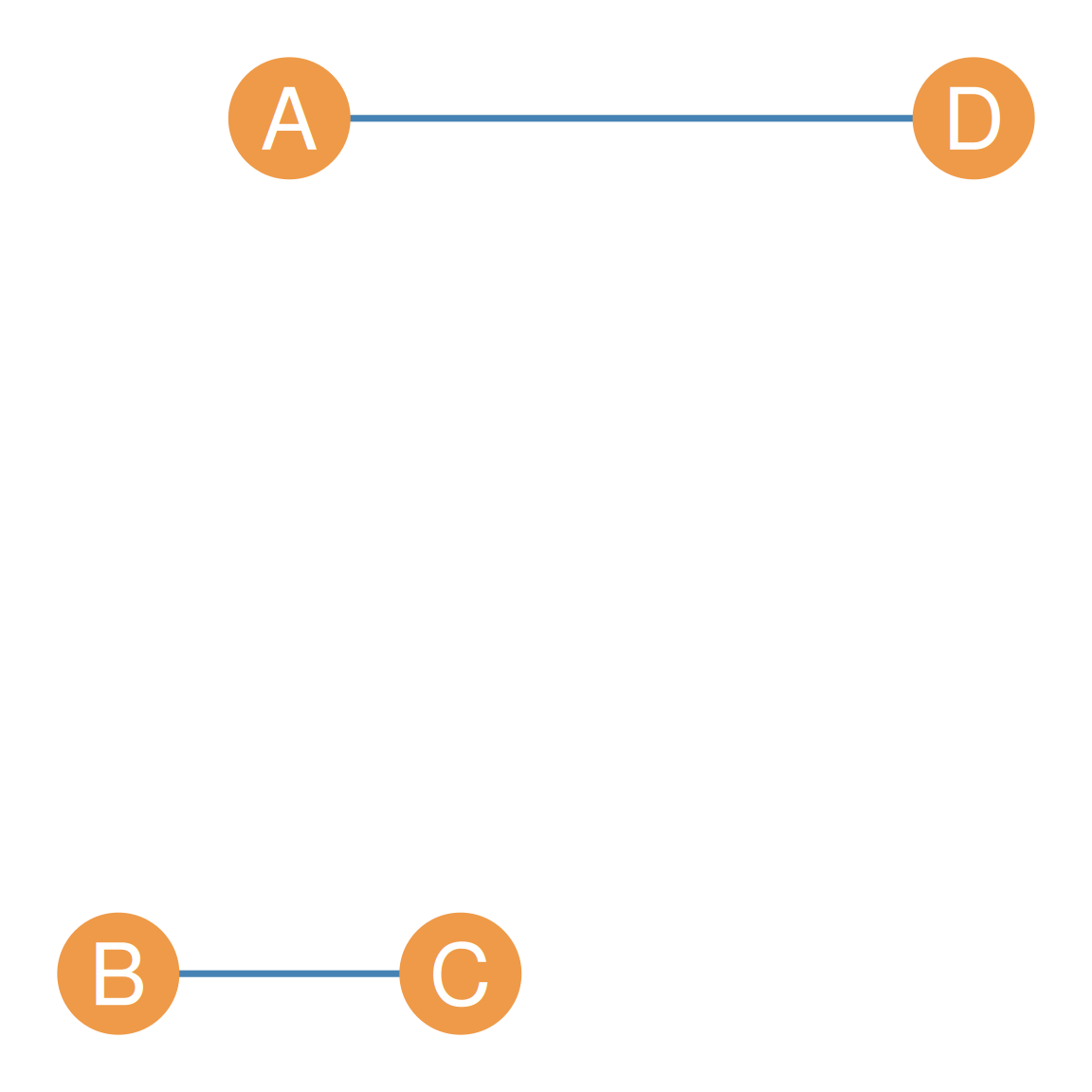
G(4, 2) Variation 4 (Unlabeled)
Graph Labeling
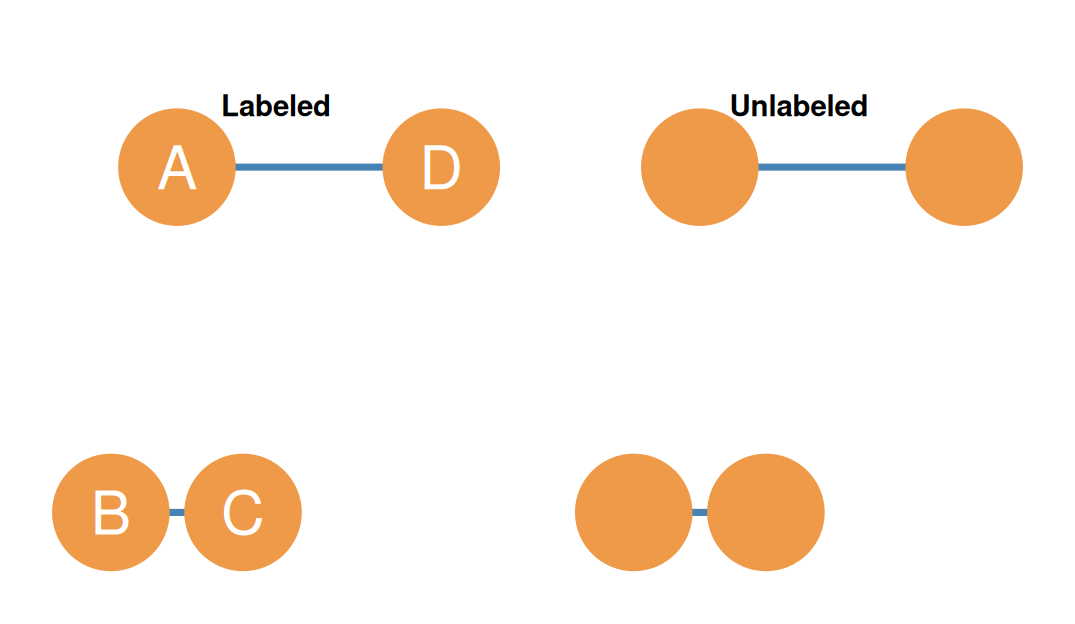
- Labeled Graphs:
- Distinctions are made between nodes (e.g., A, B, C are different people).
- Swapping node names mathematically changes the graph.
- Unlabeled Graphs:
- Nodes are interchangeable or anonymous.
- The focus is strictly on the abstract structure of connections.
Basic Relationships Between Nodes and Edges in Graphs
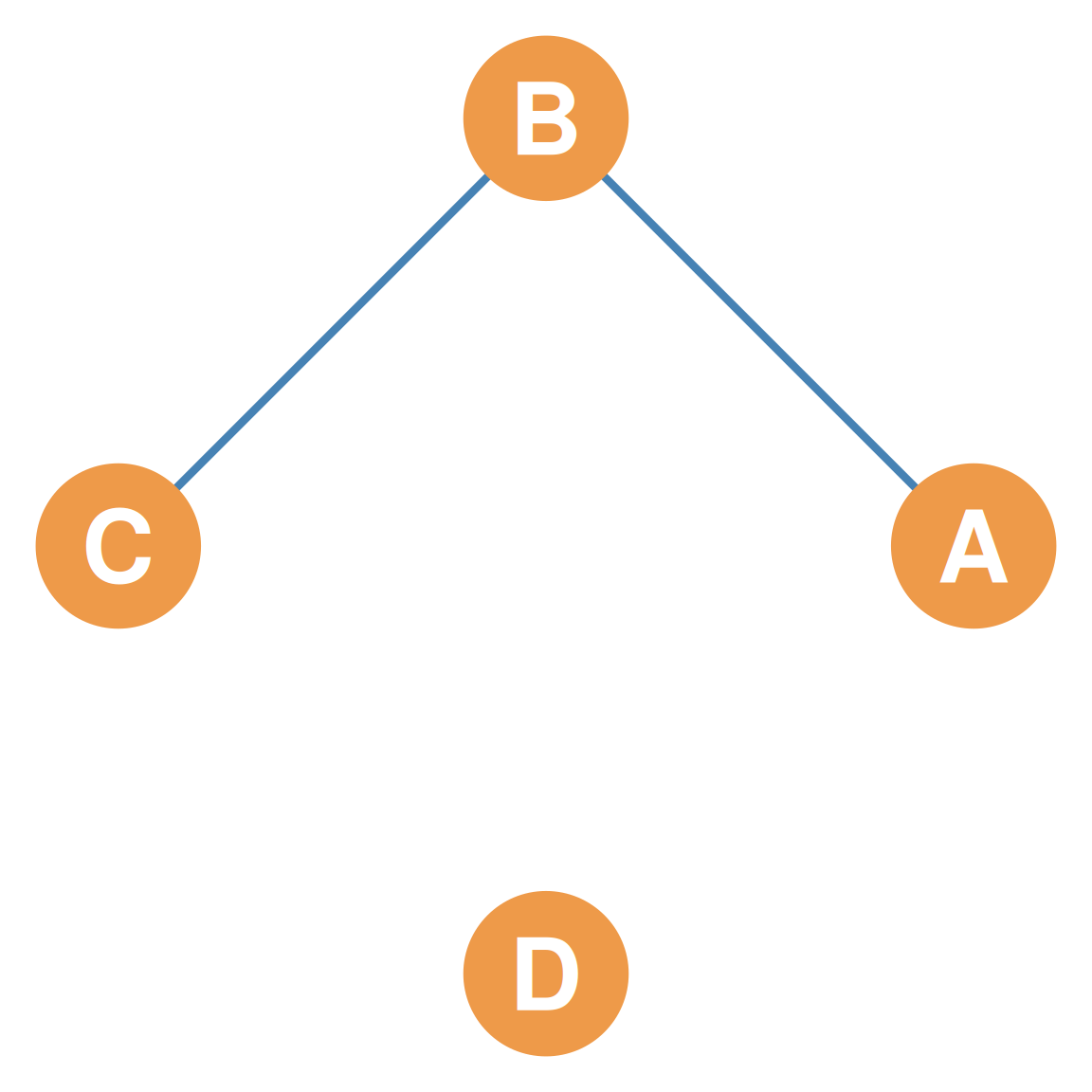
- Two nodes are:
- Adjacent: If they are joined by an edge in the graph (e.g., \(A\) and \(B\)).
- Nonadjacent: If they are not joined by an edge in the graph (e.g., \(A\) and \(C\)).
- End Vertices with respect to an edge: if they lie at the ends of an edge (e.g., \(A\) and \(B\) for edge \(AB\)).
Basic Relationships Between Nodes and Edges in Graphs
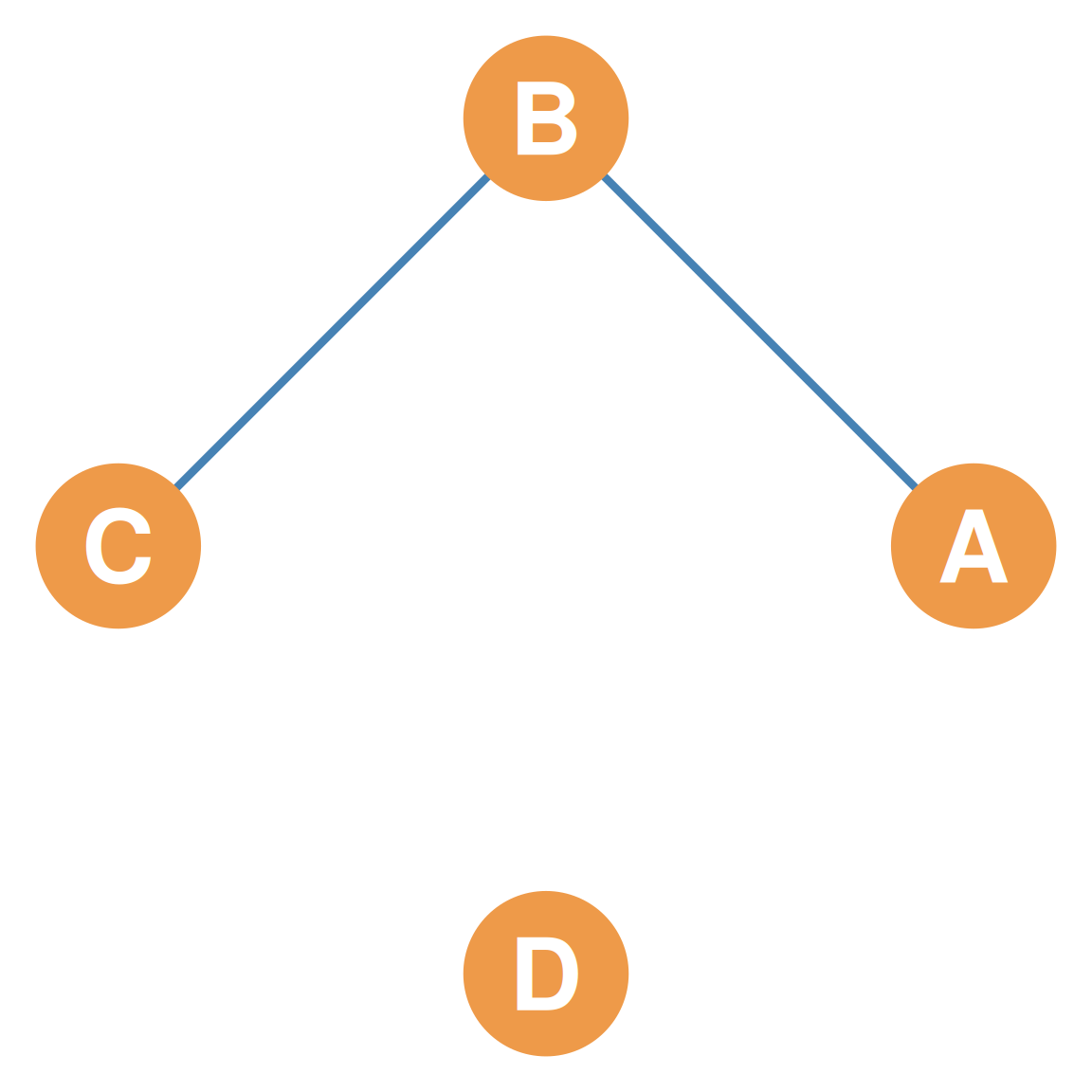
- An edge is:
- Incident to a node: If it connects to that node (e.g., edge \(AB\) is incident to nodes \(A\) and \(B\)).
- Non-incident to a node: If it does not connect to that node (e.g., edge \(AB\) is non-incident to node \(C\)).
- A node is an isolate: if it has no incident edges or is not adjacent to another node (e.g., \(D\)).
The Graph Complement: Example
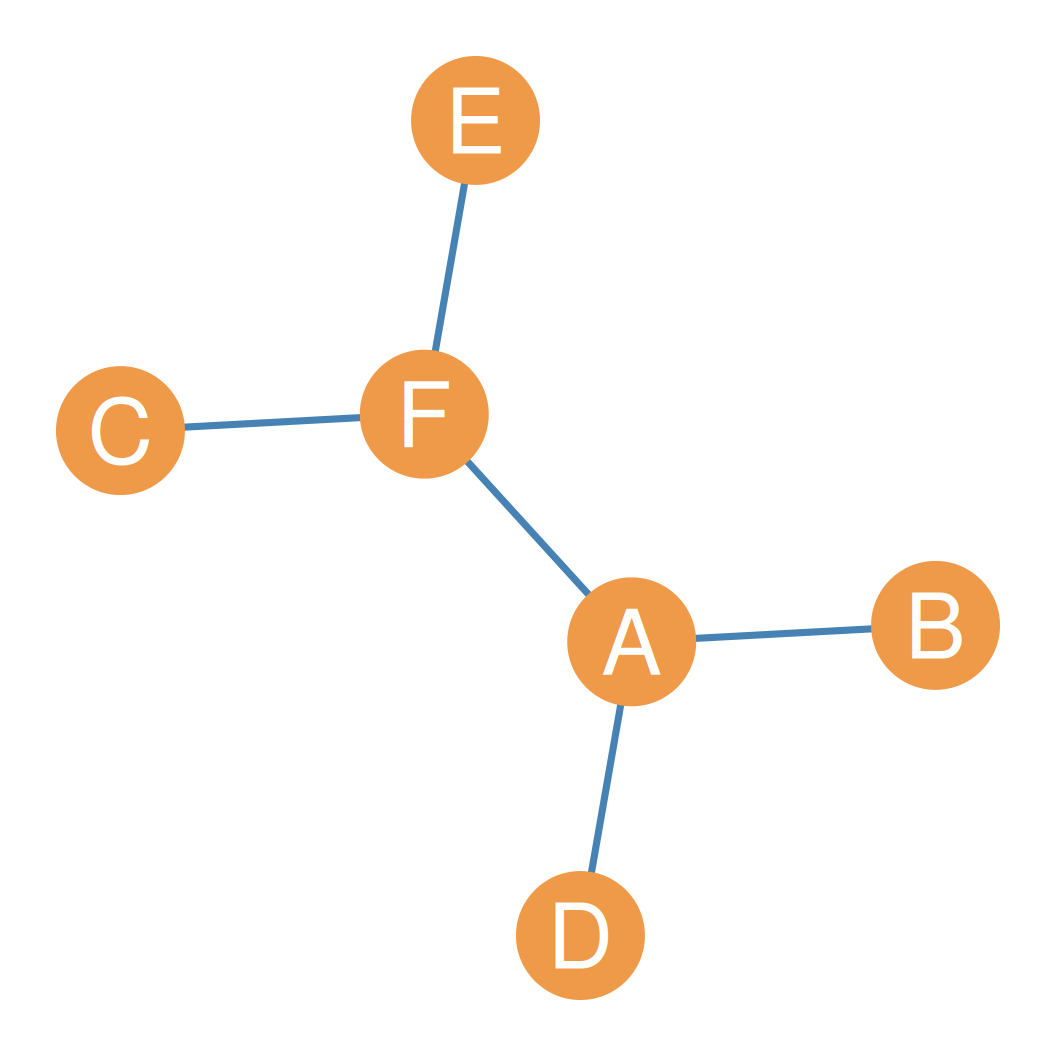
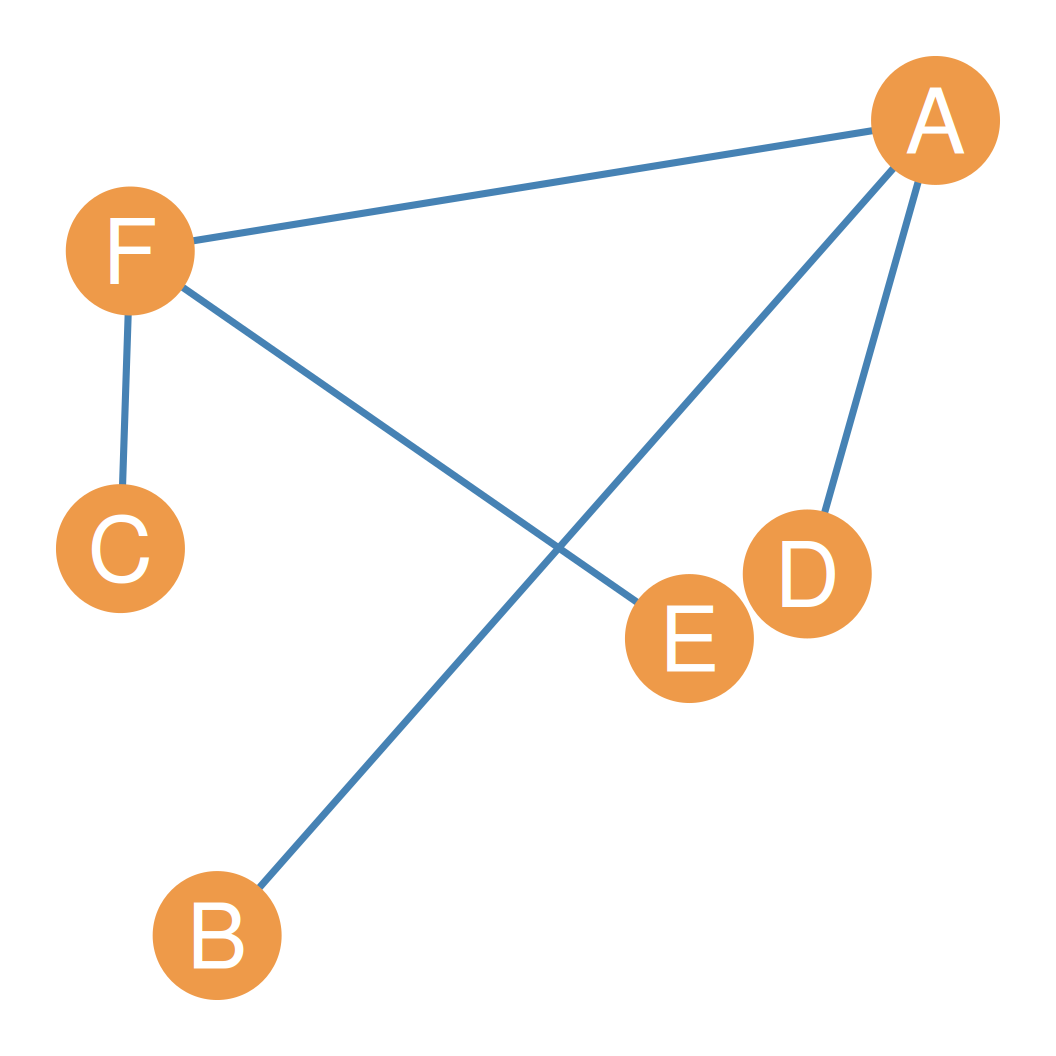
- Let’s start with a simple graph \(G\) containing 6 nodes and 5 edges.
- Nodes \(A\) and \(F\) act as central connectors.
- This original graph has many missing edges (e.g., \(B-C\), \(D-E\)).
The Graph Complement: Example
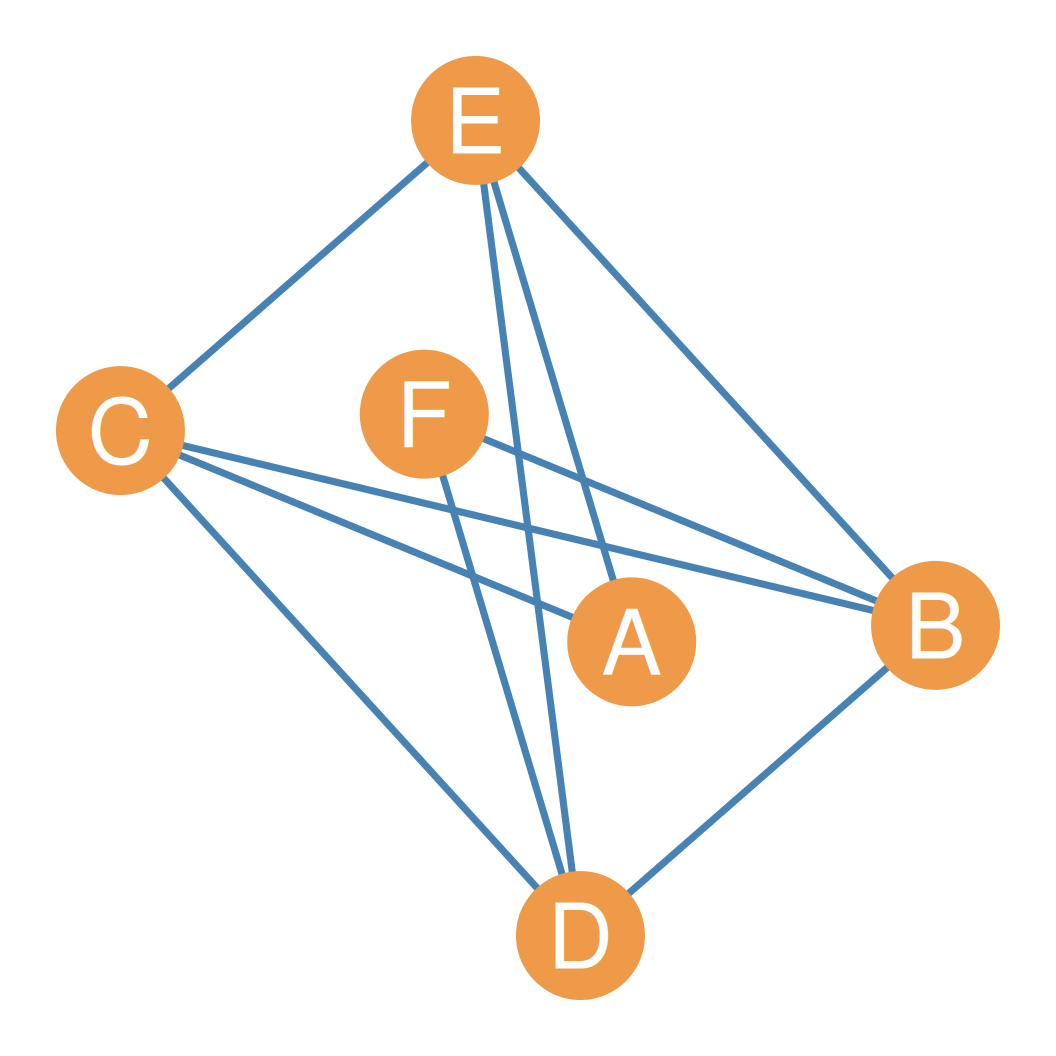
- The complement graph \(G'\) on the right connects all pairs that were not connected in \(G\).
- Every edge present in the original graph is now missing.
- Every edge missing in the original graph is now present.
Non-Simple Graphs
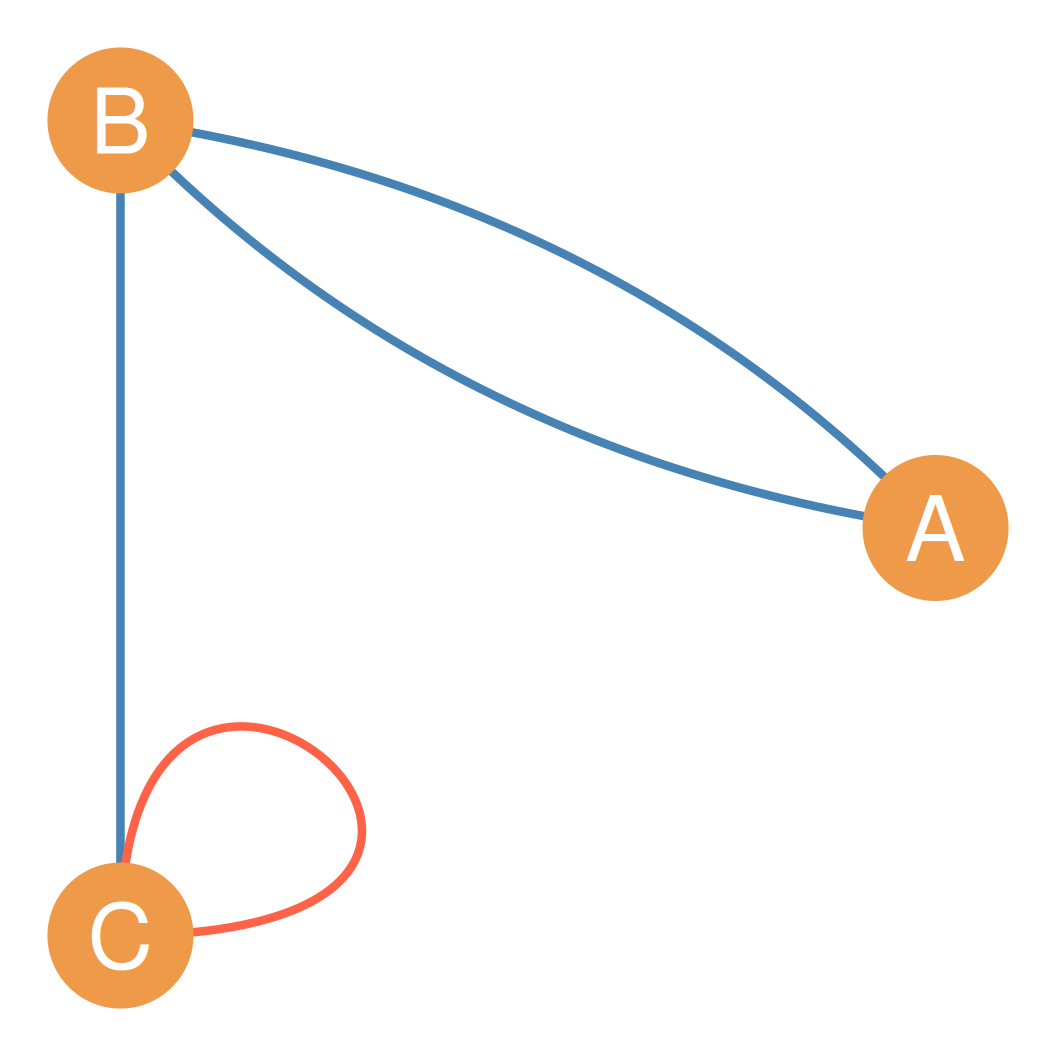
- Graphs that do not meet these requirements are non-simple (or multigraphs).
- The diagram on the right shows:
- Multiple Edges: Two edges connect nodes \(A\) and \(B\).
- Loop: An edge connects node \(C\) to itself.
Same Graph, Different Drawings (1)
Same Graph, Different Drawings (2)
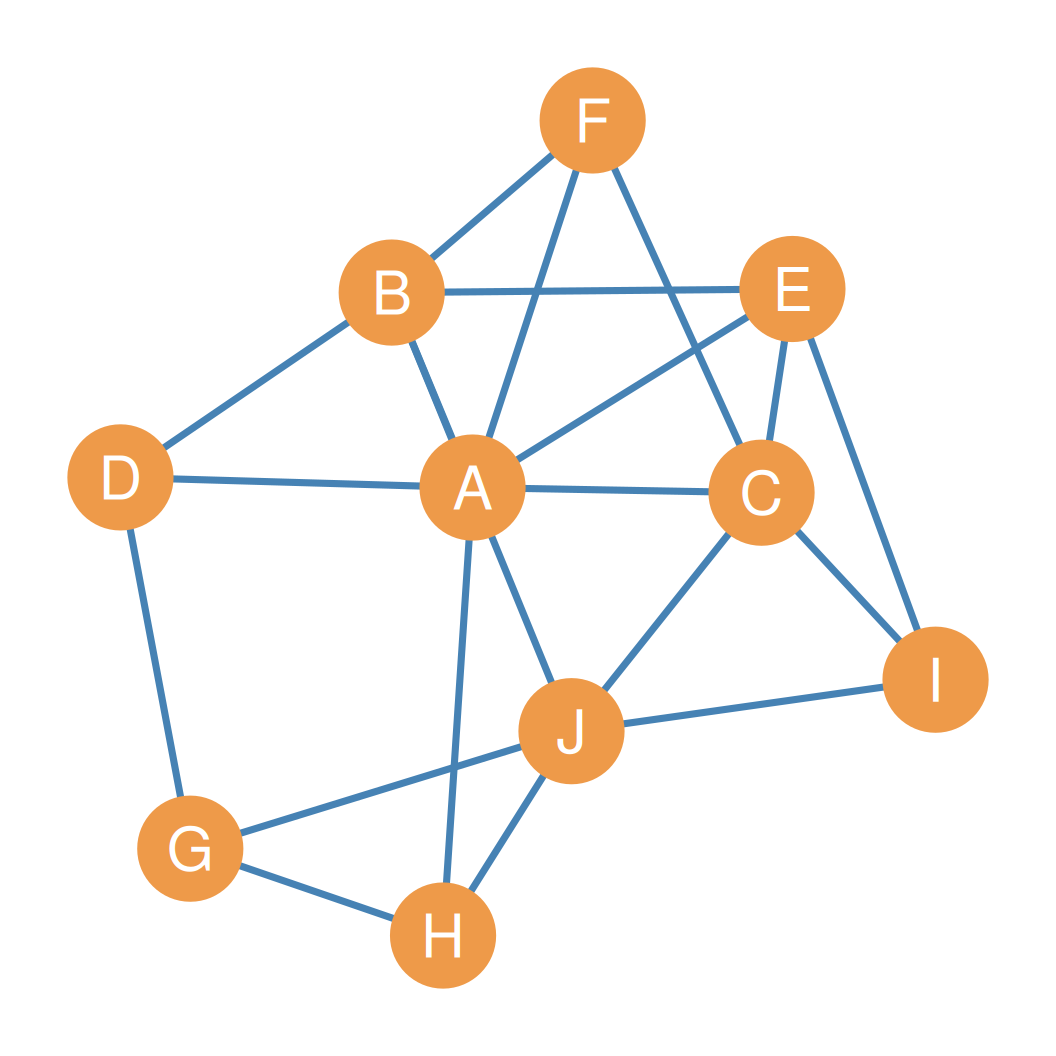
Original Graph
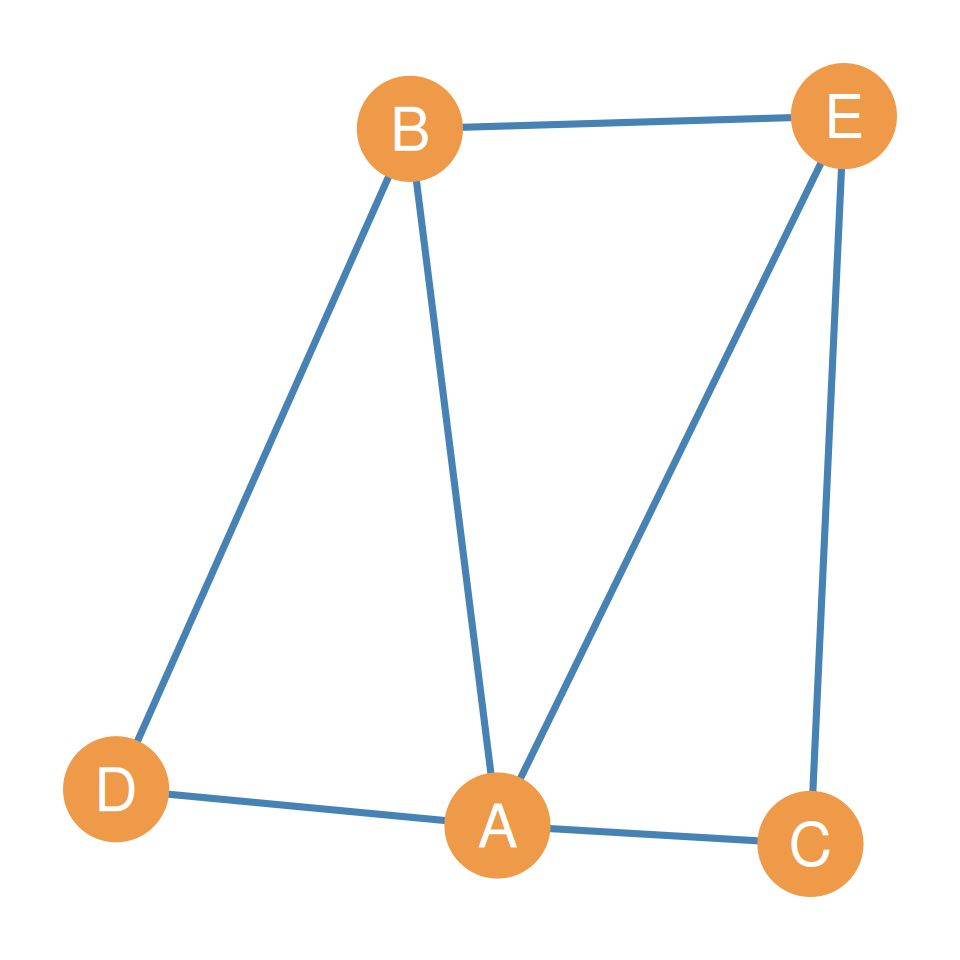
A Subgraph of the Original
- Created by keeping a subset of nodes: \(V' = \{A, B, C, D, E\}\).
- Retains only edges connecting these five nodes.
- All other nodes (\(F, G, H, I, J\)) and their incident edges are removed.
Vertex-Induced Subgraphs: Example
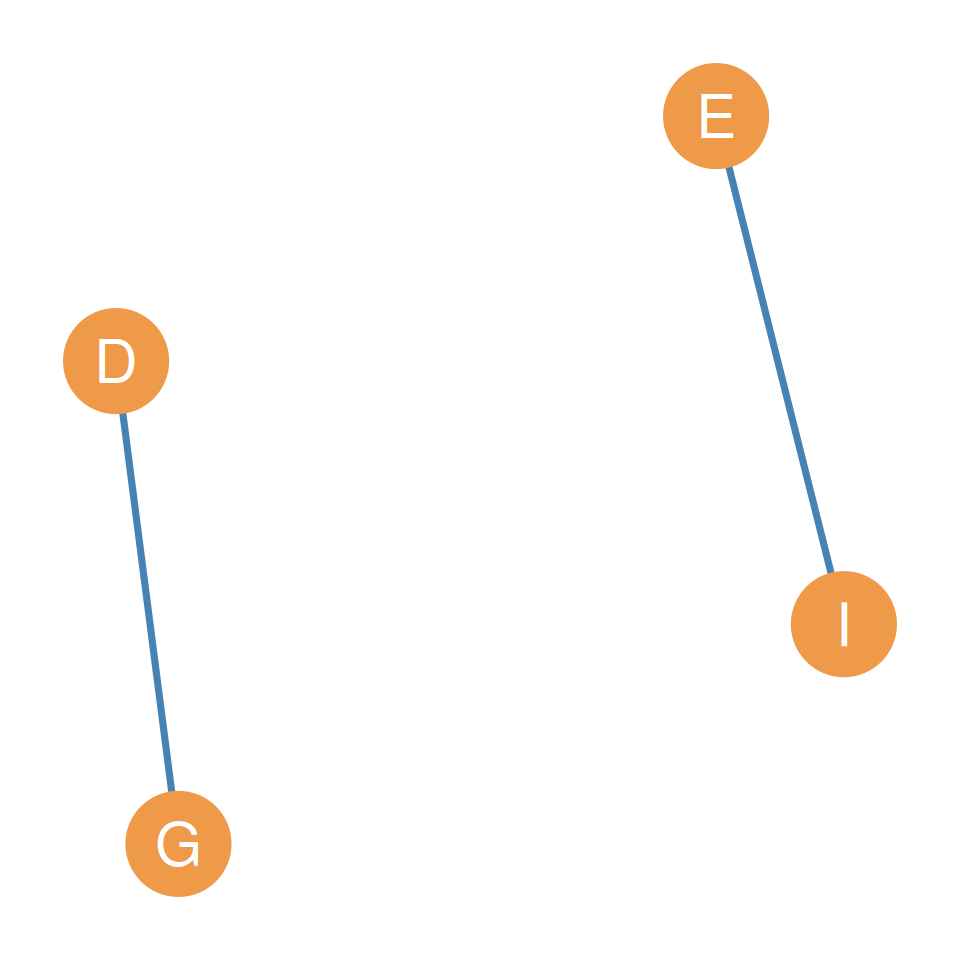
- Let’s select the subset of nodes: \[V' = \{D, E, G, I\}\]
- Keeping all original edges between these nodes yields the vertex-induced subgraph on the right.
Vertex-Deleted Subgraphs: Example
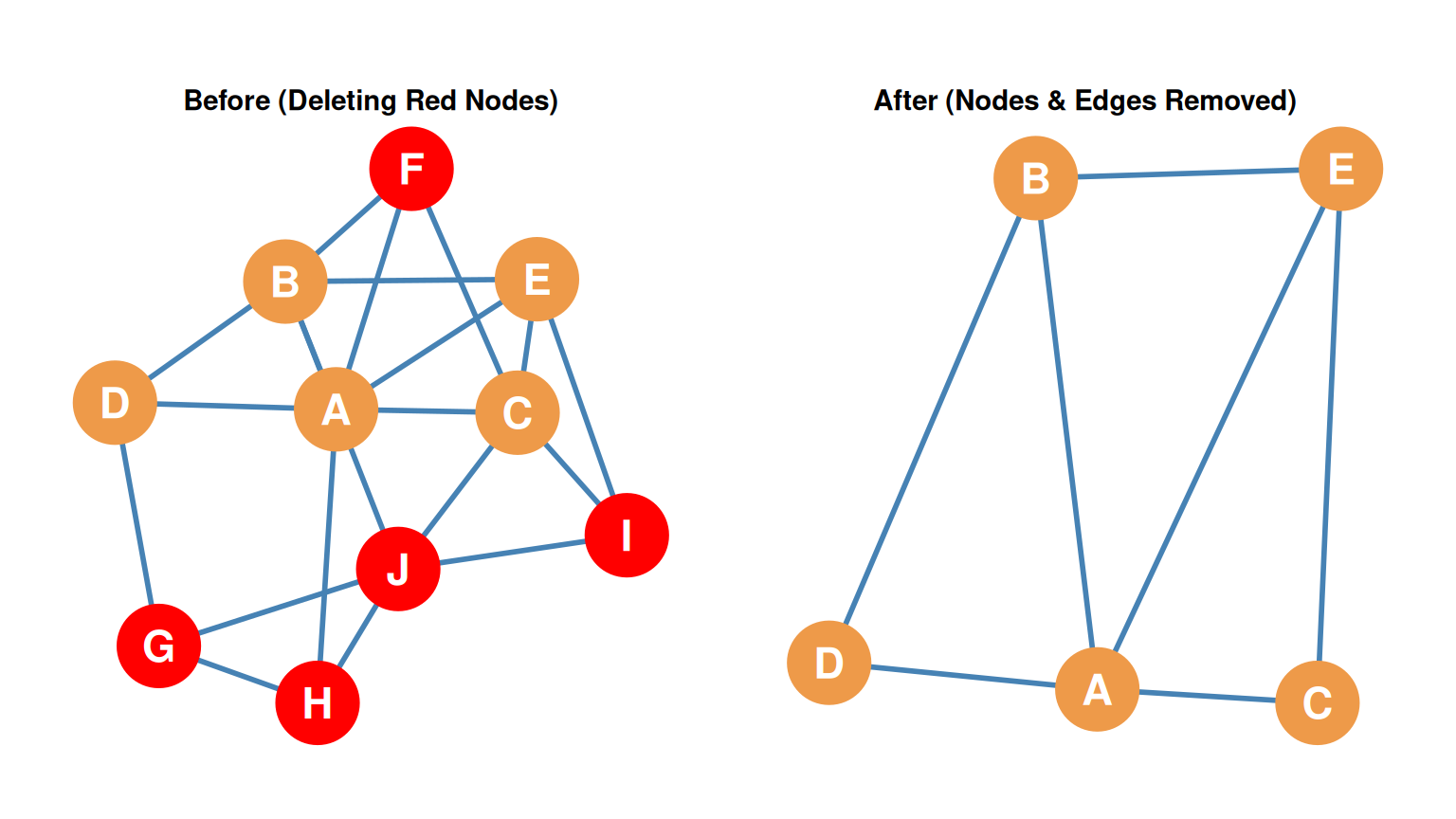
- Example: Deleting \(\{F, G, H, I, J\}\) from the original graph.
- This removes those 5 nodes (highlighted in red, left) and all their incident edges, yielding the disconnected subgraph (right).
- This is equivalent to the vertex-induced subgraph on \(\{A, B, C, D, E\}\).
Edge-Deleted Subgraphs: Example
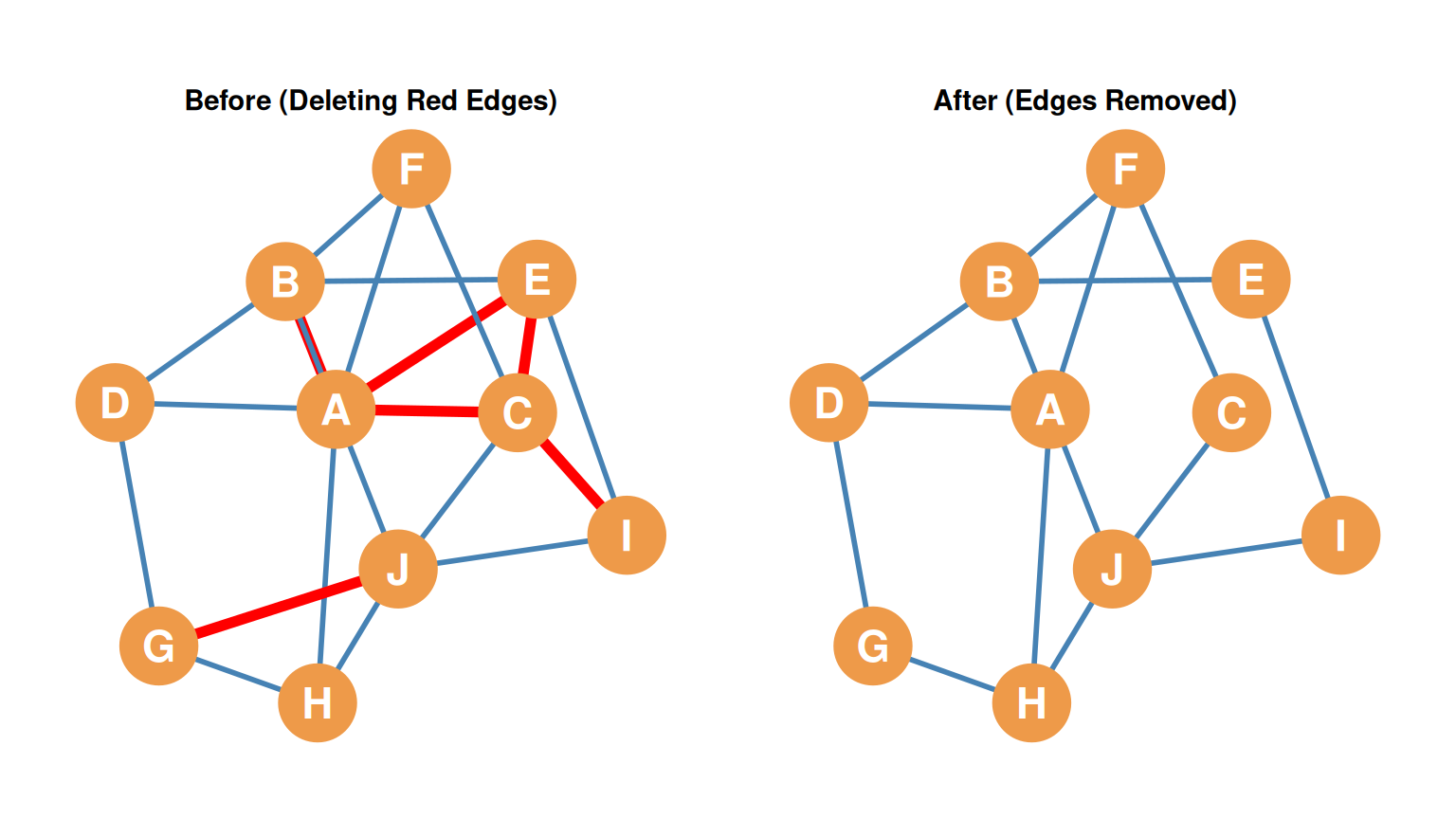
- Example: Deleting six specific edges from the original graph:
- \(\{AB, GJ, CI, AE, AC, CE\}\)
- Removing these edges (highlighted in red, left) keeps all 10 nodes intact, yielding the edge-deleted subgraph (right).
Special Subgraphs: Ego Graph
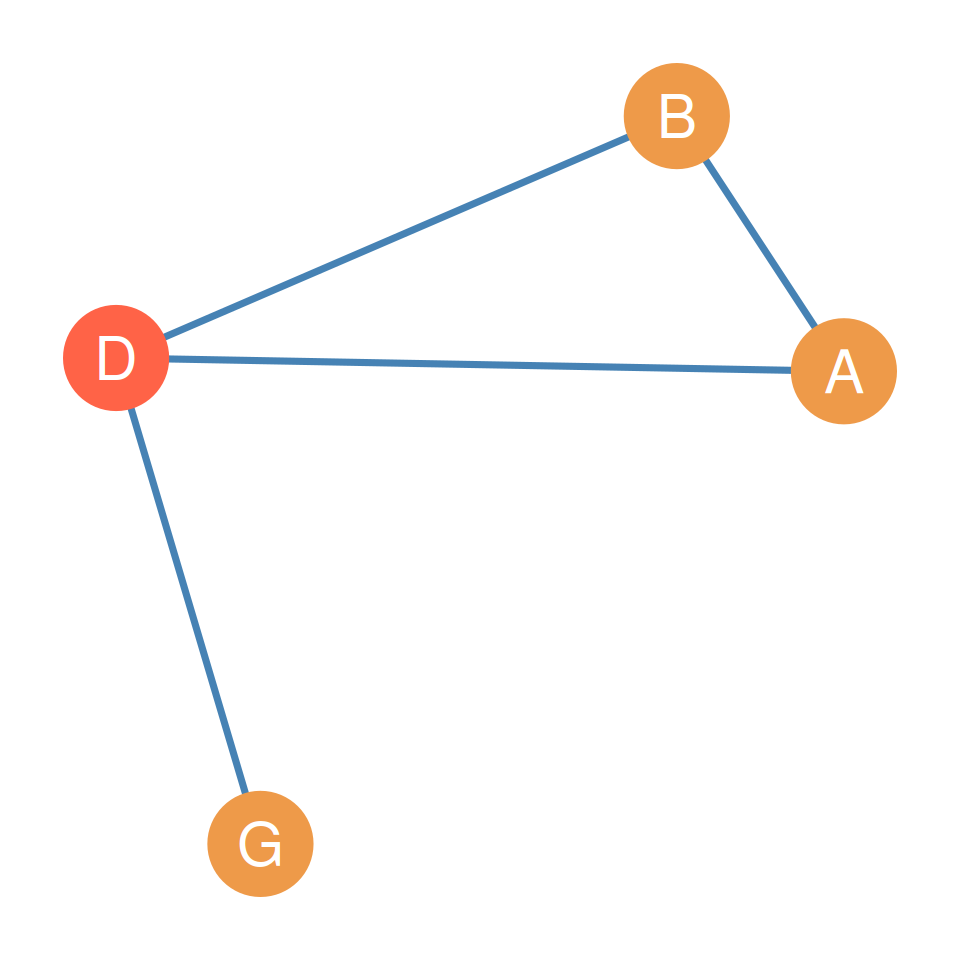
- Ego Graph: Subgraph centered on a node (ego), containing the ego, its neighbors (alters), and all ties among them.
- Particularly useful for actor-level network analysis.
- Example: Ego graph for node D (in red) and its alters A, B, and G (in tan).
Vertex Fusion (1)
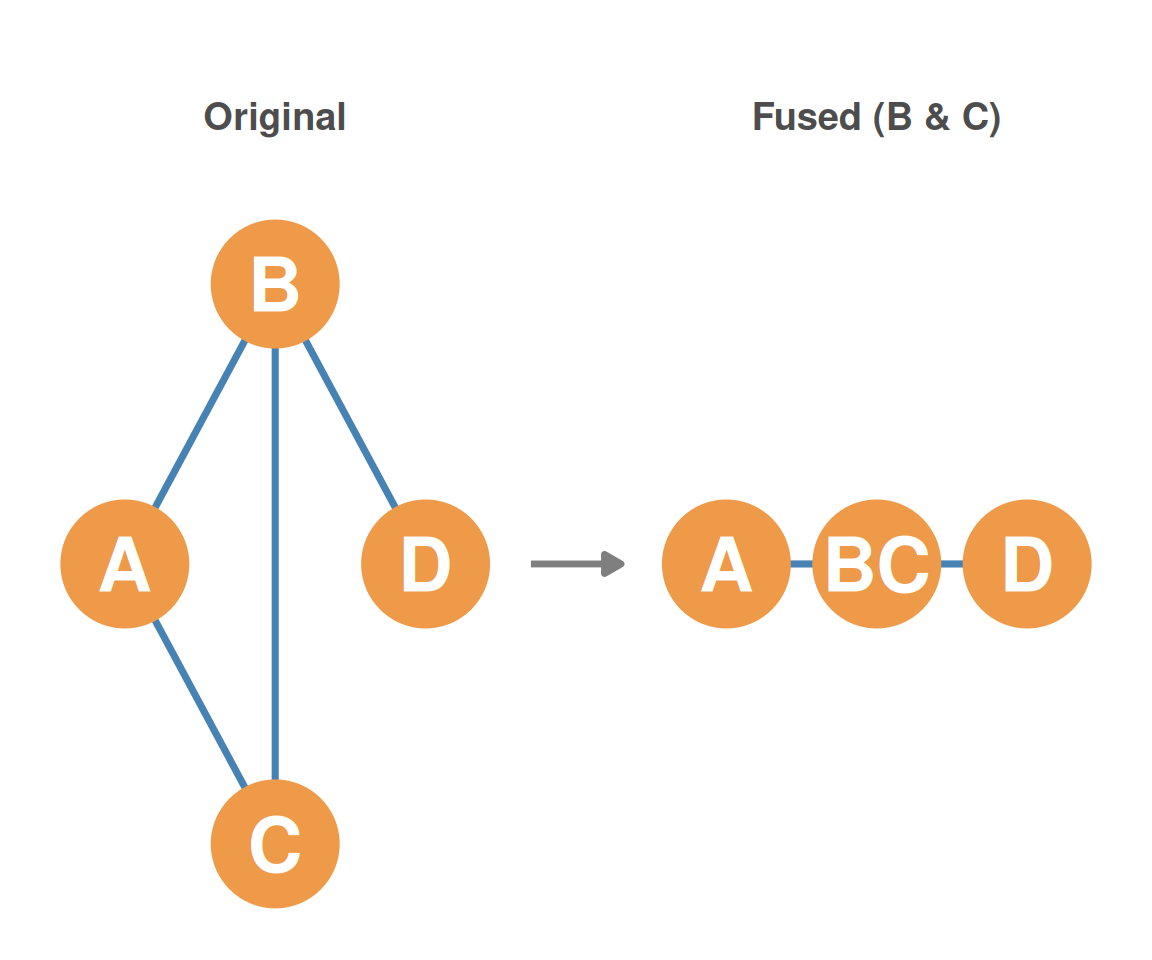
- We can construct a new graph from a graph by fusing two vertices.
- Vertex Fusion:
- Replace two original vertices with a single vertex.
- Keep the combined adjacency relations of both original vertices.
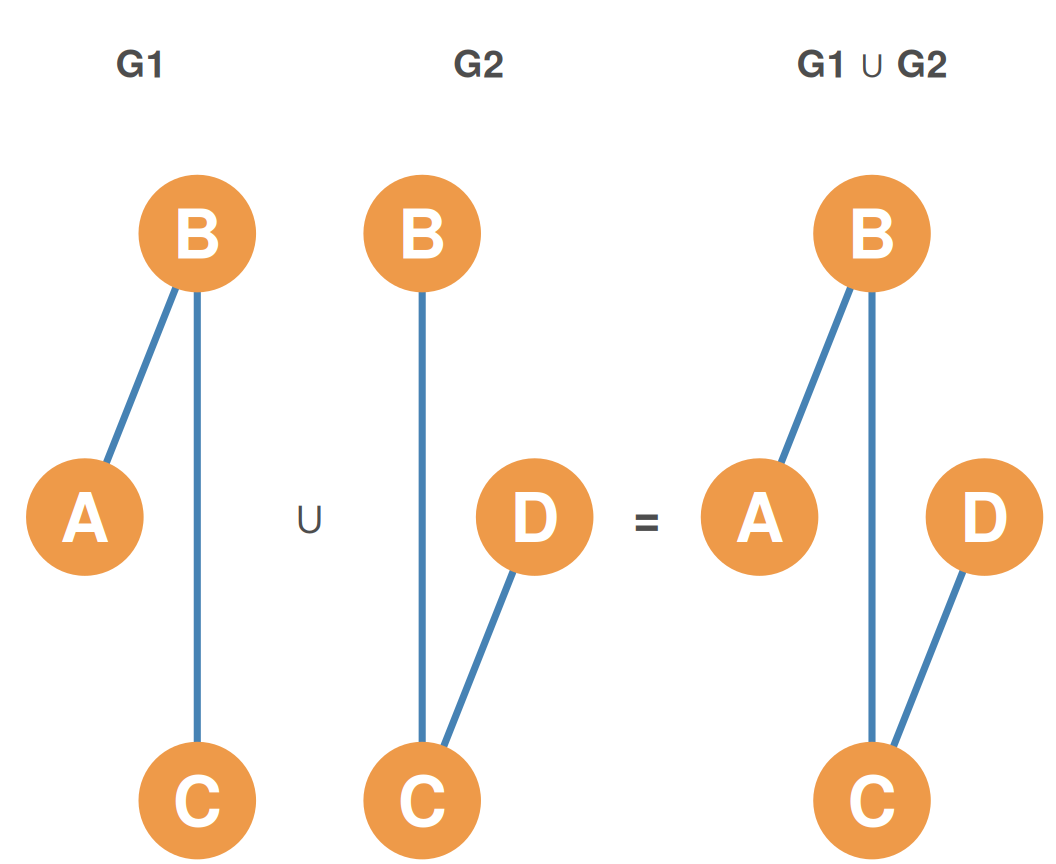
Set Operations on Graphs: Union
- Because graphs are defined as sets, we can perform standard set operations on them.
- Union (\(\cup\)): Combine the vertices and edges of two graphs.
- \(V(G_1 \cup G_2) = V(G_1) \cup V(G_2)\)
- \(E(G_1 \cup G_2) = E(G_1) \cup E(G_2)\)
Set Operations on Graphs: Intersection
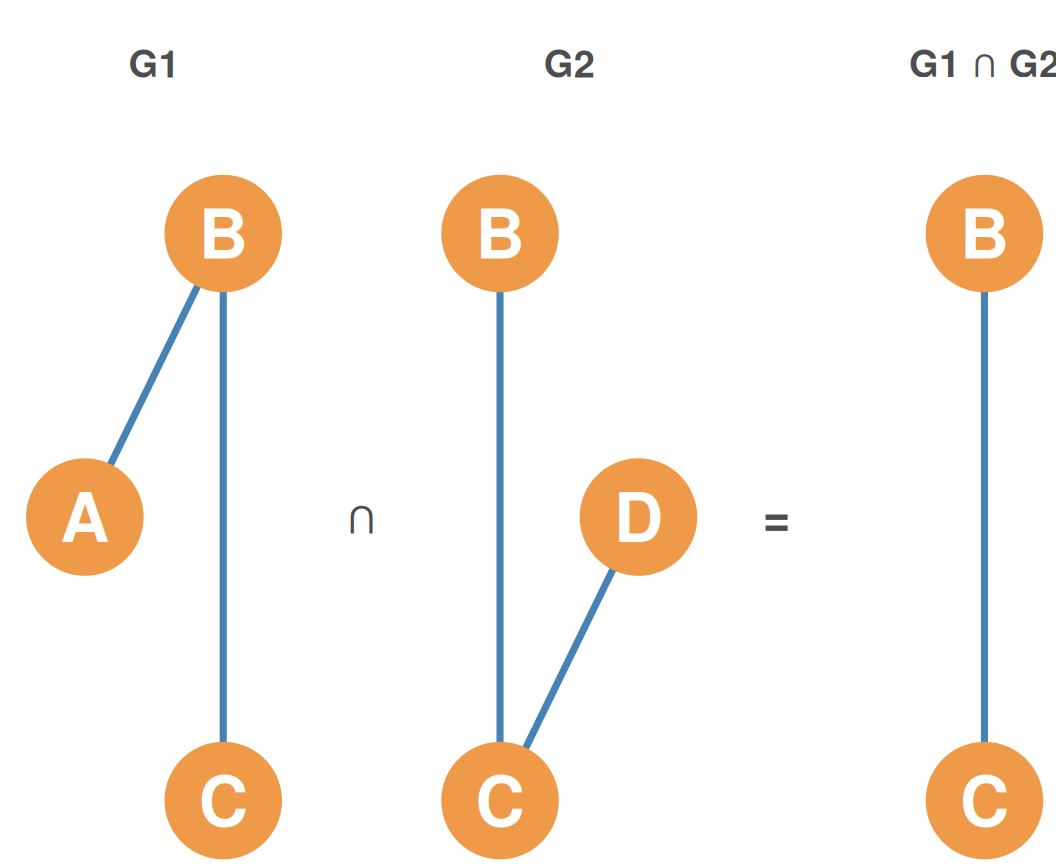
- Intersection (\(\cap\)): Keep only the vertices and edges present in both graphs.
- \(V(G_1 \cap G_2) = V(G_1) \cap V(G_2)\)
- \(E(G_1 \cap G_2) = E(G_1) \cap E(G_2)\)