The Small World Phenomenon
Bridges, Hubs, and the Science of Shortcuts
The Graph Theory Basis: Clustering
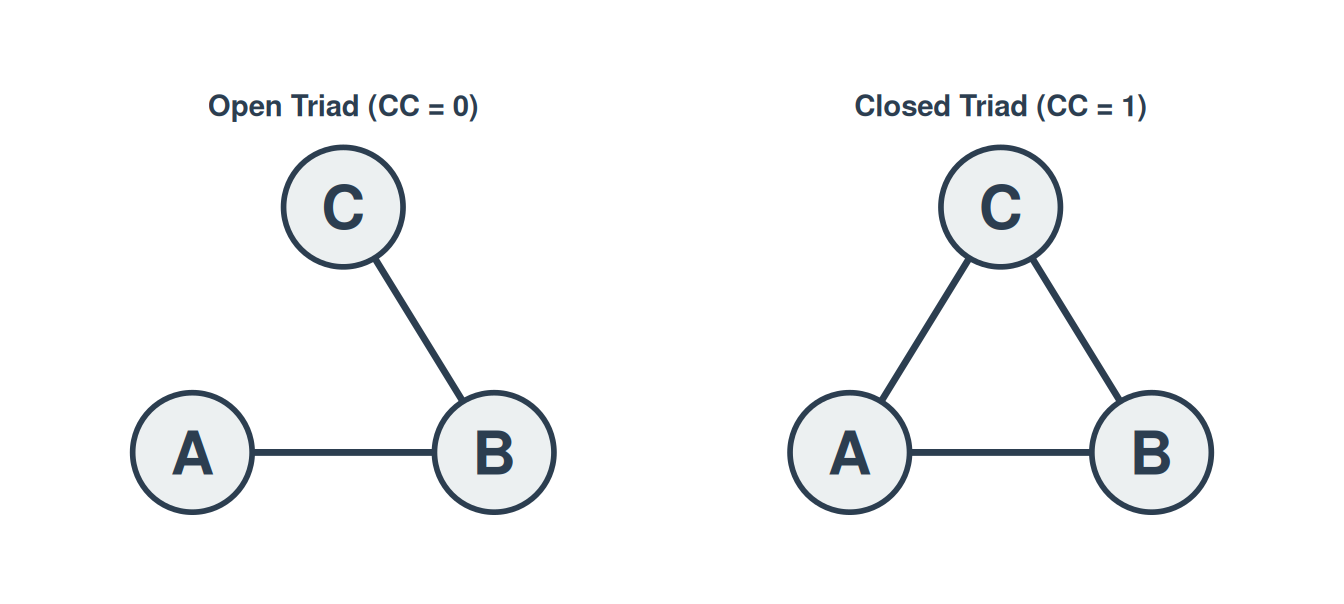
- Clustering Coefficient (\(CC_i\)): Measures the local density of an individual’s ego network (cliquishness).
- Quantifies the fraction of an ego’s contacts who are connected to each other: \[CC_i = \frac{m}{n(n-1)/2}\]
- Where \(n\) is the number of neighbors, and \(m\) is the actual number of links among them.
![]()
The Graph Theory Basis: Paths
- Connections across a network are measured via shortest paths (also called geodesics).
- Path Length: The number of edges contained in a path.
- Average Path Length: The mean geodesic distance between all pairs of nodes in a network: \[\langle L \rangle = \frac{1}{N(N-1)} \sum_{i \neq j} d(i,j)\]
- In a “Small World” network, \(\langle L \rangle\) is surprisingly small, typically scaling logarithmically with network size: \[\langle L \rangle \approx \ln(N)\]
Milgram’s Pioneer Experiment (1967)
- Stanley Milgram’s seminal letter-forwarding study in Nebraska and Boston.
- Tasked starting participants with sending a folder to a target Boston stockbroker using only chains of personal acquaintances.
- The Core Findings:
- Six degrees of separation: Completed chains took an average of 5.2 intermediaries (about six steps).
- Choice of contacts was dominated by homophily (forwarding to acquaintances of similar age, gender, and socioeconomic status).
- Proved that short paths exist empirically in massive, decentralized human societies.
Digital Replication: Dodds-Muhamad-Watts (2003)
- Replicated Milgram’s experiment for the digital era using email (98,847 participants, 166 countries, 18 targets).
- Key Discoveries:
- Confirmed the “six degrees” thesis with a median reconstructed path length of 5 to 7 steps.
- Social Foci (shared school, occupation, or work settings) acted as the critical “gateways” for successful chains.
- Professional ties (rather than close kin or friends) were highly effective “bridges” for linking distant segments of the network.
Computational Models: Watts-Strogatz (1998)
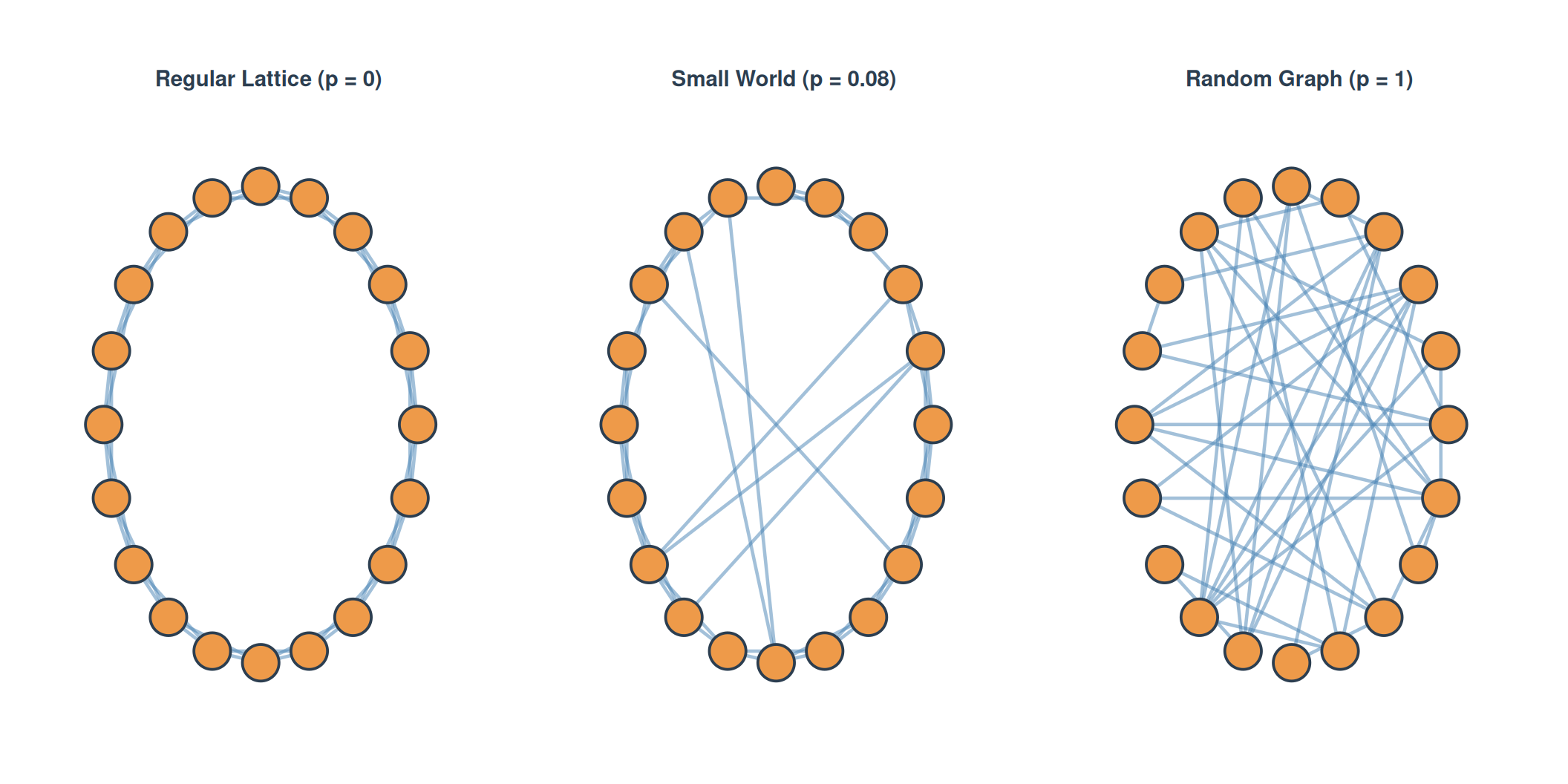
- Duncan Watts and Steven Strogatz modeled the transition from a highly clustered circle lattice to a random network.
- By introducing a small probability (\(p\)) of random rewiring:
- Regular Lattice (\(p=0\)): High clustering, but long path lengths (very localized).
- Random Graph (\(p=1\)): Low clustering, but very short path lengths.
- Small-World Region (\(p \in (0.01, 0.1)\)): High clustering is preserved, but path length drops precipitously!
- A tiny fraction of shortcuts (bridging ties) connects distant clusters, creating massive shortcuts.
Visualizing the Watts-Strogatz Transition
- As \(p\) increases, random shortcuts link opposite sides of the circle, slashing average path length while maintaining dense local neighborhoods.
![]()
Scale-Free Shortcuts: The Barabási-Albert Model (1999)
- Preferential Attachment: A growth model where new nodes are more likely to connect to highly connected nodes (“the rich get richer”).
- Results in a power-law degree distribution featuring massive hubs.
- These high-degree hubs act as natural super-shortcuts, connecting peripheral nodes and keeping the network’s diameter low.
- Trade-off: Unlike real social networks, BA networks have very low local clustering.
Navigating the Small World: Searchability
- How do individuals find targets without seeing the whole graph?
- Watts, Dodds, and Newman (2002) modeled searchability:
- Human social networks are organized into nested, multi-dimensional communities (geography, occupation, interests).
- We use a social distance heuristic to navigate, passing the message to the contact closest to the target in social dimensions (leveraging homophily).
- Alternatively, we employ a hub strategy, routing messages through highly connected, high-status actors.
Summary of the Small World Phenomenon
- Socio-Structural Principle: Real human networks are local and global—dense clusters connected by rare but powerful bridges.
- Empirical Proof: From Milgram’s letters to modern email cascades, we are linked by approximately six degrees of separation.
- Generative Models:
- Watts-Strogatz: Random rewiring (\(p \approx 0.05\)) creates shortcuts.
- Barabási-Albert: Preferential attachment creates shortcutting hubs.
- Cognitive Navigation: Search succeeds because we exploit nested social communities and use social distance heuristics.