Ties, Dyads, and Triads

The Motifs of Social Network Analysis

Today’s Roadmap

  • Today’s guiding principle: the type of tie strictly controls which micro-structures are possible.
  • Part 1 — The Taxonomy of Ties: how sociologists classify ties (similarities, social relations, interactions, flows), and how graph theory classifies them by directionality (symmetric, asymmetric, anti-symmetric).
  • Part 2 — Dyads and Their Realizations: the possible configurations of a pair of nodes under each tie type.
  • Part 3 — Triads and Motifs: scaling from pairs to triples — the triad census that underlies balance, brokerage, and hierarchy.
  • Keep one question in mind throughout: what does this tie type allow two (or three) people to do?

Part 1: The Taxonomy of Ties

The Relational Basis of Networks

  • In social network analysis, a graph represents concrete relationships (ties) between actors.
  • Not all relationships are created equal!
    • Some ties are naturally mutual (e.g., being siblings).
    • Others are directional (e.g., seeking advice).
    • Some strictly forbid mutuality (e.g., being a supervisor).
  • To study networks, we must separate the mathematical property of the relationship (the tie type) from its empirical realization (the dyad or triad).

The Sociological Classification of Types of Ties

  • Instead of treating all connections identically, sociologists classify social ties into four major types (Borgatti et al. 2009):
    1. Similarities: Having something in common (e.g., co-location, shared attributes).
    2. Social Relations: Culturally recognized labels or sentiments (e.g., friend, spouse, boss).
    3. Interactions: Regular communication or behavior (e.g., texting, talking).
    4. Flows: Transmission of resources or states (e.g., virus infection, lending money).

States vs. Events in Social Networks

  • We can divide these four types of ties into two fundamental clusters:
  • States (Static Situations):
    • Similarities & Social Relations.
    • Represent continuous, long-standing conditions.
    • Examples: Being in the same class, being siblings, being coworker/boss.
  • Events (Discrete Activities):
    • Interactions & Flows.
    • Occur at specific points in time and are transient.
    • Examples: Texting someone, lending money, transmitting a virus.

Graph-Theoretic Classification of Ties

  • While sociologists classify ties by their substantive content (similarities, relations, interactions, flows)…
  • Mathematicians and graph theorists classify ties by their formal, directionality properties:
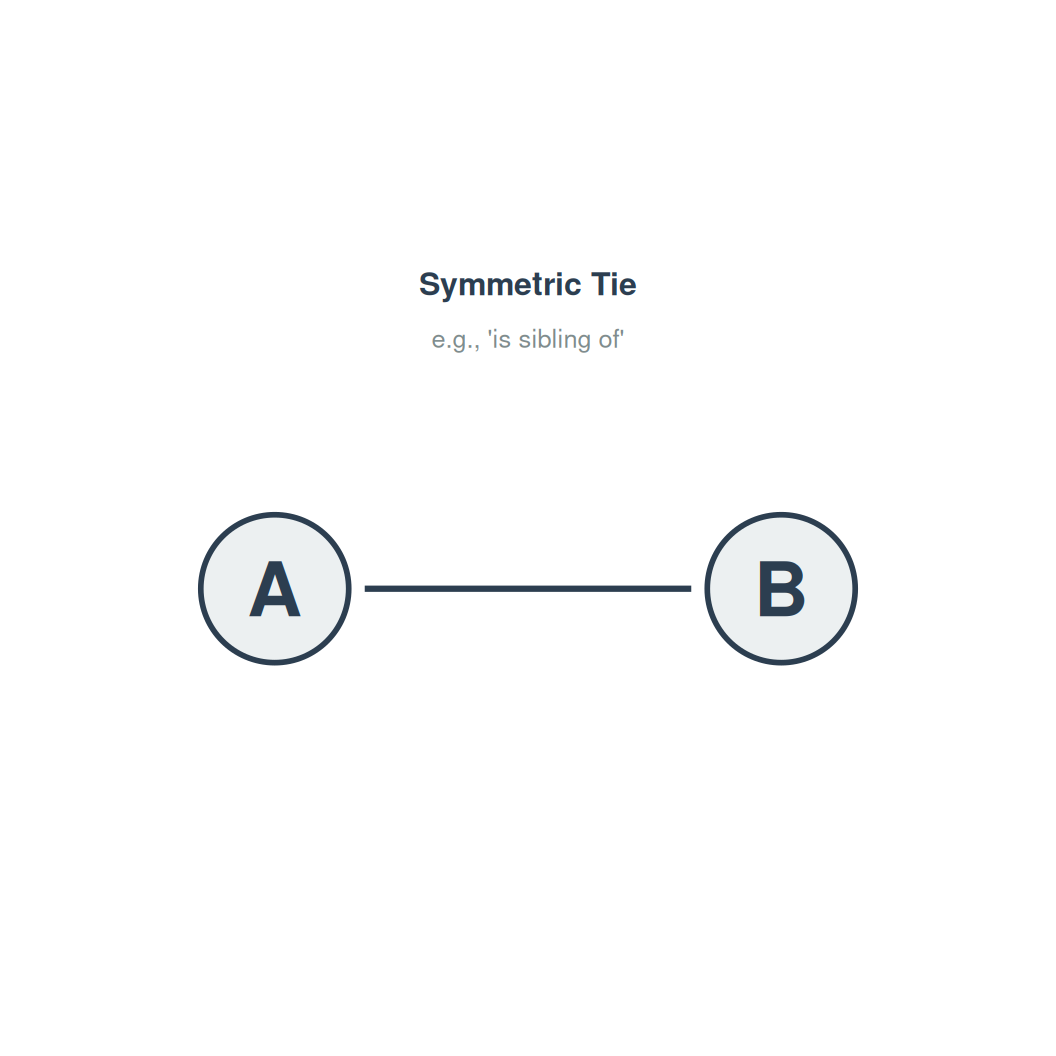
    • Symmetric Ties: Inherently mutual and undirected (\(AB \iff BA\)).
    • Asymmetric Ties: Directional, where reciprocity is optional (\(AB \implies\) optional \(BA\)).
    • Anti-Symmetric Ties: Directional, where reciprocity is forbidden (\(AB \implies \neg BA\)).
  • The bridge: To represent a network, we must map our sociological tie types (e.g. boss-of, friend-of) onto these three graph-theoretic classes!

1. Symmetric Ties & Similarities

  • Definition: A relation where connection is built-in and mutual by construction:
    • Formally: \(AB \iff BA\)
  • Representation: Represented by undirected graphs.
  • Structural Constraint: Pairs of actors can only be disconnected or connected by a single undirected edge.
  • Symmetric Similarities:
    • Similarities are necessarily symmetric:
      • If you are in the same place at the same time as someone, they are there with you.
      • If you are zooming with someone, they are zooming with you.
      • If you go to UCLA with someone, they also go to UCLA with you.

2. Asymmetric Ties & Interactions

  • Definition: A relation with natural directionality where reciprocity is possible but not guaranteed:
    • Formally: \(AB \implies\) nothing about \(BA\)
  • Representation: Represented by directed graphs (digraphs).
  • Structural Constraint: Reciprocity is an empirical event (it may or may not occur), yielding three possible dyad configurations.
  • Asymmetric Relations:
    • Note: Asymmetric relations can be states (liking) or events (texting) — both naturally asymmetric:
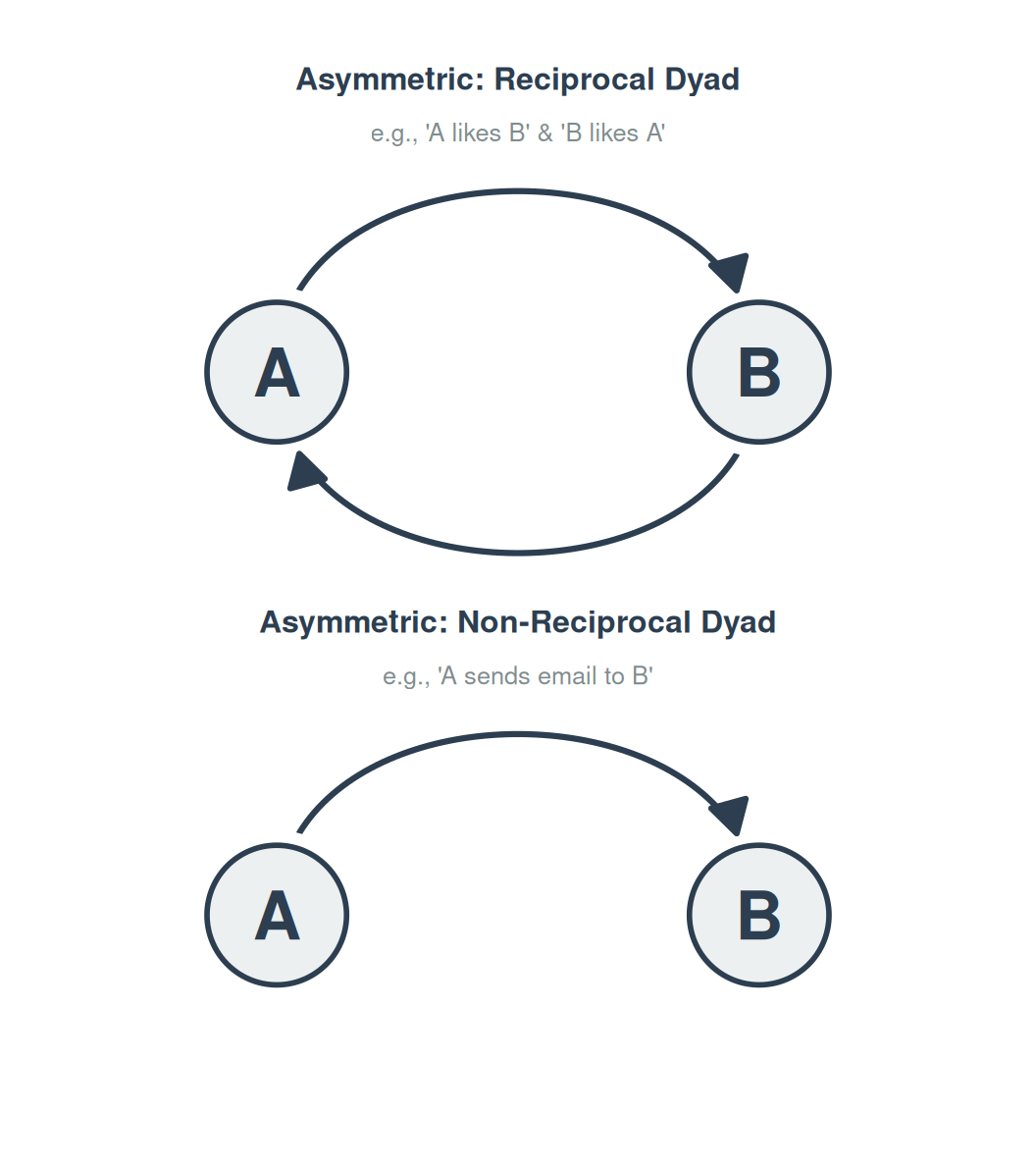
      • You can follow someone on Twitter, but they don’t have to follow you back.
      • You can send a text to someone, but they don’t have to respond.

3. Anti-Symmetric Ties & Hierarchies

  • Definition: An inherently directional relation where reciprocity is strictly forbidden:
    • Formally: \(AB \implies \neg BA\)
  • Representation: Represented by directed graphs (oriented graphs, DAGs, or trees).
  • Structural Constraint: Reciprocity is structurally impossible, yielding only two possible dyad configurations.
  • Anti-Symmetric Hierarchies:
    • Hierarchical role relations are anti-symmetric:
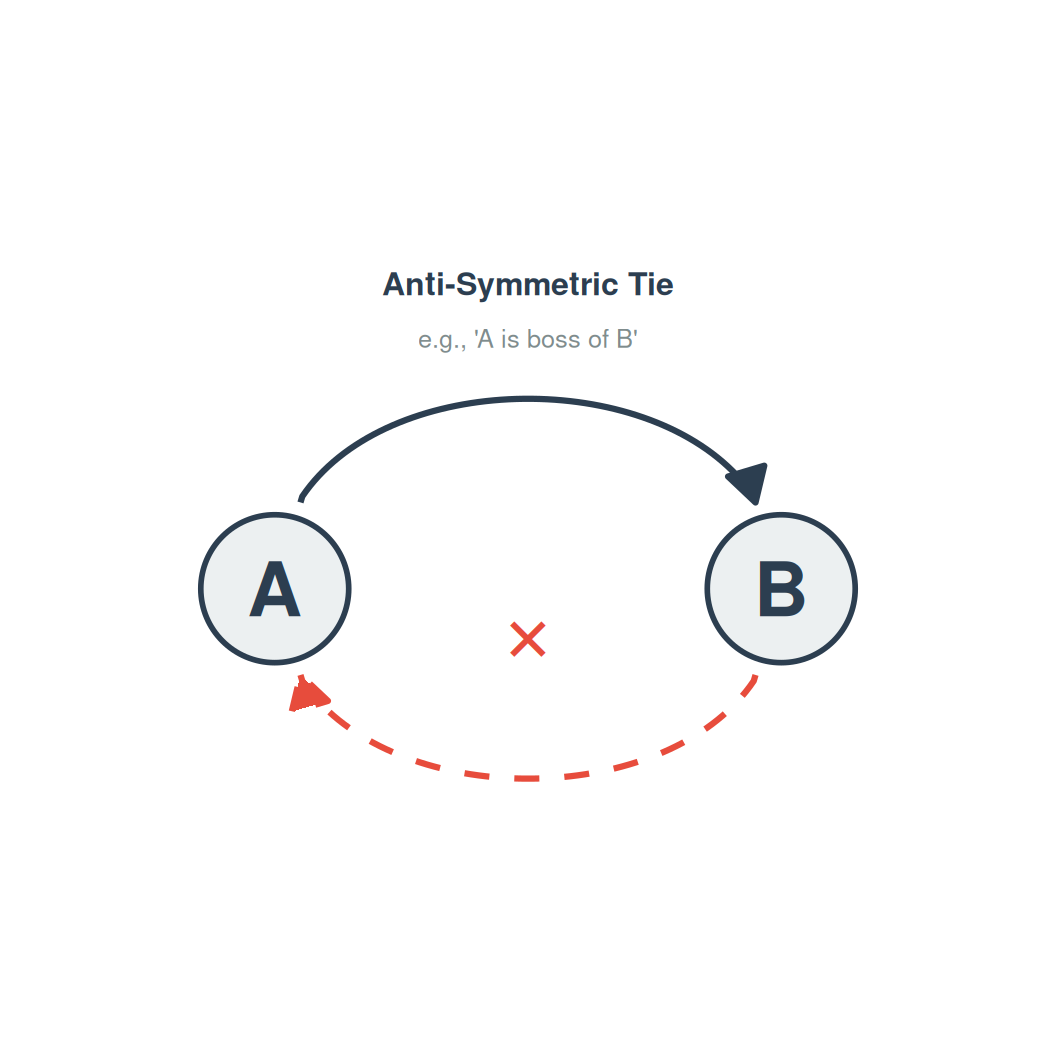
      • Kinship: If you are someone’s parent, they cannot be your parent.
      • Formal: If you are someone’s boss, they cannot be your boss at the same time.

Mapping Sociological to Graph-Theoretic Classifications

Sociological Classification (Types of Ties) Graph-Theoretic Classification (Mathematical Properties) Allowed Dyads Visual Graph Representation
Co-membership, Propinquity Symmetric • Disconnected
• Connected
Undirected Graph (\(A - B\))
Sentiments, Advice-seeking Asymmetric • Disconnected
• Non-reciprocal
• Reciprocal
Directed Graph (\(A \rightarrow B\) or \(A \leftrightarrow B\))
Formal Hierarchies, Kinship Anti-symmetric • Disconnected
• Non-reciprocal
Oriented Graph/Tree (\(A \rightarrow B\), no cycles)

Multiplexity in Social Relations

  • In real-world social networks, actors are rarely linked by only one relationship.
  • Multiplexity refers to the presence of multiple, distinct types of ties linking the same pair of nodes simultaneously.
    • e.g., \(A\) and \(B\) are coworkers (symmetric tie) AND \(A\) is the supervisor of \(B\) (anti-symmetric tie) AND they are friends (asymmetric tie).
  • Multiplexity adds rich, multi-layered complexity to networks, as the behavior or pattern in one relation heavily influences and moderates others.

Multiplexity: A Visual Example

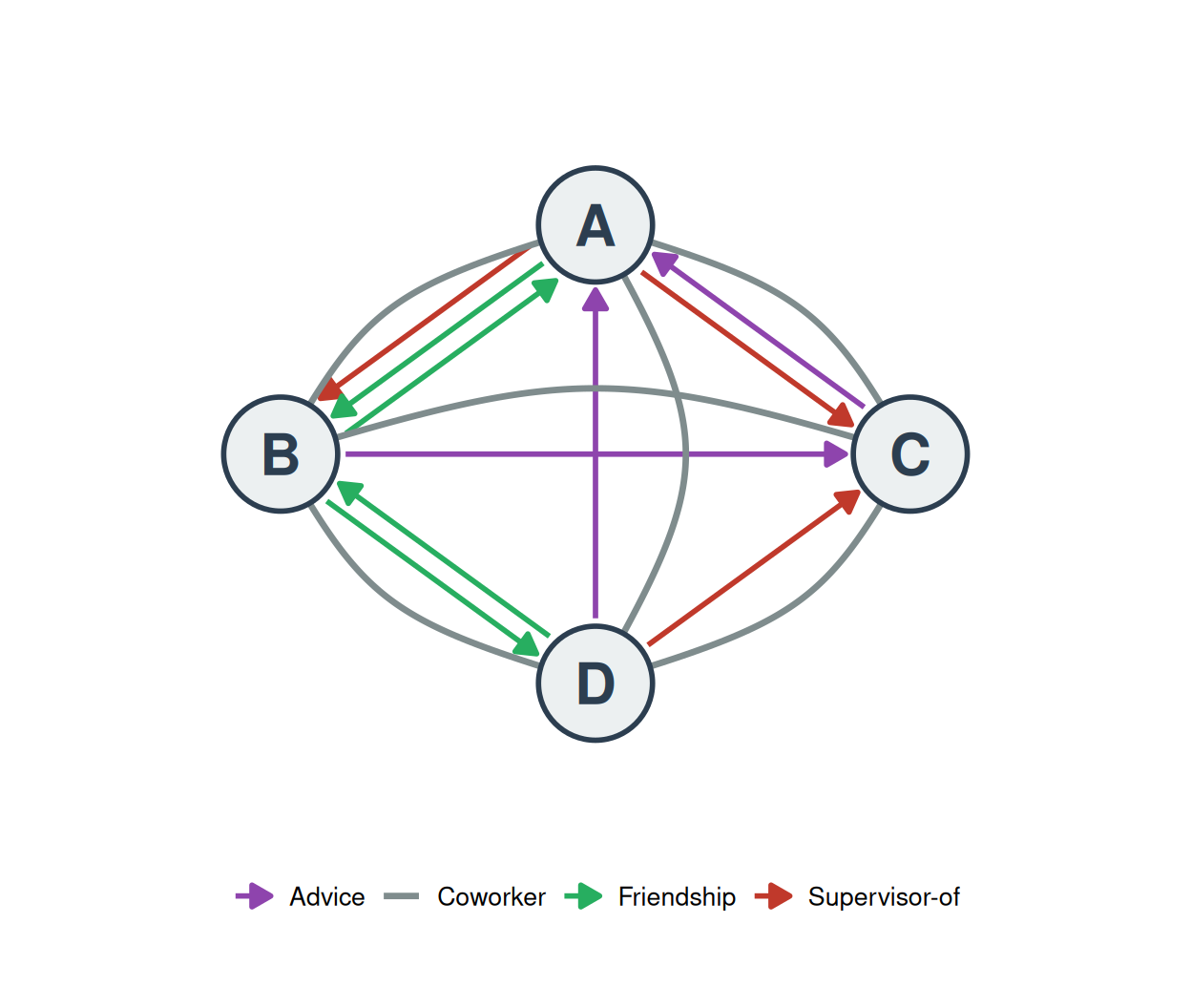
  • Four nodes (diamond layout) connected by four distinct relationship layers:
    • Symmetric Coworker: links every pair of nodes — a fully connected baseline.
    • Anti-Symmetric Supervisor-of
    • Asymmetric Advice-Seeking
    • Asymmetric/Mutual Friendship
  • The friendship, advice, and supervisor layers are multiplex on top of this fully connected coworker baseline (e.g., supervisors who are also friends).
The Growth of Social Networks: The Marriage Cascade

  • Social networks are highly dynamic, growing and evolving over time.
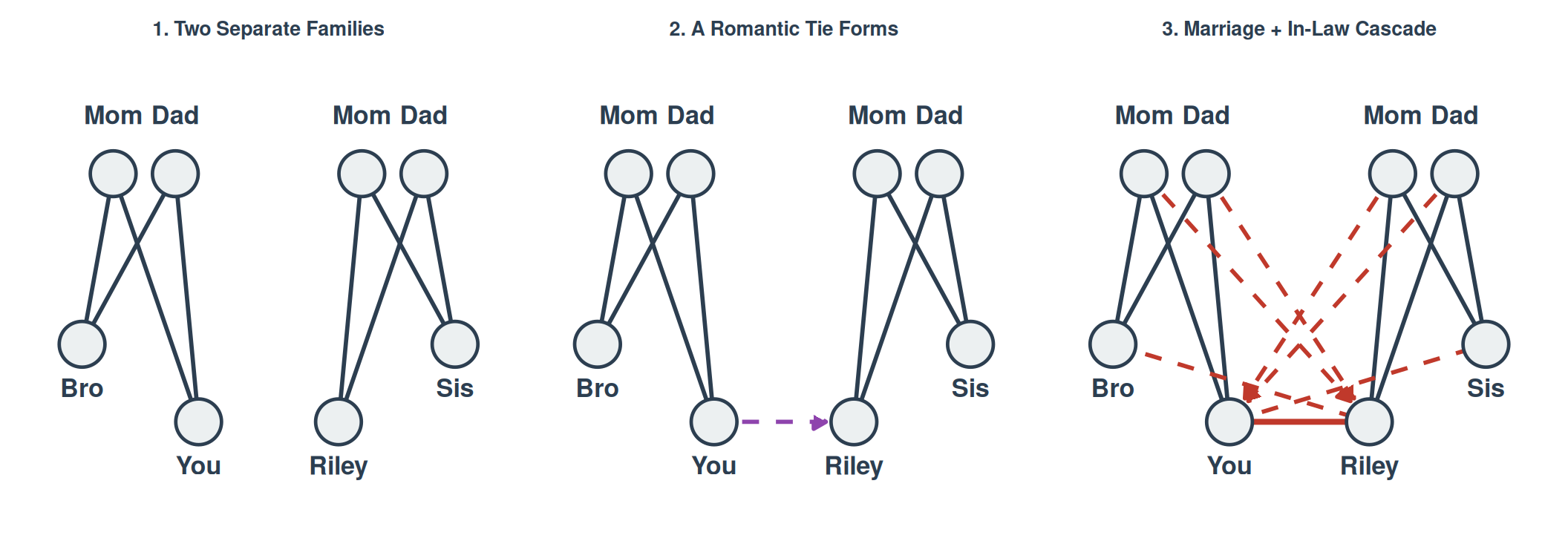
  • A classic example of network growth is the marriage cascade:
    1. A romantic tie (asymmetric) forms between two people from separate families: You \(\rightarrow\) Riley.
    2. It solidifies into marriage (a symmetric kin tie): You \(\leftrightarrow\) Riley.
    3. The marriage triggers a cascade of new in-law ties:
      • Symmetric sibling-in-law ties: You \(\leftrightarrow\) Sis and Bro \(\leftrightarrow\) Riley.
      • Anti-symmetric parent-in-law ties: your parents \(\rightarrow\) Riley, and Riley’s parents \(\rightarrow\) You.
    4. Two previously separate kinship trees merge into a single multiplex network.

The Marriage Cascade: A Visual Example
Part 2: Dyads and Their Realizations

What is a Dyad?

  • A dyad is any pair of nodes in a graph, whether they are joined by an edge or not.
  • Mathematically, a dyad is any subgraph of order two (\(n = 2\)).
  • Crucially, a dyad represents the realized configuration of ties between two nodes.
  • Sociological Insight: Ties that do not exist (disconnected dyads) are often just as socially meaningful as those that do!
  • Dyads: The Building Blocks:
    • The simplest possible subgraph of order two.
    • Can contain zero, one, or two directed edges depending on relational constraints.
Dyads under Symmetric Ties

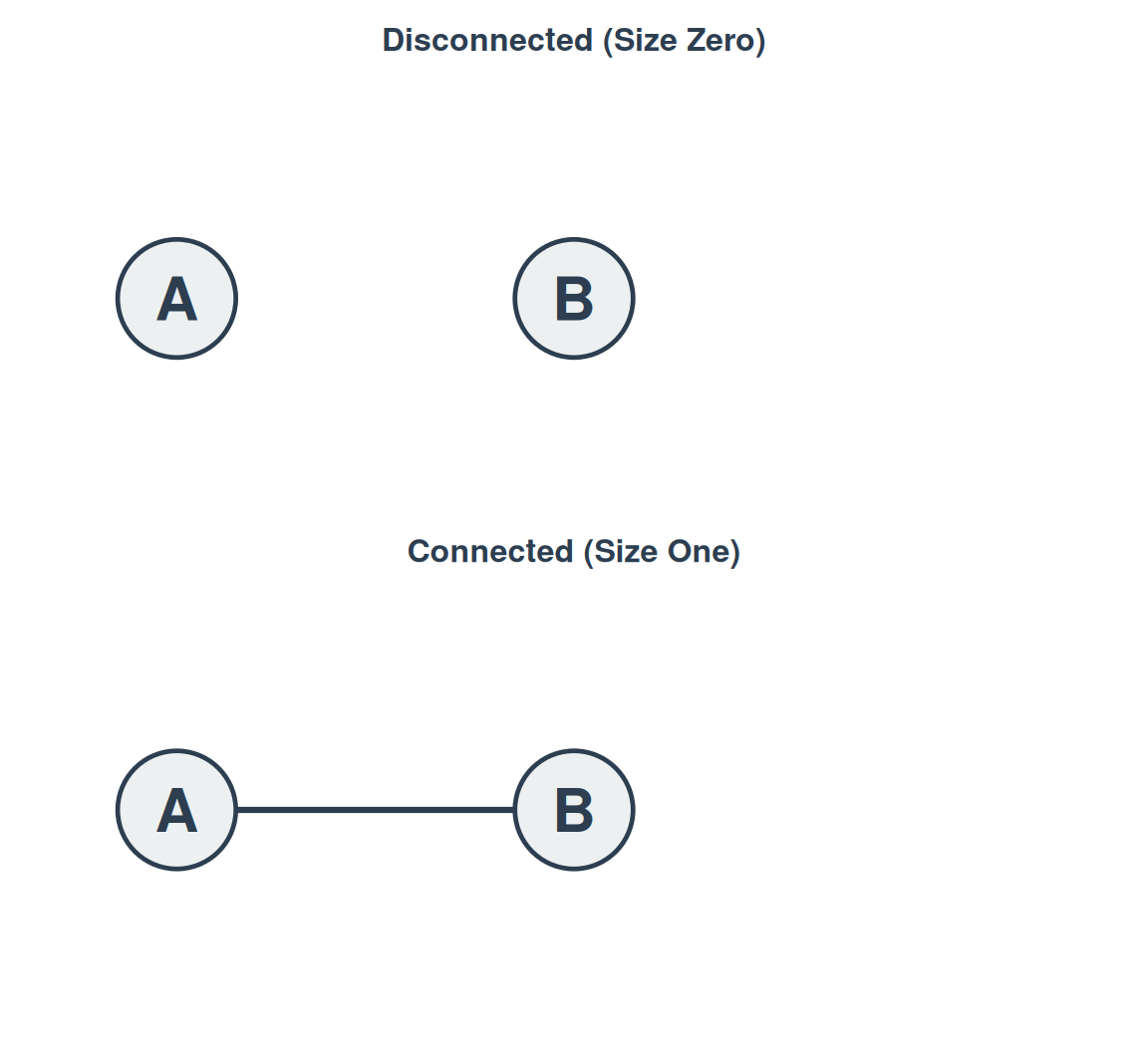
  • Because undirected graphs do not allow directionality, a symmetric relation can only take on two dyadic states:
    1. Disconnected Dyads (historically called null dyads): The two nodes do not share an edge (size zero).
    2. Connected Dyads: The two nodes share an edge (size one).
  • Every pair of actors in an undirected graph is either connected or disconnected.
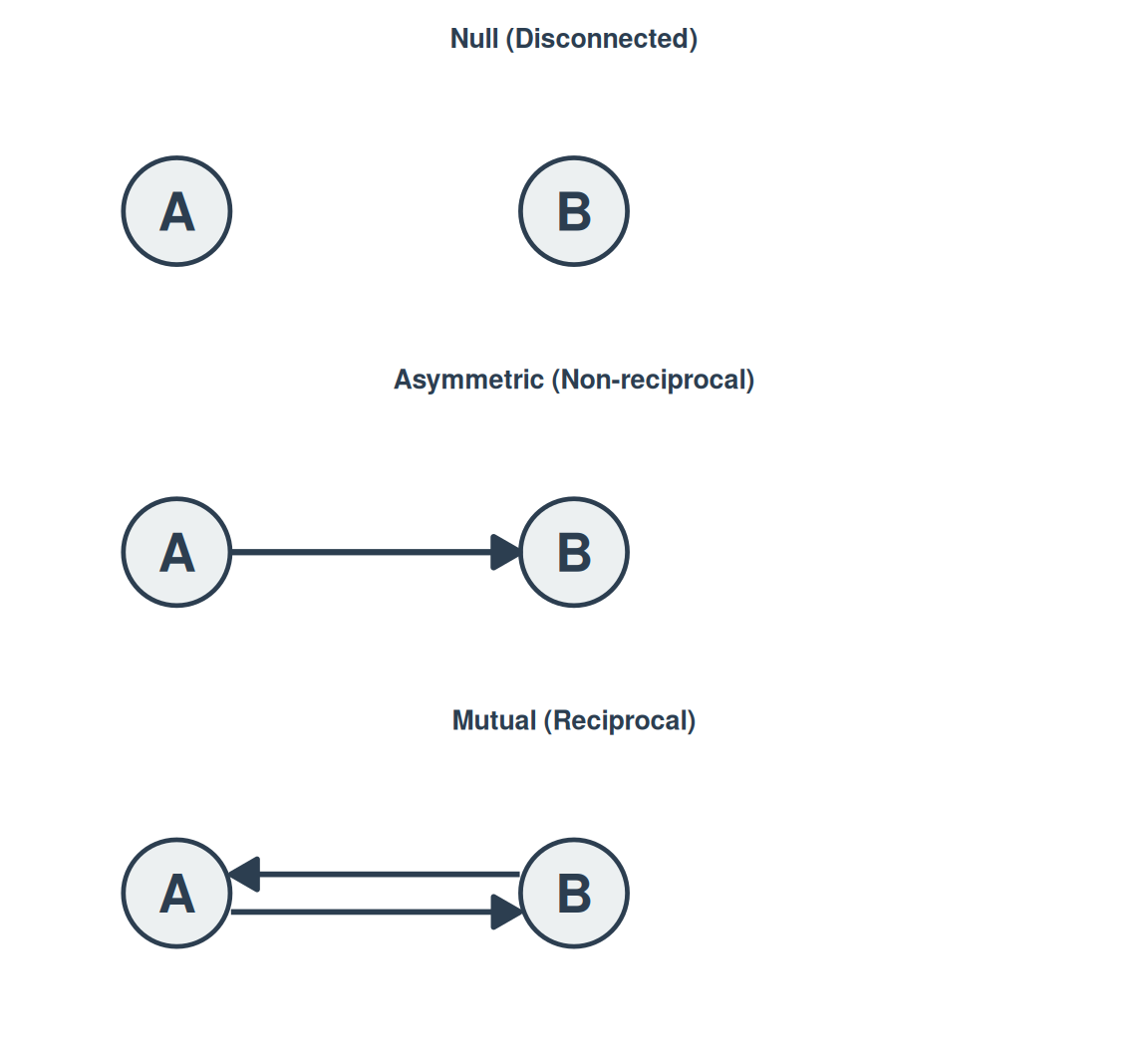
Dyads under Asymmetric Ties

  • In directed graphs, reciprocity is possible but optional.
  • Thus, asymmetric ties can yield three distinct kinds of dyads (the classic MAN classification):
    1. Disconnected Dyads (Null): Neither node sends a directed tie to the other (size zero).
    2. Non-Reciprocal Dyads (Asymmetric): One node sends a tie to another, but it is not reciprocated (size one).
    3. Reciprocal Dyads (Mutual): Both nodes send directed ties to each other (size two).
Dyads under Anti-Symmetric Ties

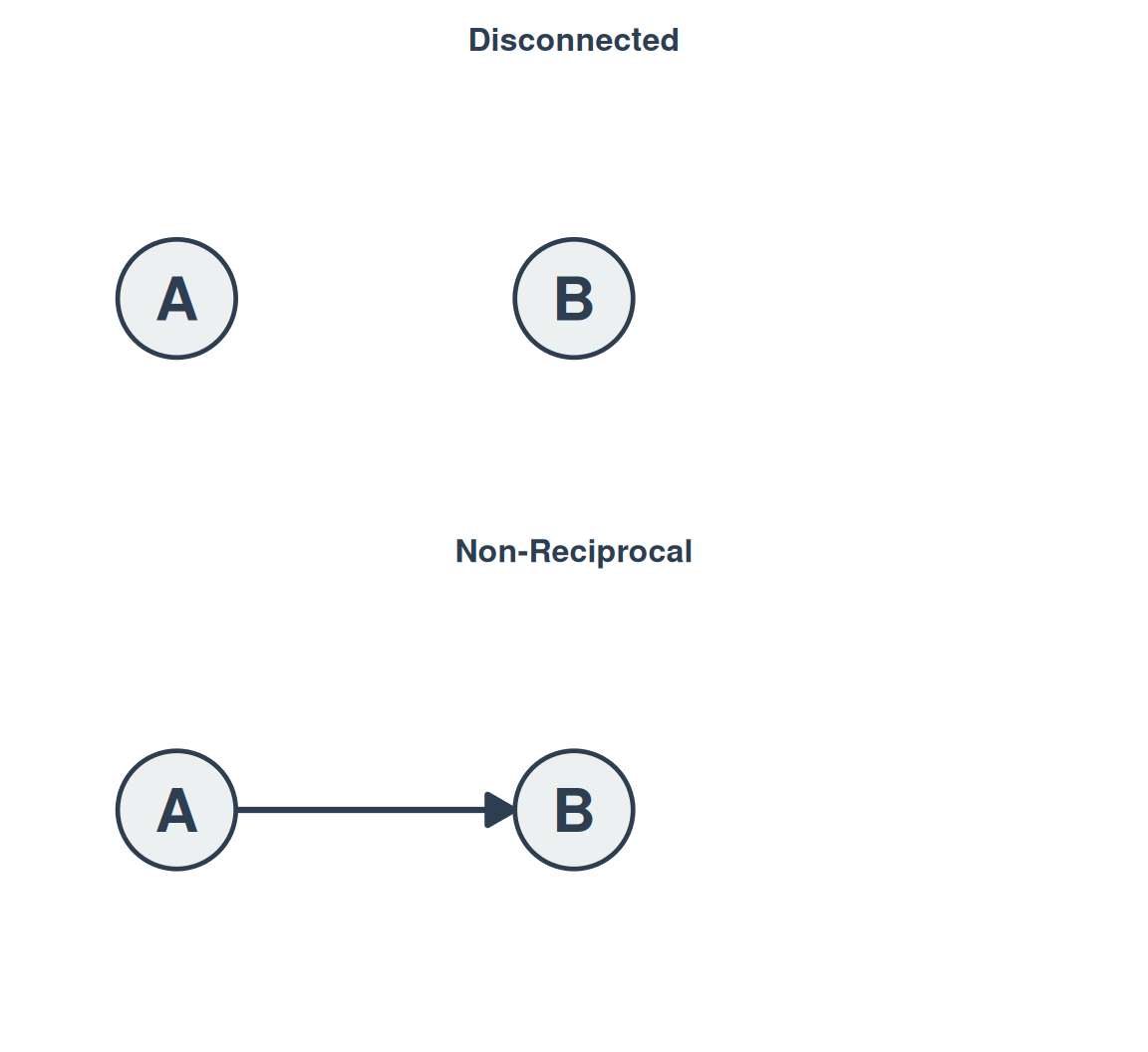
  • Because reciprocity is strictly forbidden under anti-symmetric ties, mutual (reciprocal) dyads cannot occur.
  • Therefore, anti-symmetric ties can only yield two types of dyads:
    1. Disconnected Dyads: The two nodes do not share any directed edge.
    2. Non-Reciprocal Dyads: Only a single one-way directed tie exists between them (\(A \rightarrow B\)).
  • This simplifies the dyad census of hierarchical networks: every pair of nodes is either completely disconnected or connected by a strictly non-reciprocal arrow.
Separating Tie Properties from Dyad Realizations

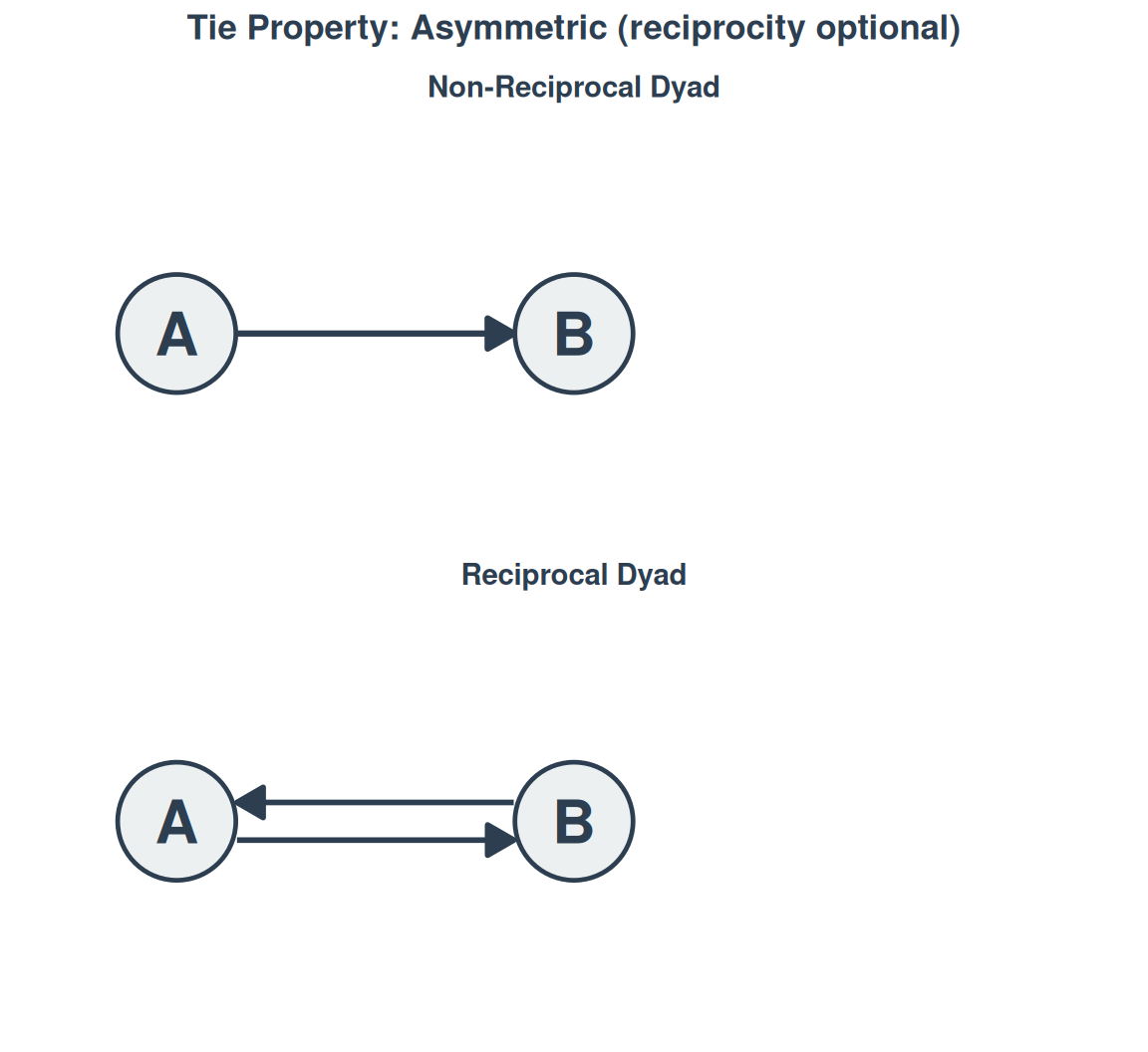
  • It is critical to keep the property of the tie separate from the property of the dyad:
    • Asymmetric Tie: Describes the type of relation (directionality is allowed; reciprocity is optional).
    • Non-Reciprocal Dyad: Describes a realized configuration of a pair of nodes where reciprocity failed to occur empirically.
    • Reciprocal Dyad: Describes an empirical configuration composed of a pair of directed edges under an asymmetric relation.
  • Confusing “asymmetric tie” with “asymmetric dyad” is a common conceptual error!
  • With the dyad census complete for all three tie types, we are ready to scale up from pairs to triads.
Part 3: Triads and Motifs

What is a Triad?

  • A triad is any set of three nodes, whether joined by edges or not.
  • Mathematically, a triad is any subgraph of order three (\(n = 3\)).
  • Triads have incredibly powerful sociological properties (e.g., structural balance, brokerage, coalitions).
  • A triad can be thought of as a concatenation of three dyads: \(\{A, B\}\), \(\{B, C\}\), and \(\{A, C\}\).
  • Just like dyads, the allowed configurations of a triad depend entirely on the relational properties of its ties.

Triads under Symmetric Ties

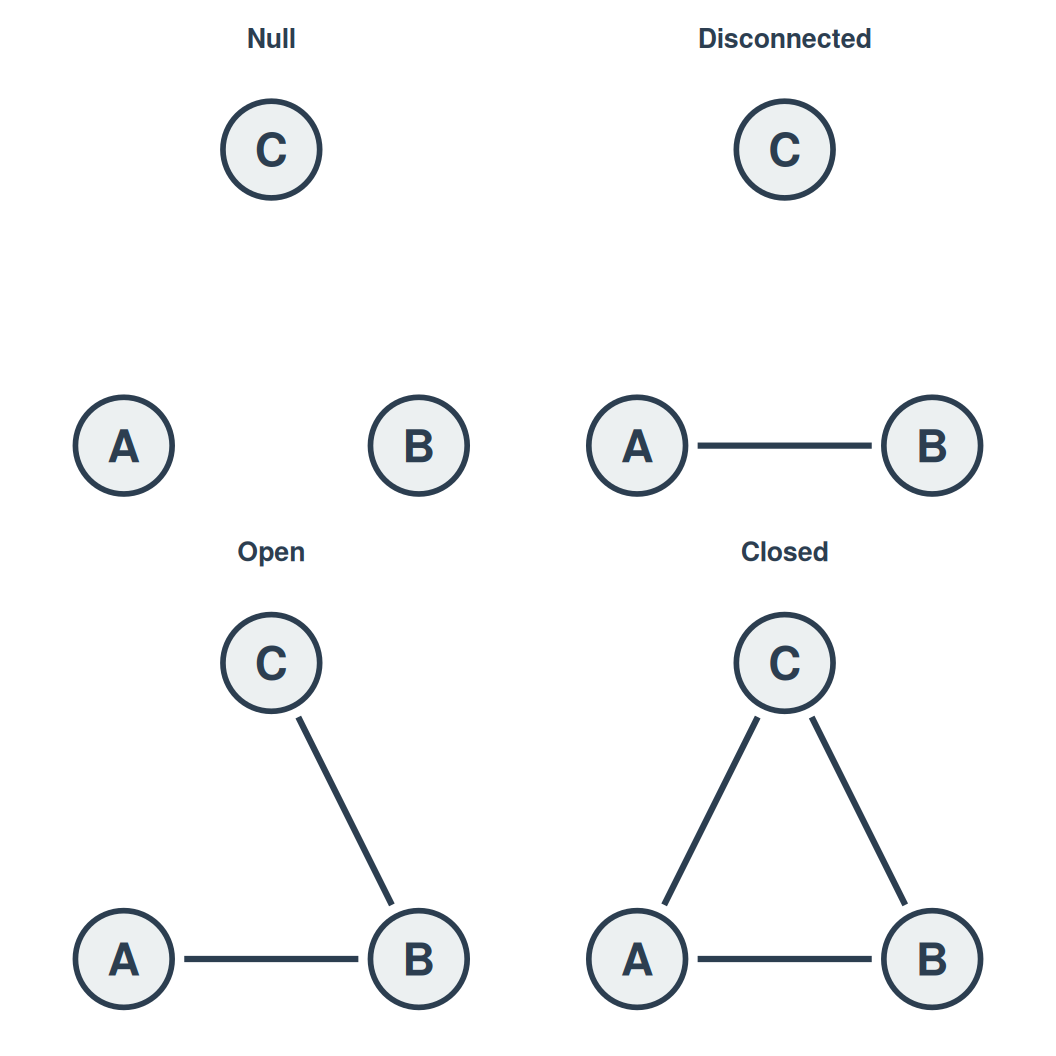
  • Since undirected dyads can only be connected or disconnected, there are only four possible undirected triad configurations:
    1. Null Triad: 0 connected dyads (\(DDD\)).
    2. Disconnected Triad: 1 connected dyad (\(CDD\)).
    3. Open Triad: 2 connected dyads (\(CCD\)).
    4. Closed Triad: 3 connected dyads (\(CCC\)).
  • These constitute the classic undirected subgraphs shown on the right.
The Four Undirected Triads
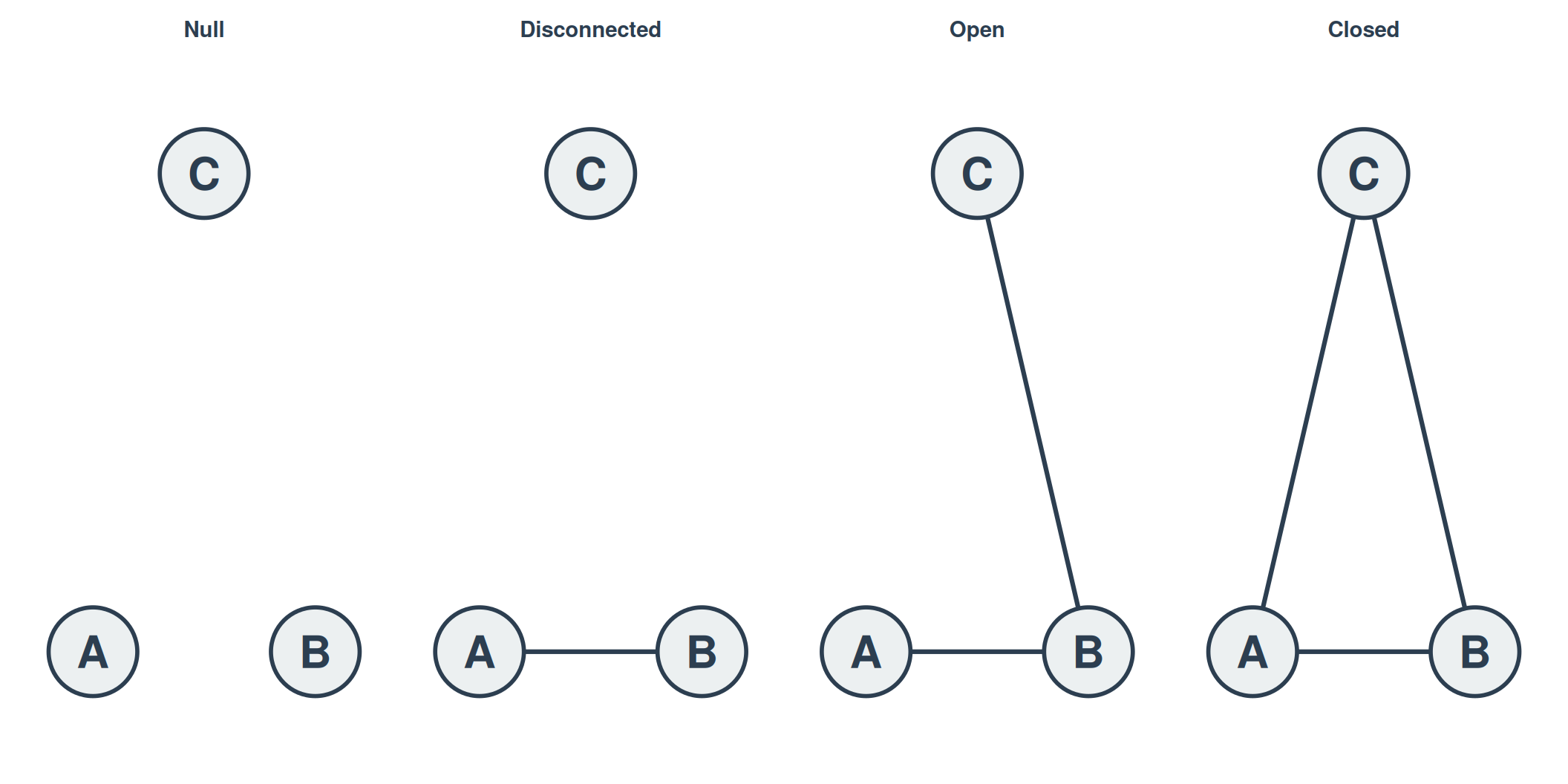
Figure 1: The four types of undirected triads.

The Holland & Leinhardt (MAN) Labeling System

  • Directed triads are classified using the standard Holland and Leinhardt (1970) system.
  • Labels are composed of three digits representing:
    • M: Number of Mutual (reciprocal) dyads.
    • A: Number of Asymmetric (non-reciprocal) dyads.
    • N: Number of Null (disconnected) dyads.
  • Since there are 3 node pairs, M + A + N = 3 always.
  • A trailing letter distinguishes triads sharing identical M-A-N counts — coming up on the next slide.

MAN Labels: The Trailing Letter (D, U, C, T)

  • The trailing letter distinguishes triads with identical M-A-N counts, based on how the asymmetric arrows are arranged:
    • D (Down): an out-star — one node sends both arrows (\(021D\)); with a mutual pair, the arrow points into it (\(111D\)).
    • U (Up): an in-star — one node receives both arrows (\(021U\)); with a mutual pair, the arrow points out of it (\(111U\)).
    • C (Cyclic): a directed chain (\(021C\)) or closed loop (\(030C\)).
    • T (Transitive): a transitive hierarchy \(A \rightarrow B \rightarrow C\) with the shortcut \(A \rightarrow C\) (\(030T\)).
  • The names come from Holland and Leinhardt’s canonical drawings — don’t read “up”/“down” literally.
  • These four letters label every directed triad configuration in the slides that follow.
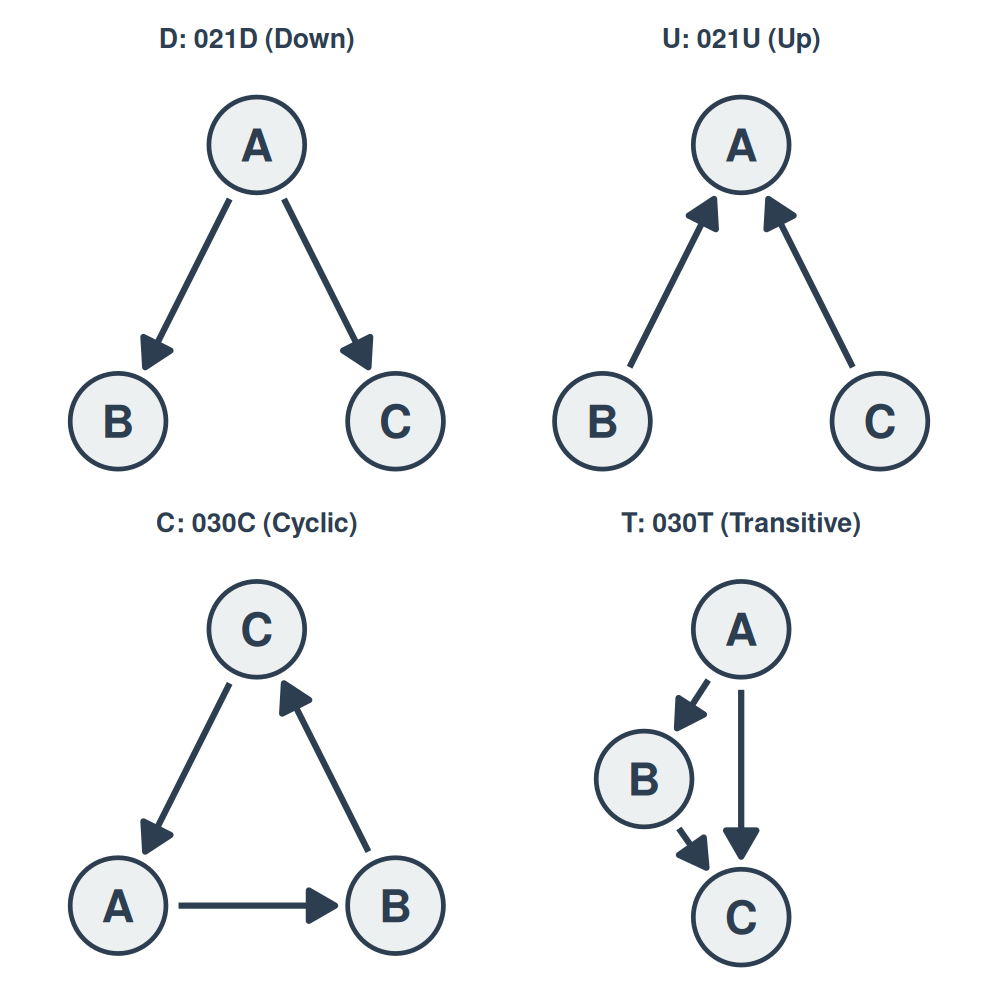
Triads under Anti-Symmetric Ties

  • Because reciprocity is strictly forbidden, any triad containing a mutual connection is impossible.
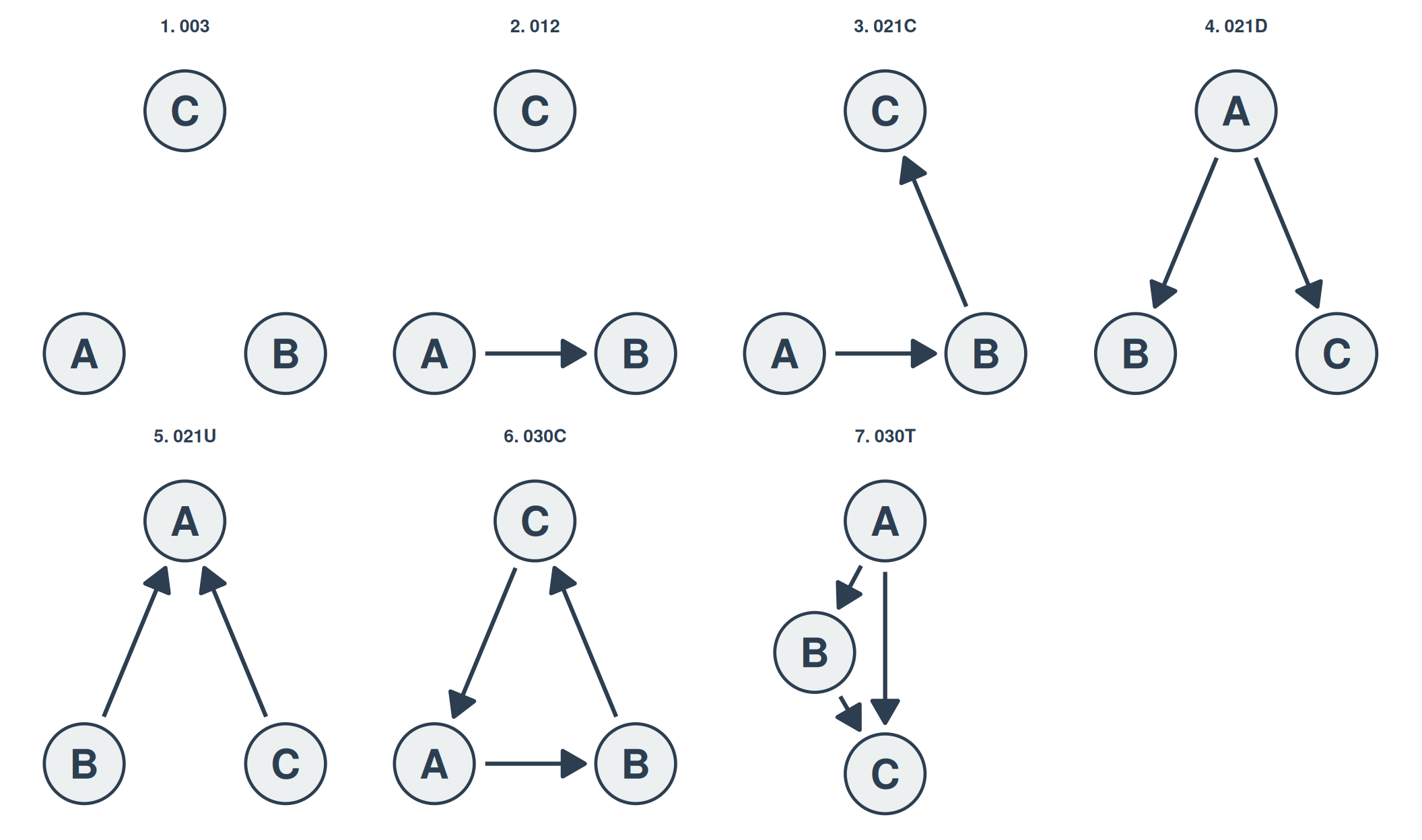
  • This prunes the directed triad census from 16 down to exactly seven allowed configurations:
    1. Null Triad (\(003\)): All three dyads are completely disconnected.
    2. One-tie Triad (\(012\)): Contains a single non-reciprocal directed tie.
    3. Directed Line (\(021C\)): Non-reciprocal ties form a directed path.
    4. Out-Star Triad (\(021D\)): A single node sends ties to both other nodes.
    5. In-Star Triad (\(021U\)): Both other nodes send ties to a single node.
    6. Cycle Triad (\(030C\)): A directed cycle of length three (\(A \rightarrow B \rightarrow C \rightarrow A\)).
    7. Transitive Hierarchy (\(030T\)): The classic transitive triad (\(A \rightarrow B \rightarrow C\) and \(A \rightarrow C\)).

Anti-Symmetric Triads

Figure 2

Anti-Symmetric Triads and Command Chains

  • This mathematical pruning simplifies the analysis of hierarchies.
  • In formal organization command structures:
    • We expect to see transitive triads (\(030T\)), representing clean, unified chains of command (e.g., “the boss of my boss is my boss”).
    • Cycles (\(030C\)) are structurally avoided because they generate circular authority paradoxes, where everyone takes orders from someone else in a loop.

Hierarchies: A Visual Example

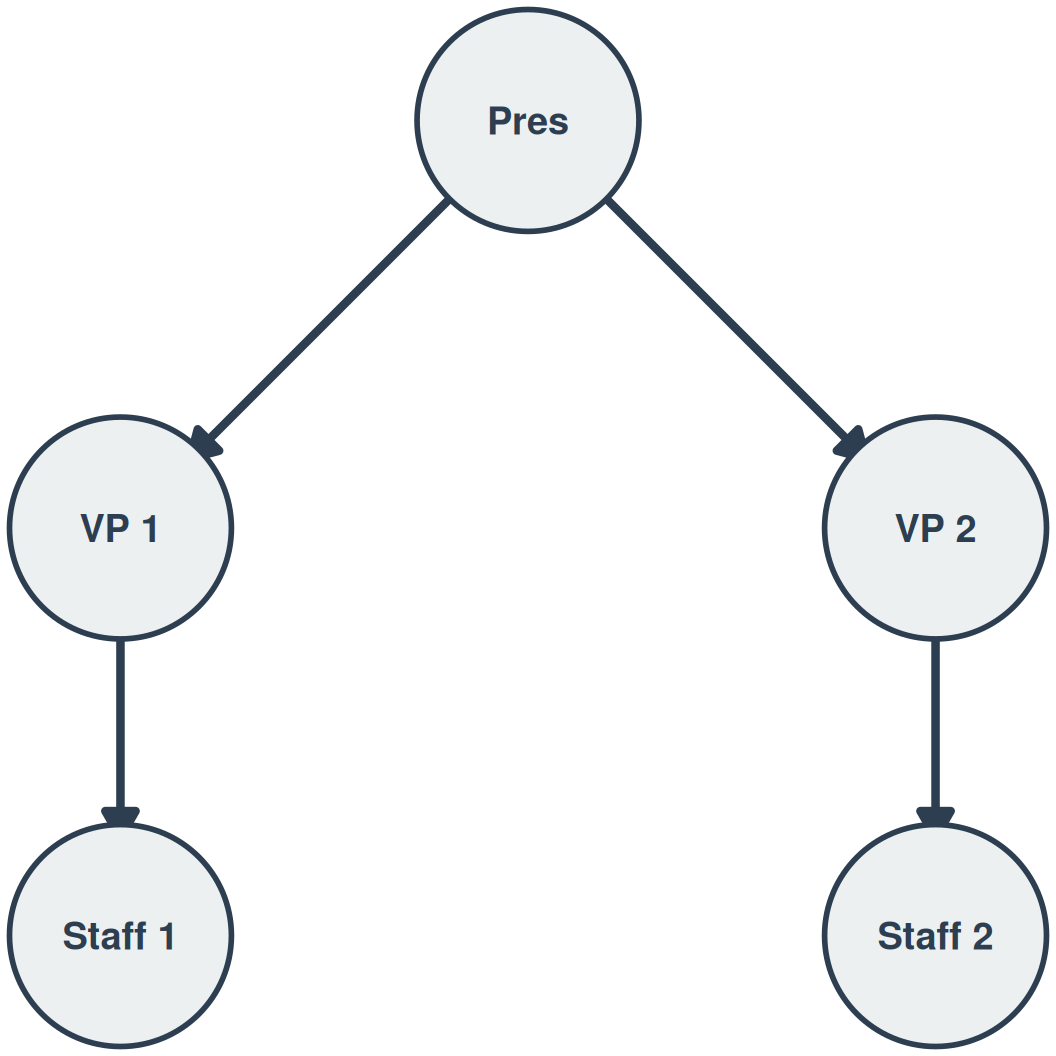
  • On the right is a formal organization hierarchy built strictly from anti-symmetric ties (supervisor of):
    • Every connection flows downward.
    • The graph is completely acyclic (no loops).
    • Every node (except the President root) has an indegree of exactly 1.
  • Removing the transitive and cyclic “noise” results in a clean directed tree.
Triads under Asymmetric Ties

  • When relations are asymmetric, reciprocity is allowed but optional.
  • Because each dyadic slot can take on any of the three MAN states, we can generate all sixteen directed triad configurations.
  • On the next slide, we show the nine directed configurations that require at least one reciprocal (mutual) dyad to exist:
    • Single Mutual: \(102\), \(111D\), \(111U\).
    • Double Mutual: \(201\).
    • Mutual-Mixed Closed: \(120C\), \(120D\), \(120U\).
    • Cohesive Closed: \(210\), \(300\).

Reciprocal Triads (Part 1: Single Mutual)
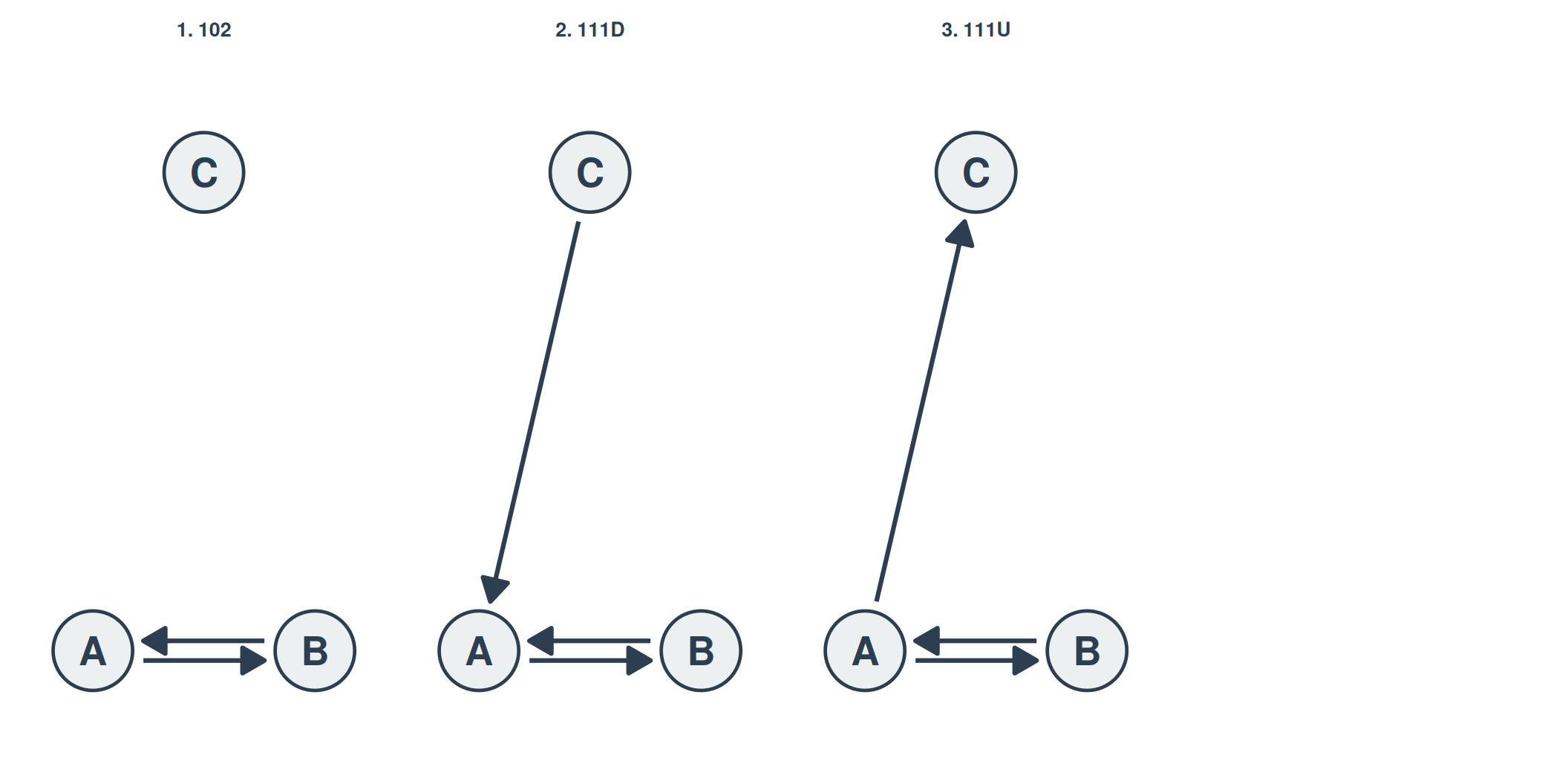
Figure 3

Reciprocal Triads (Part 2: Double Mutual & Mixed Closed)
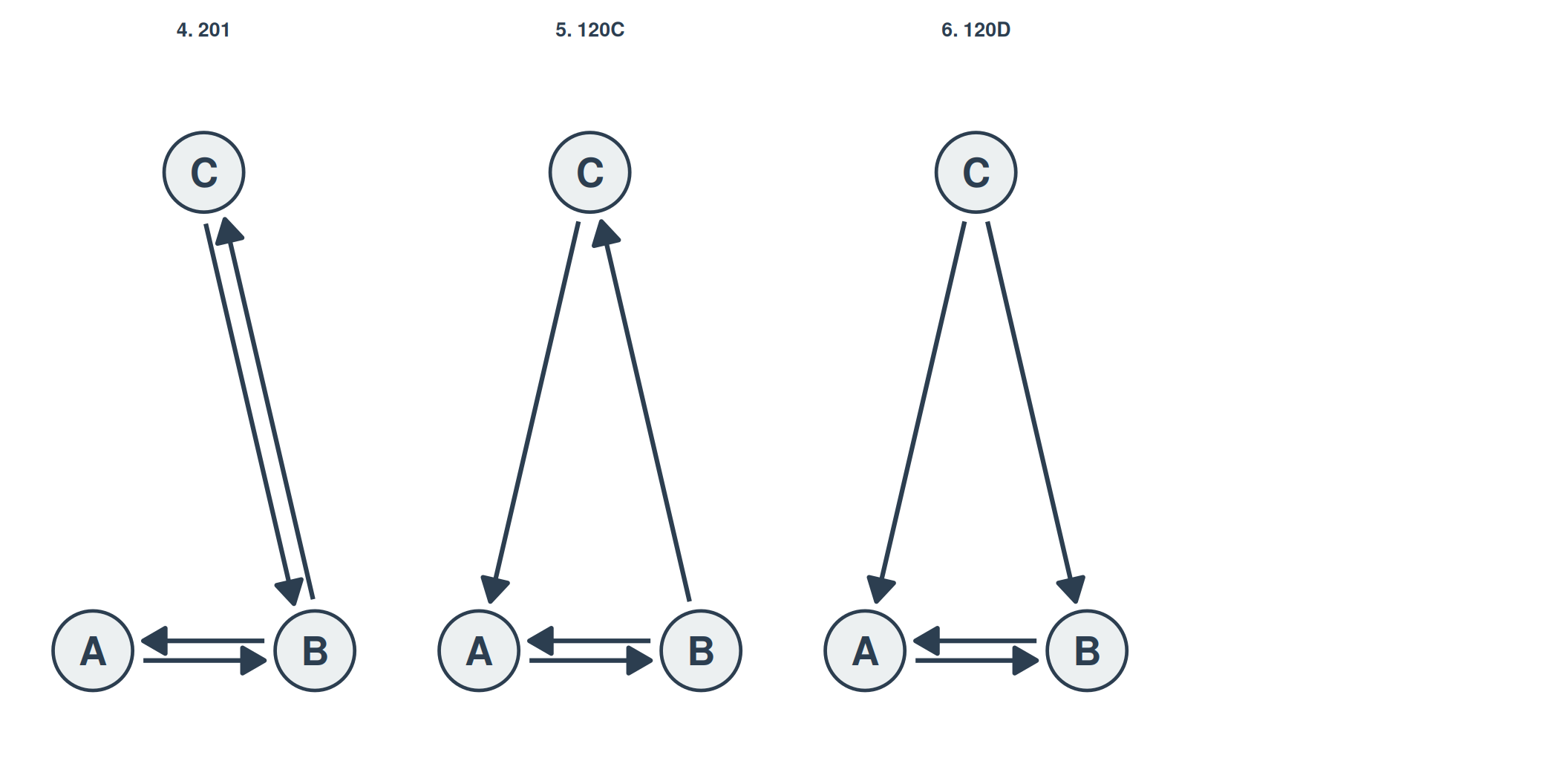
Figure 4

Reciprocal Triads (Part 3: In-Star Closed & Cohesive)
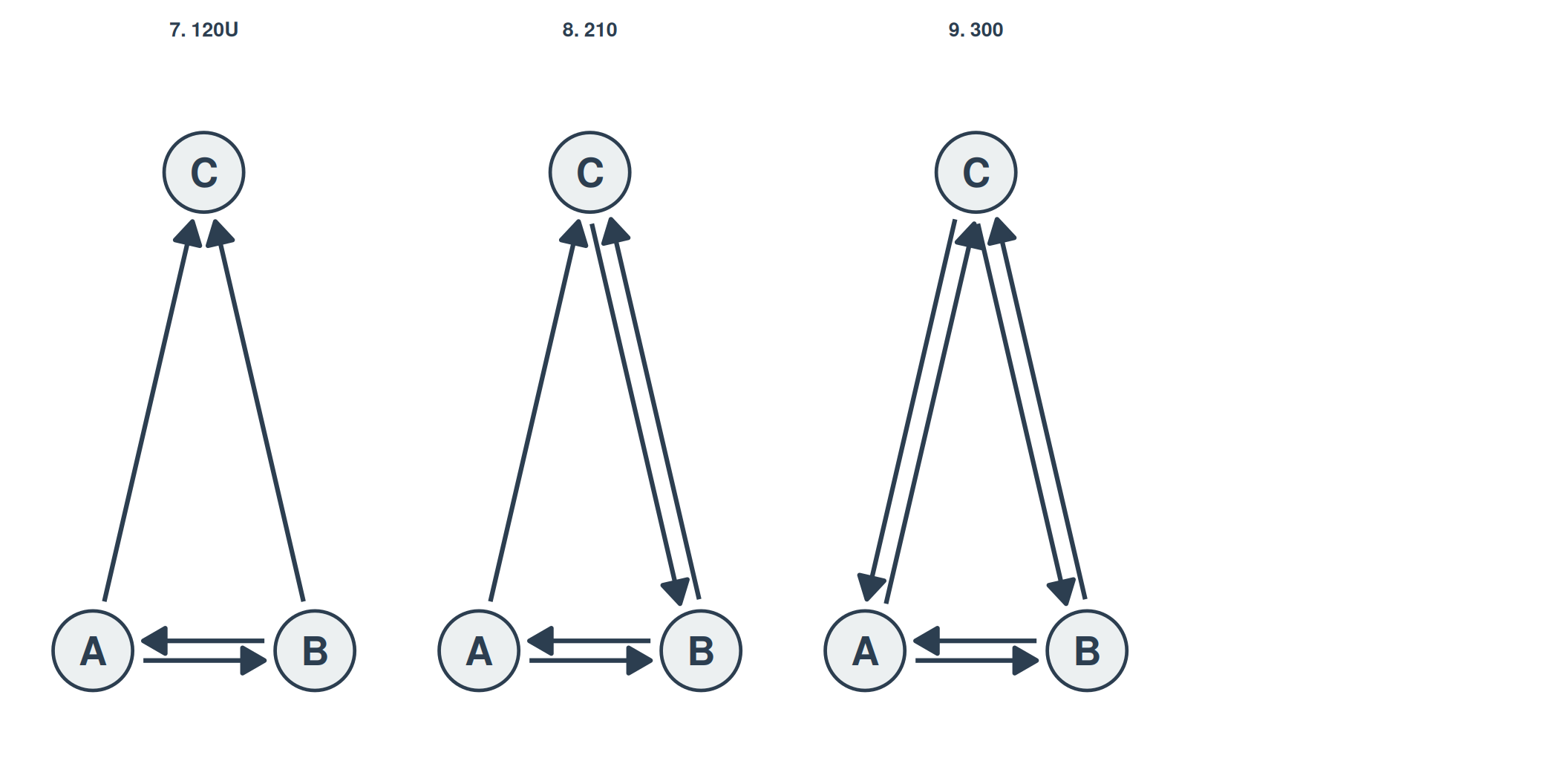
Figure 5

The Full Directed Triad Census
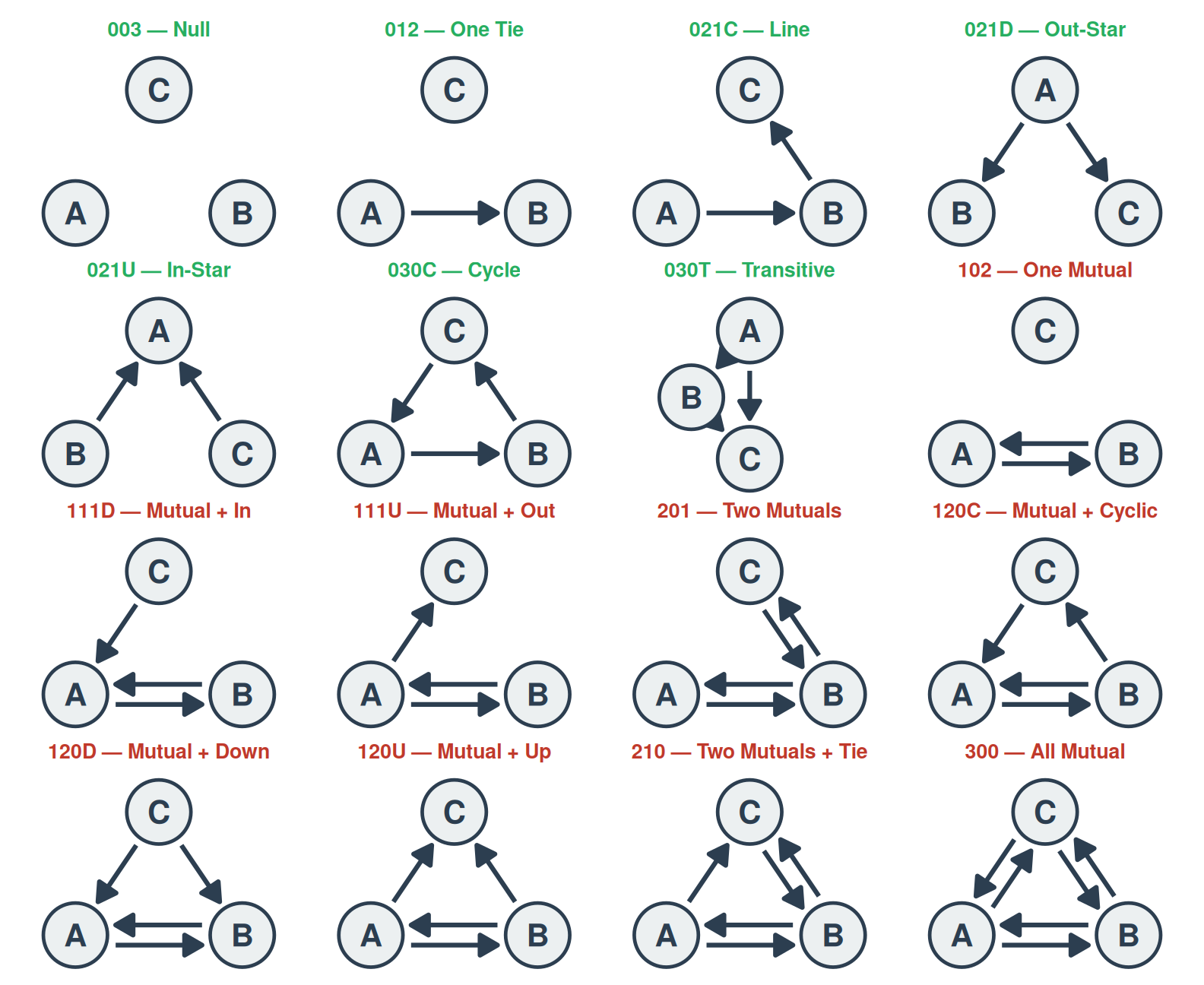
Figure 6: The 16 directed triad isomorphism classes. Titles in green are permitted under anti-symmetric relations (no mutual dyads); titles in red require at least one reciprocal (mutual) dyad.

Conclusion & Core Takeaways
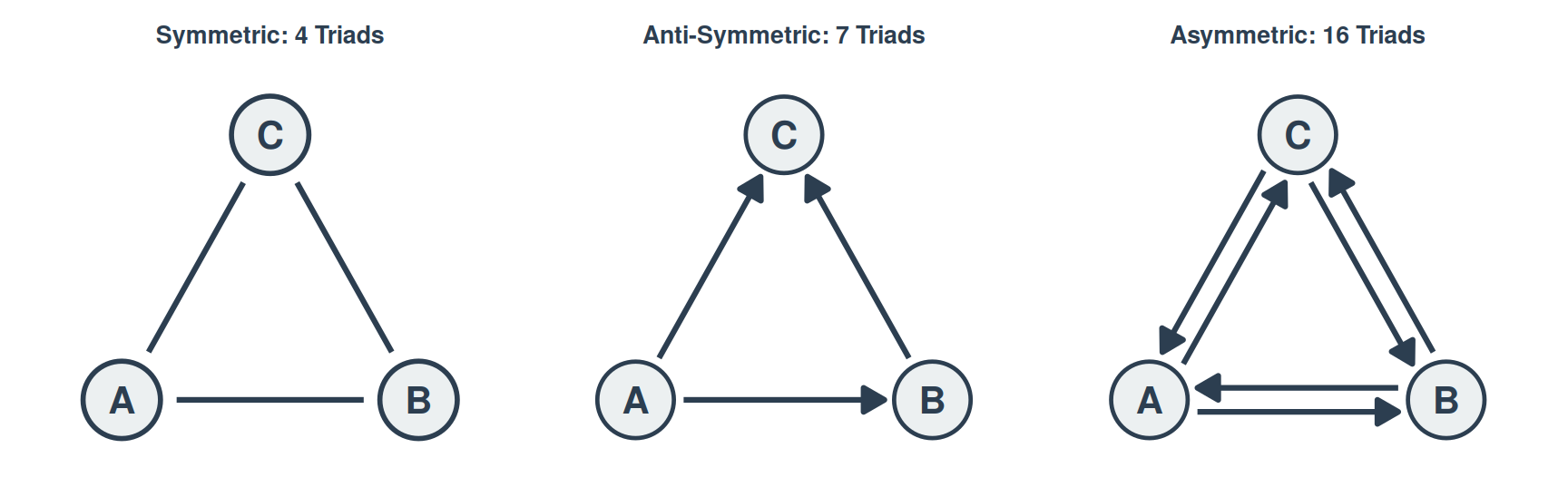
  • Ties define dyads, and dyads define triads:
    • The mathematical type of relationship strictly controls the possible micro-structures in a network.
  • Symmetric Ties \(\implies\) connected vs. disconnected dyads \(\implies\) 4 undirected triads.
  • Anti-Symmetric Ties \(\implies\) disconnected vs. non-reciprocal dyads \(\implies\) 7 directed triads.
  • Asymmetric Ties \(\implies\) disconnected, non-reciprocal, or reciprocal dyads \(\implies\) 16 directed triads (Triad Census).
  • Understanding these micro-motifs is the key to decoding the macro-structures of power, friendship, and organization in society.