Theories of Valenced Interactions
Karma, Status, Solidarity, and Dominance in Sentiment Networks
Karma Theory: Core Concept
What You Send Out Predicts What You Get Back
- Core Principle: “You get what you spread out!”
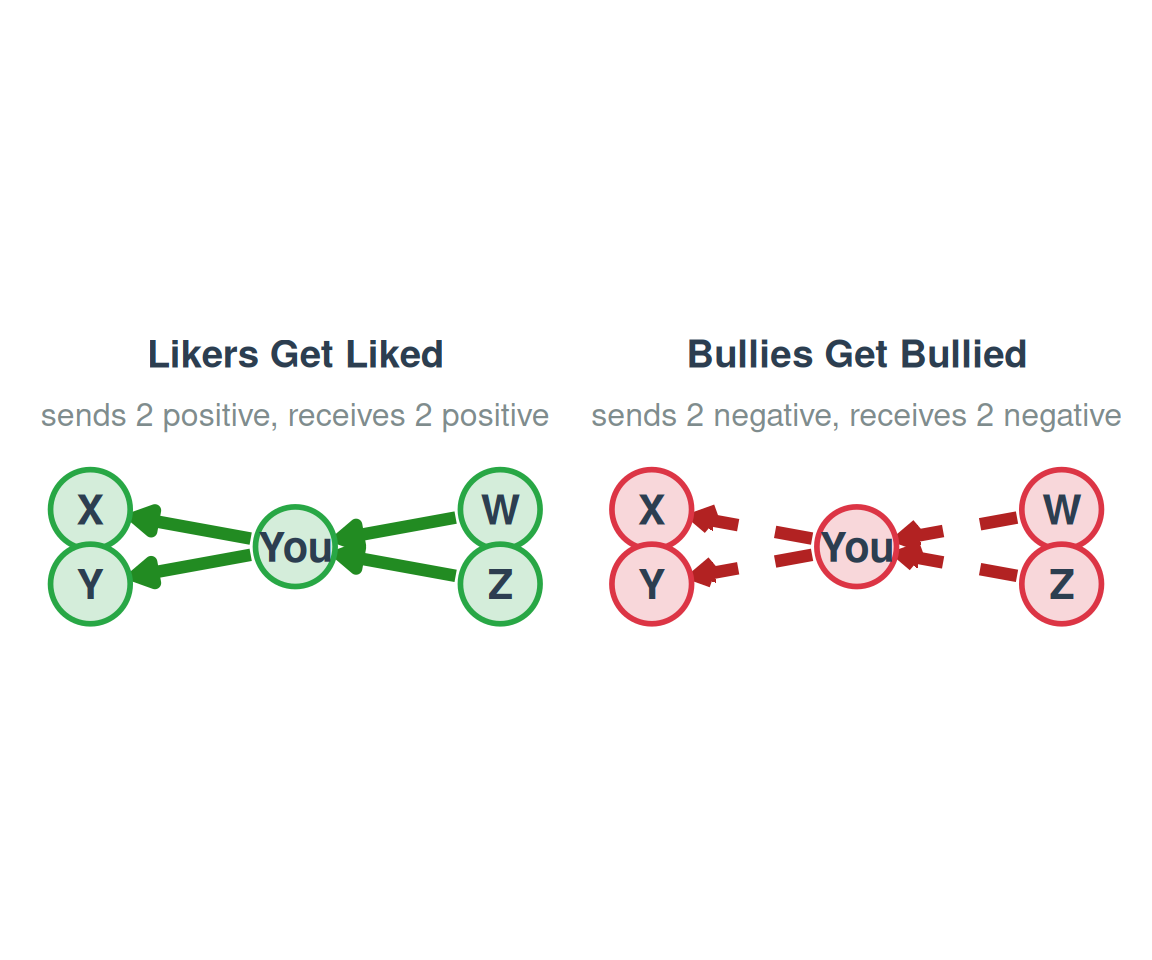
- The valence of the ties you send out predicts the valence of the ties you receive back — from the network at large, not necessarily from the same alter.
- Predicts received valenced indegree (what you receive) based on expressed valenced outdegree (what you send out).
- Illustrates common expressions:
- “Likers get liked” (positive).
- “Bullies get bullied” (negative).
Karma Theory: Network-Wide Flow
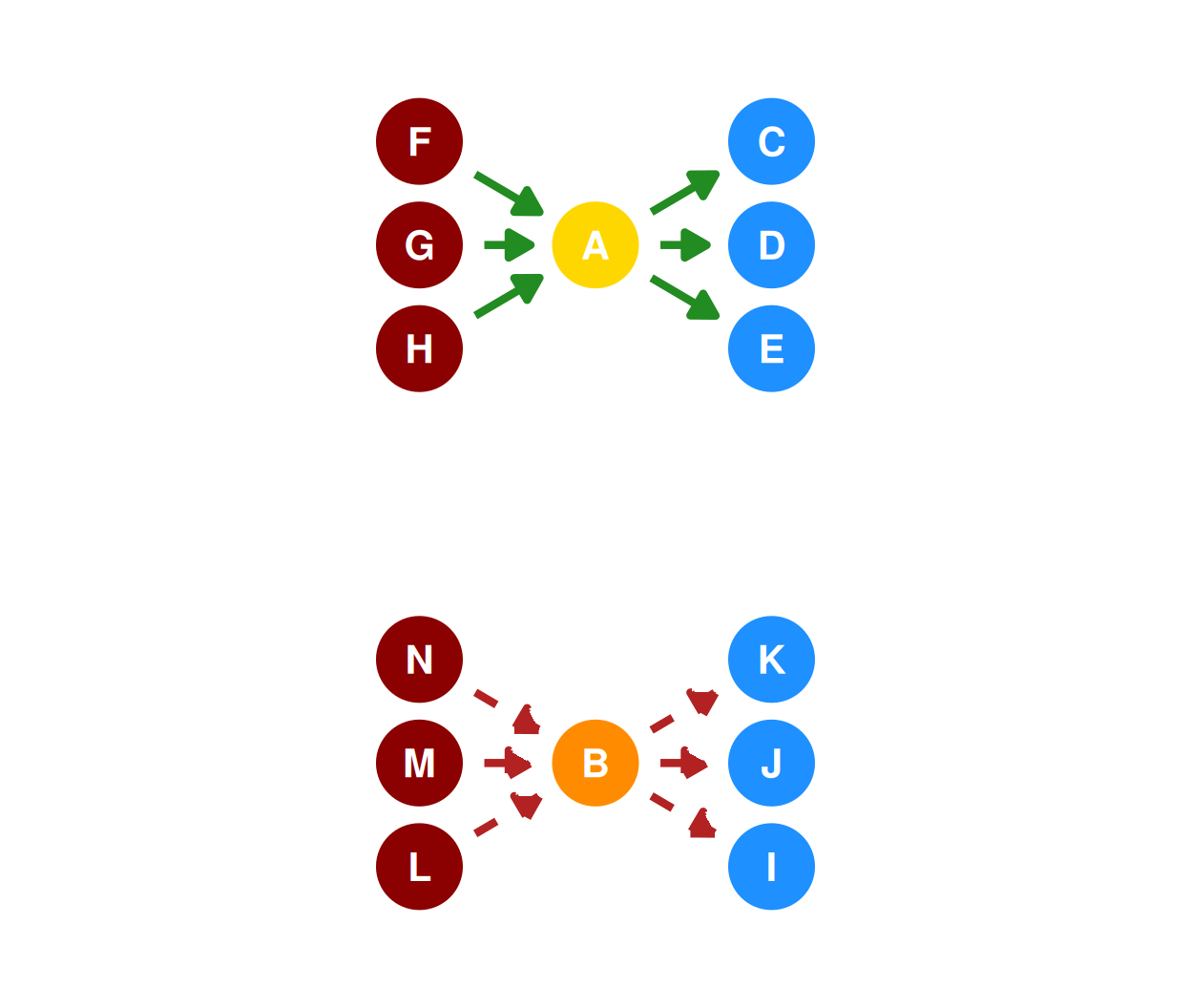
- Karma Flows can be generalized across broader spheres in the network.
- Positive Sphere: Node A (positive spreader) actively initiates friendly ties and receives deference/support in return from the network.
- Negative Sphere: Node B (negative spreader) actively initiates hostile ties and attracts reciprocal conflict/bullying from multiple alters.
- No alter returns a tie directly; the match is between what each sends and what it receives from others.
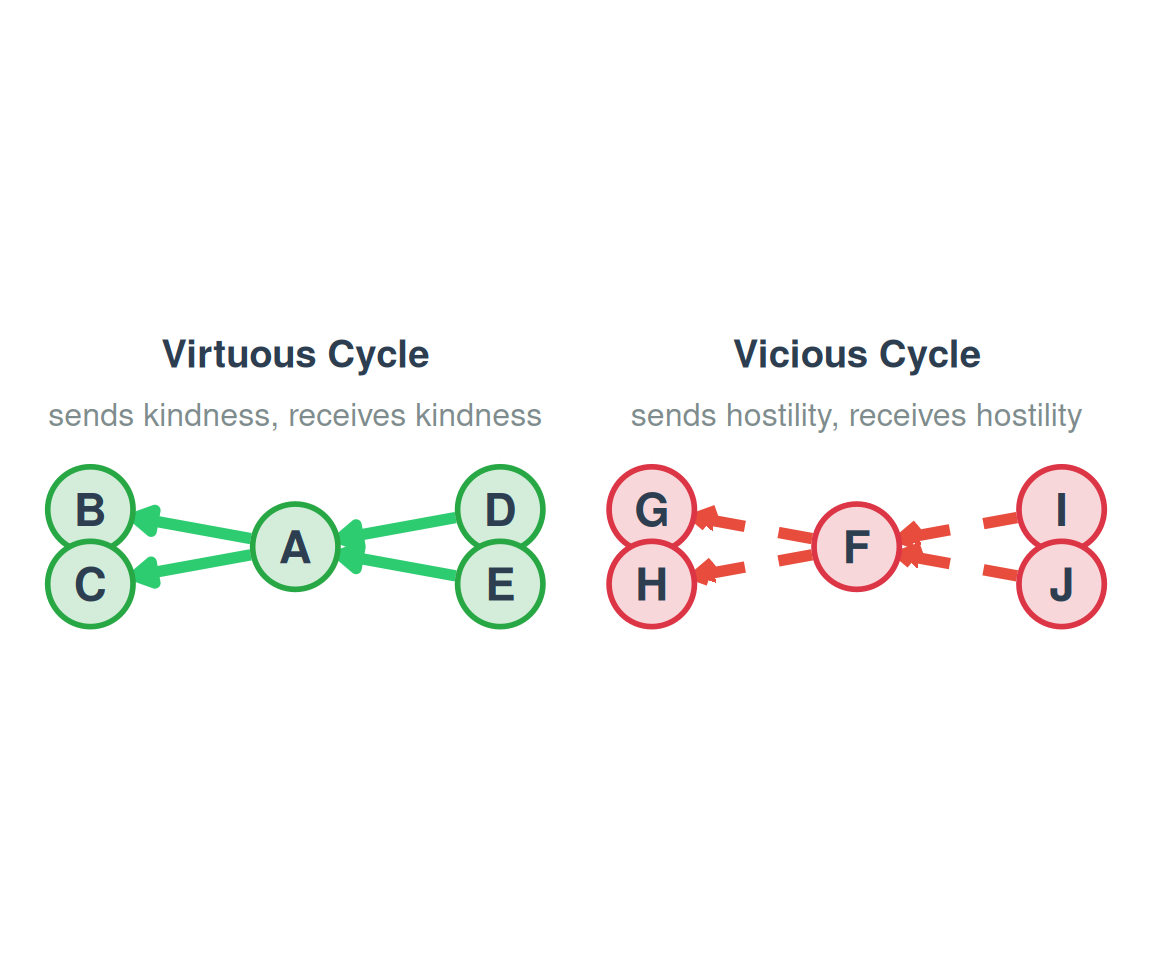
Karma Dynamics: Virtuous vs. Vicious Cycles
- Karma principles drive valenced networks to grow and evolve via feedback loops:
- Virtuous Cycles: An initial positive act (\(+\)) breeds matching positive sentiment from others (\(+\)) — not necessarily from the same alter. These positive feedback loops lock actors into mutually reinforcing, cooperative cliques.
- Vicious Cycles: A single unprovoked negative act (\(-\)) breeds hostile counter-attacks (\(-\)). This triggers cascading negative spirals, spreading localized conflict throughout the network.
- Over time, outdegree and received indegree valences converge on a node-by-node basis.
Status Theory: Introduction
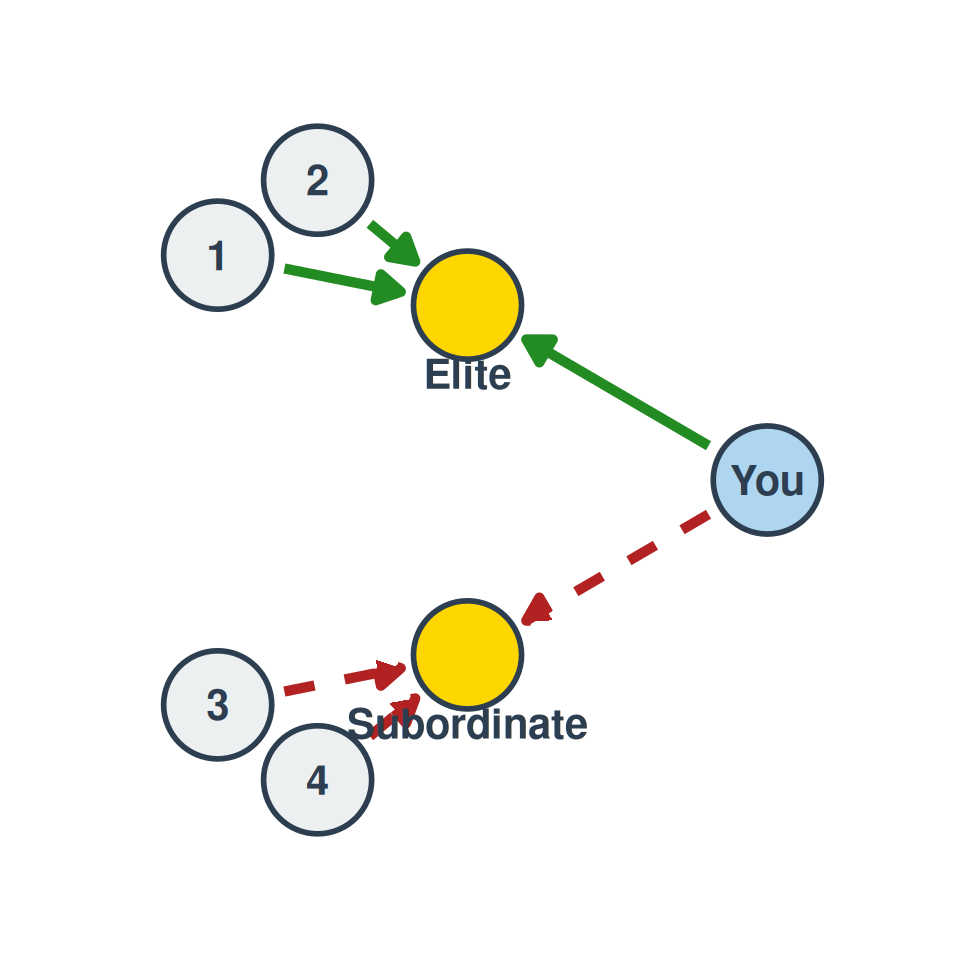
- Status Theory proposes that sentiments towards an alter are heavily driven by how others feel about them.
- It extends the triadic balance logic from the previous lecture.
- This represents a social prestige alignment mechanism:
- If someone is liked by many, you align your sentiment and like them too.
- If someone is disliked by many, you align your sentiment and dislike them.
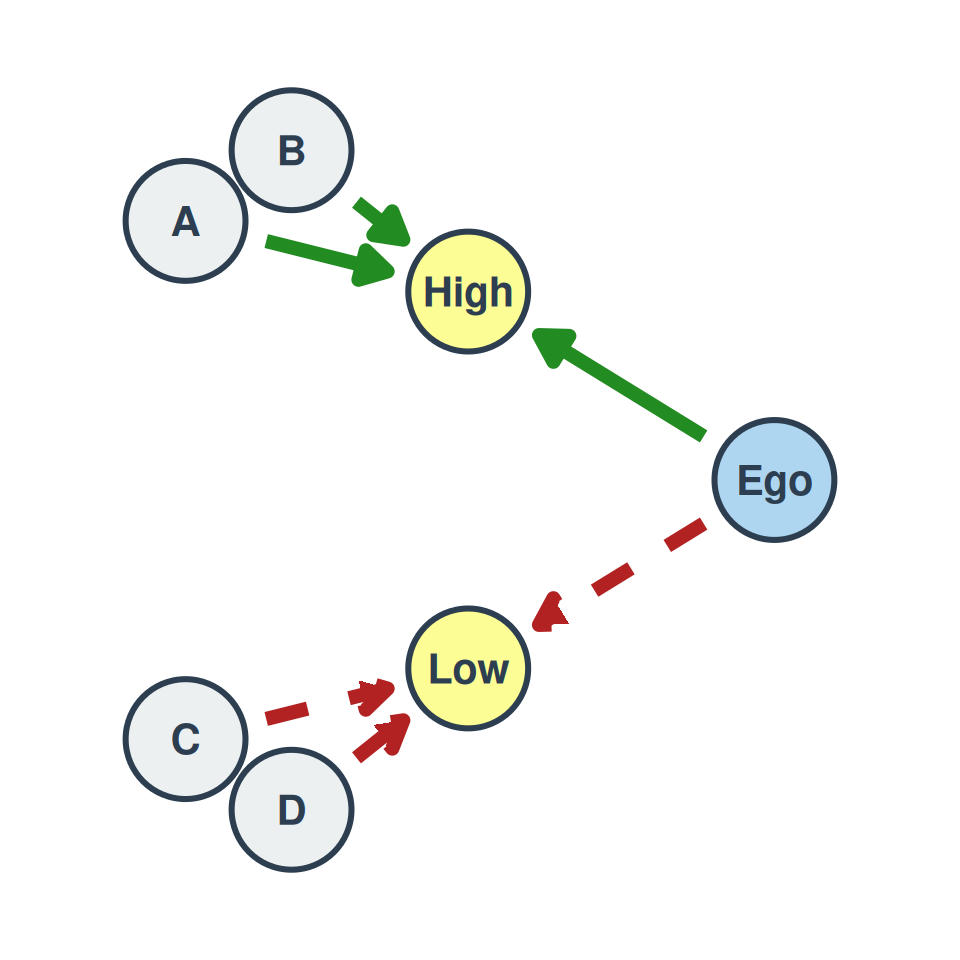
- A node’s status is determined by the valence signs of incoming ties:
- High status = receiving many positive links.
- Low status = receiving many negative links.
Prestige and Deference Alignment
- Inside status-seeking systems, tie directions carry implicit status expectations:
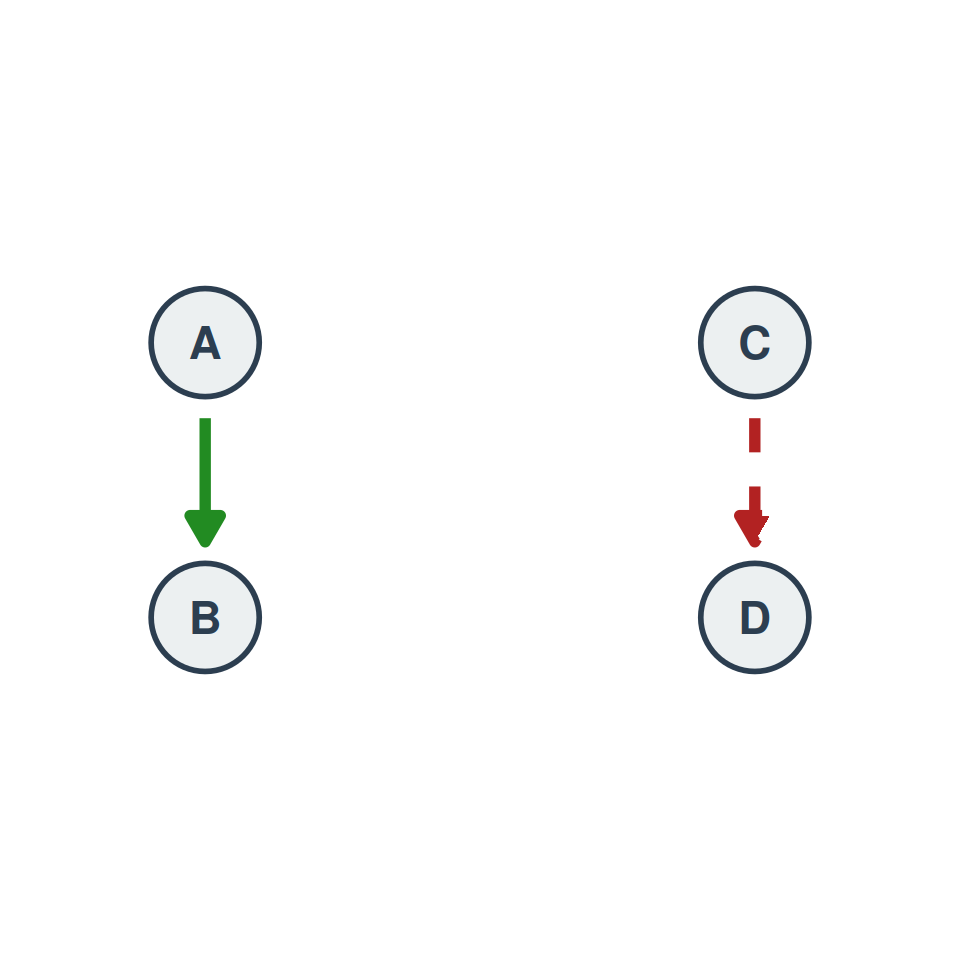
- Directed positive tie from Ego to Alter \(\implies\) Ego considers Alter to have higher status (Deference).
- Directed negative tie from Ego to Alter \(\implies\) Ego considers Alter to have lower status (Dominance).
- Status-seeking actors strive to align their sentiments with prestige to avoid losing their own social standing.
Status Dynamics: Centralization and Hierarchy Growth
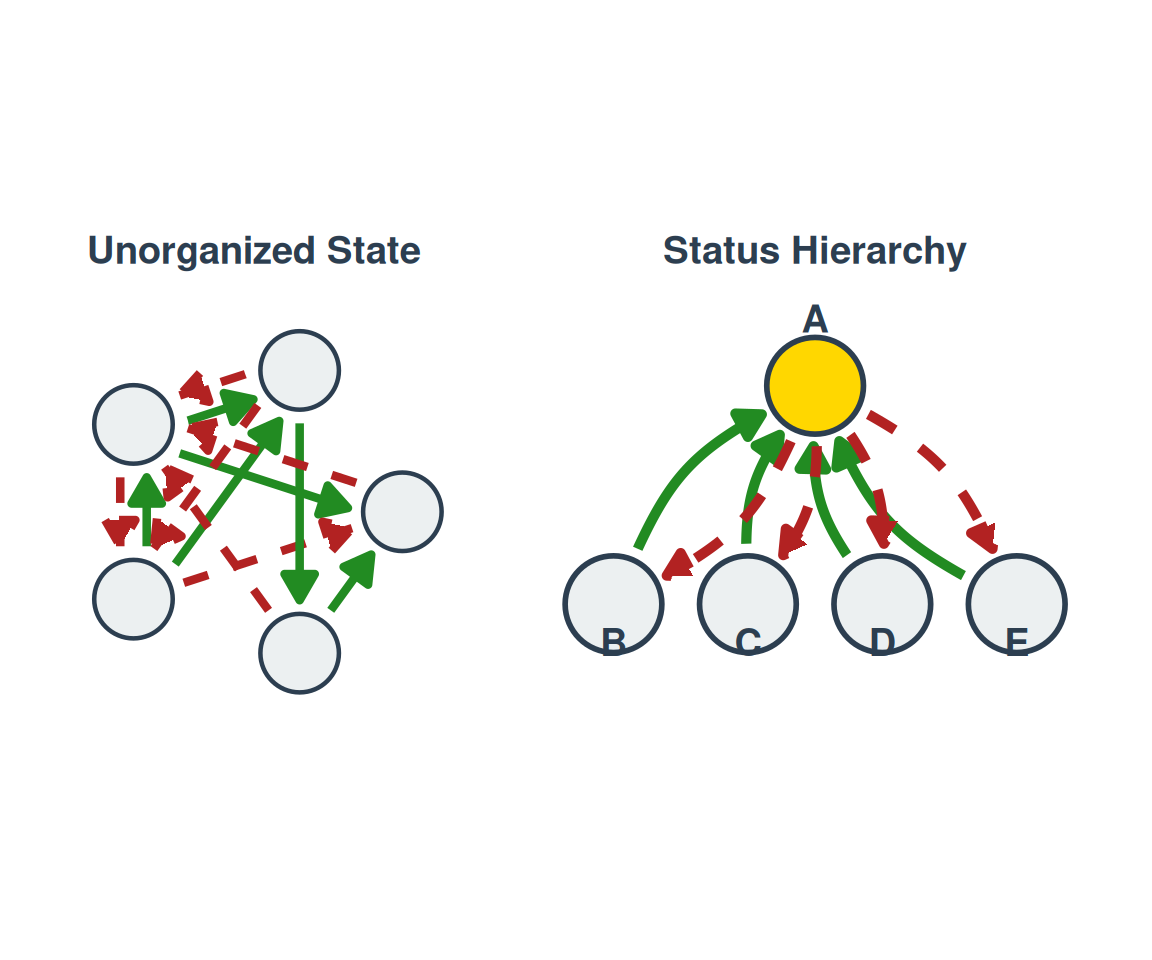
- How status networks grow and change over time:
- Preferential Deference: High-status nodes attract a disproportionate share of incoming positive ties over time (a “rich-get-richer” effect).
- Dynamic Pruning: High-status nodes lose their negative ties, while low-status nodes lose their positive ties.
- “Gang-up” Effect: Subordinates consolidate negative ties onto low-status pariahs to boost their own standings.
- Hierarchy Emergence: Sentiments organize into highly centralized, strictly ordered prestige rankings.
Solidarity Theory: Core Concept
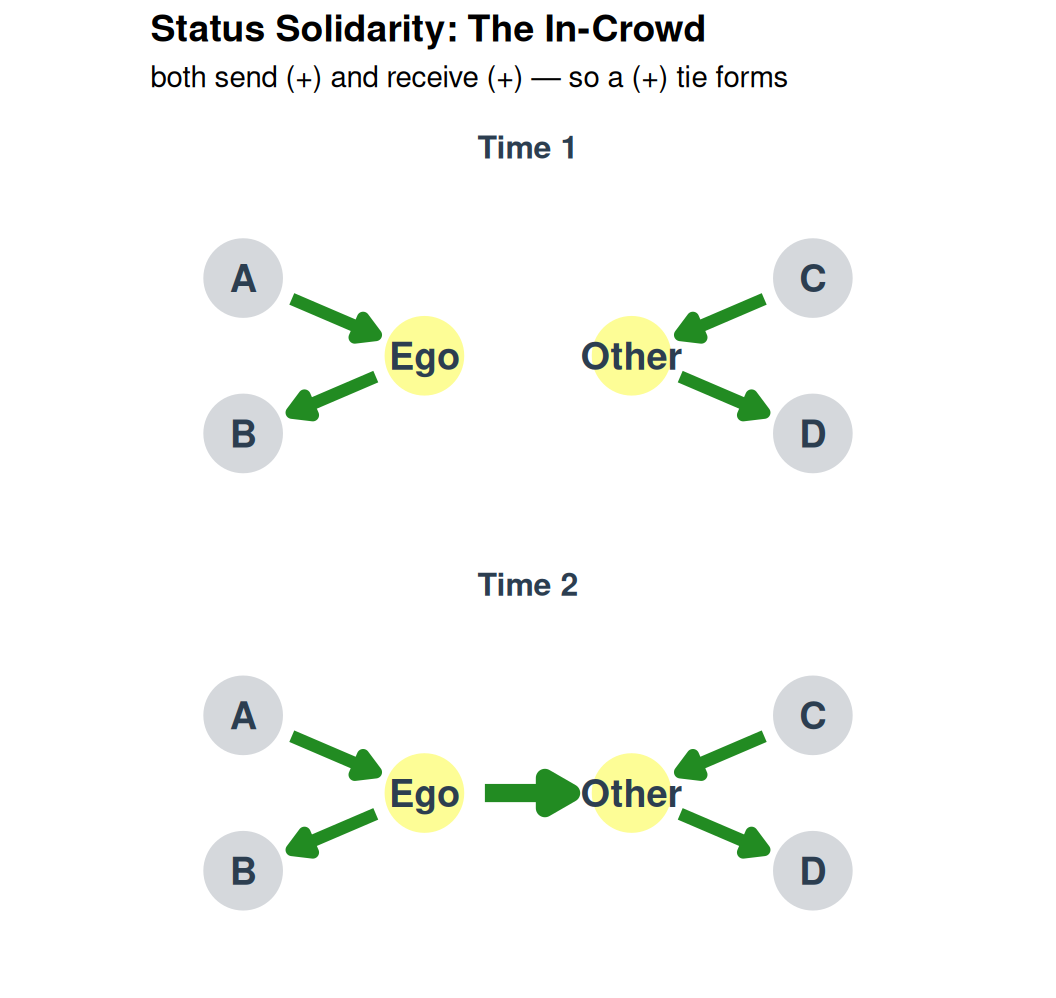
- Central idea: “People in the same position in the valenced interaction network are likely to link via positive ties.”
- Time 1: Ego and Other already occupy the same position — each sends (+) and receives (+) ties from distinct alters (the popular “in-crowd”).
- Time 2: The shared position generates a new positive tie between them — status solidarity: “Cool kids stick together!”
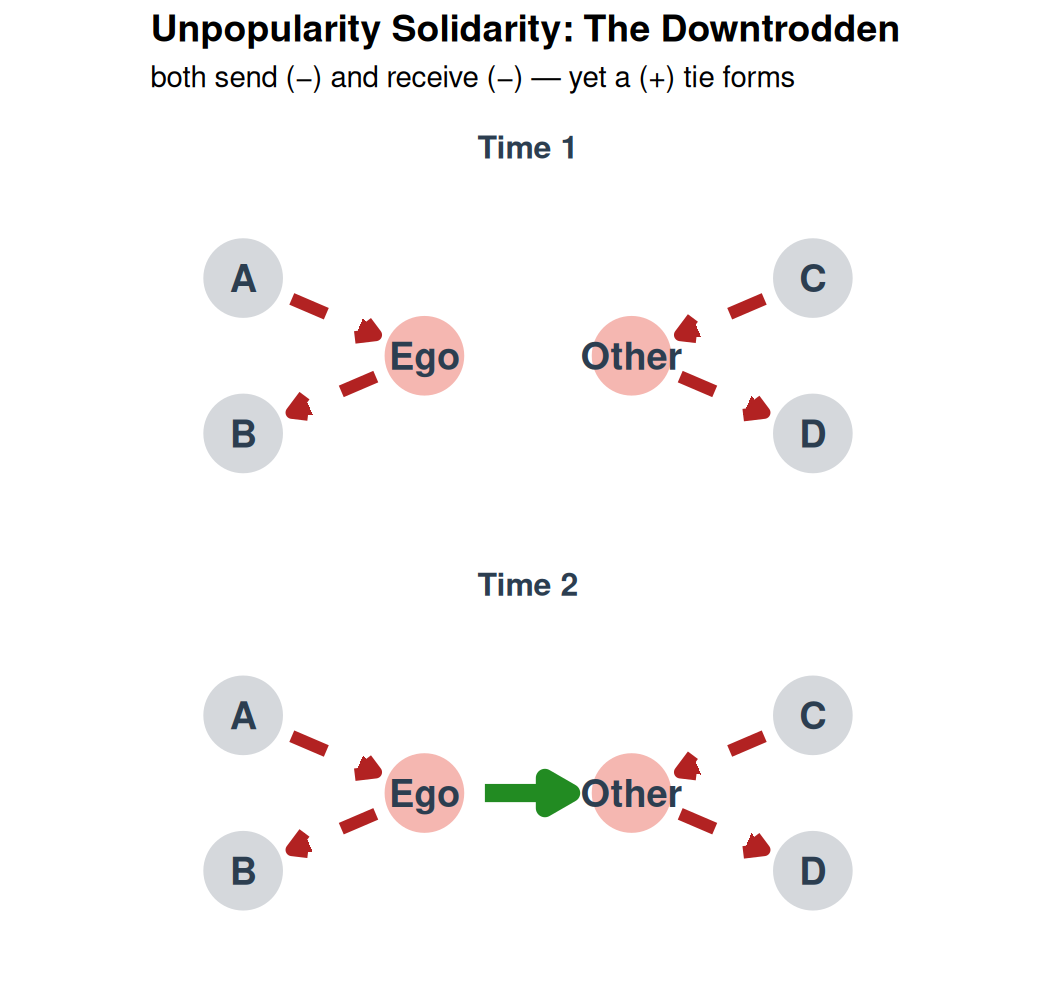
Solidarity on the Negative Side: The Downtrodden
- The same logic holds at the bottom of the status order: actors who send and receive negative ties are similarly situated (karma solidarity).
- Shared unpopularity motivates positive bonding between them — “misery loves company.”
- Note: the solidarity tie is itself positive, even though the shared position is built entirely out of negative exchange.
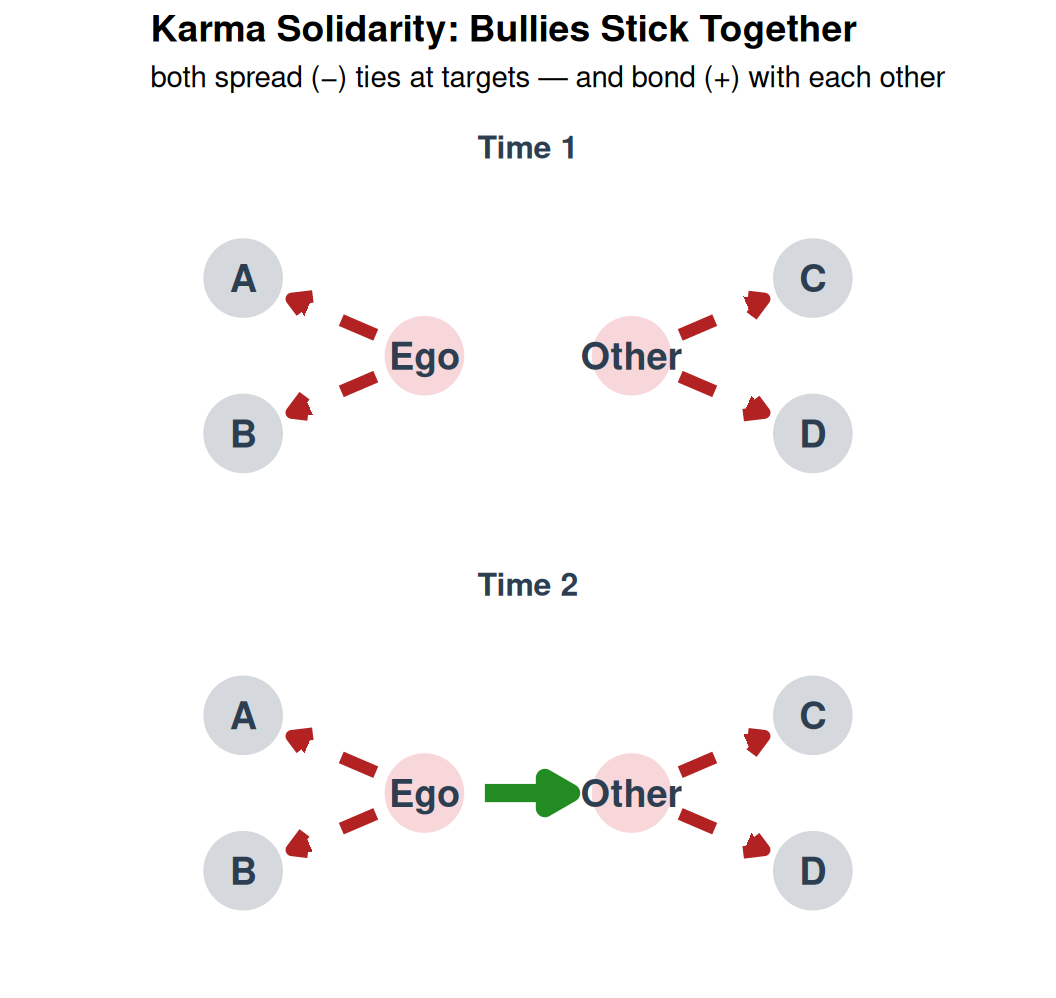
Karma Solidarity: Bullies Stick Together
- Solidarity can also form around the negative-sender position: actors who spread hostility occupy the same spot in the network.
- Bullies direct (−) ties at their targets — and form a positive bond with each other.
- Same-position actors close ranks; their targets (grey) receive the hostility but are outside the solidarity tie.
Solidarity Dynamics: Stratification and Clique Growth
- How Solidarity networks grow and stratify over time:
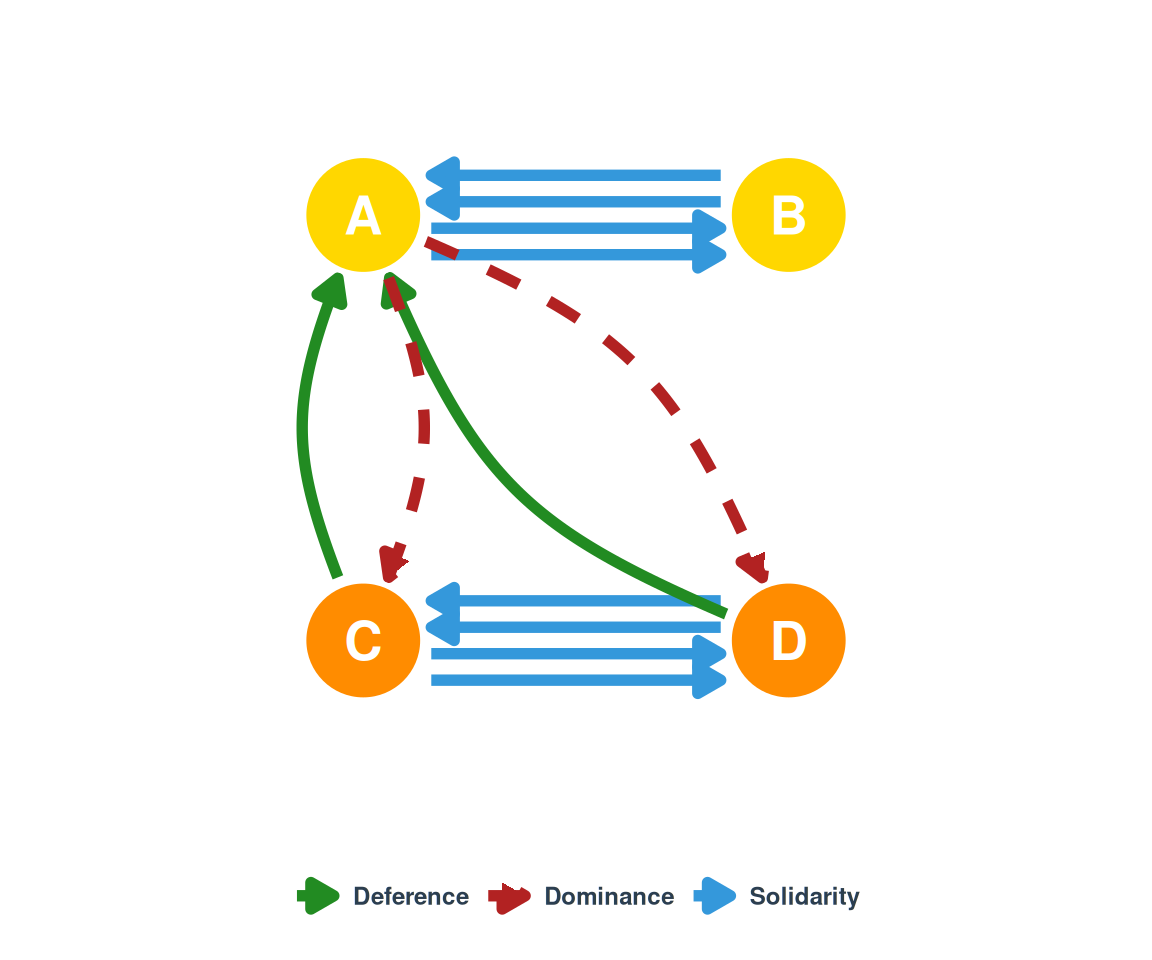
- Horizontal Integration: Sharing the same status position drives the creation of reciprocal positive ties within the same tier (clique formation).
- Class Cohesion: Solidarity processes stabilize clusters into horizontal social classes (e.g., unions, associations, exclusive clubs).
- Vertical Hostility: Cross-tier bonding is severed. What remains across tiers is asymmetric — deference flowing up to the elite, dominance flowing down.
- Clique Stratification: The network evolves into a horizontally integrated, vertically polarized system.
Dominance Orders in the Animal Kingdom
- Dominance hierarchies are observed across many species — most notably among chickens. No big brain needed to build a complex social network!
- A “pure” dominance order has three algebraic properties:
- Directed: a tie means “i dominates j.”
- Antisymmetric: if A dominates B, B cannot dominate A.
- Complete: for every pair, someone dominates — either A dominates B or B dominates A.
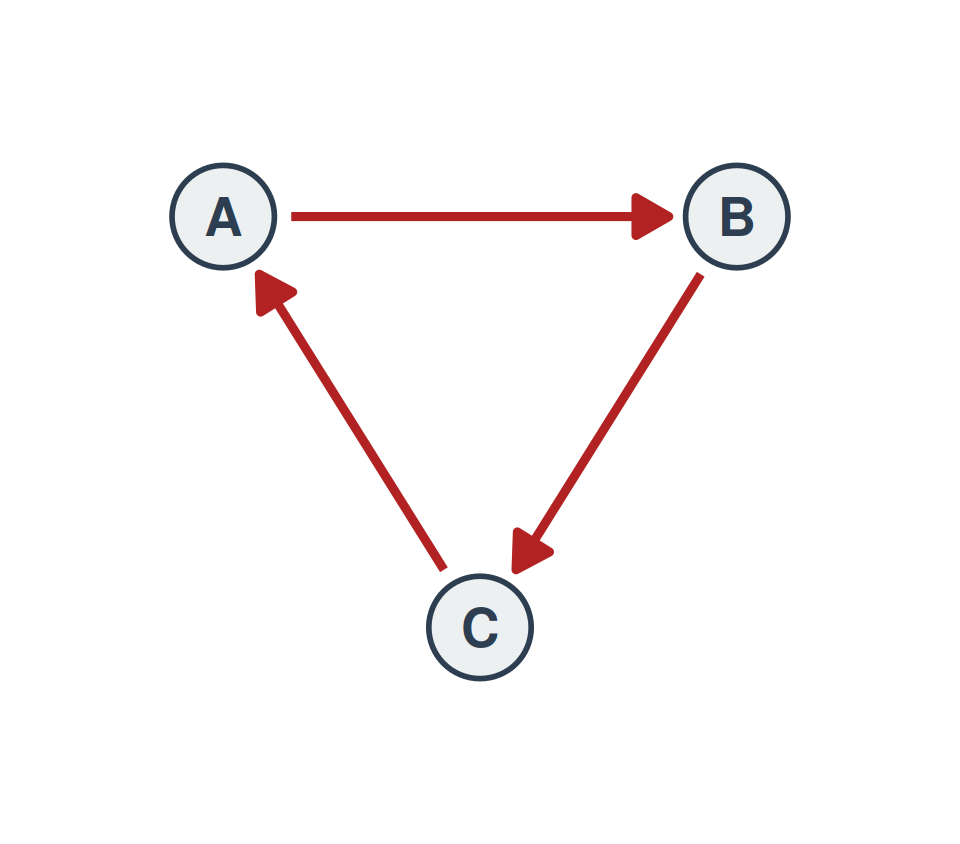
One tie per pair (antisymmetric, complete) — but arranged as a cycle, which a pure dominance order cannot contain.
Transitivity in Dominance Orders
- Transitivity: dominance passes through nodes.
- If A dominates B, and B dominates C, then A also dominates C — just like \(A > B\) and \(B > C\) imply \(A > C\).
- In a directed network: if A is above B, A is above everyone B is above.
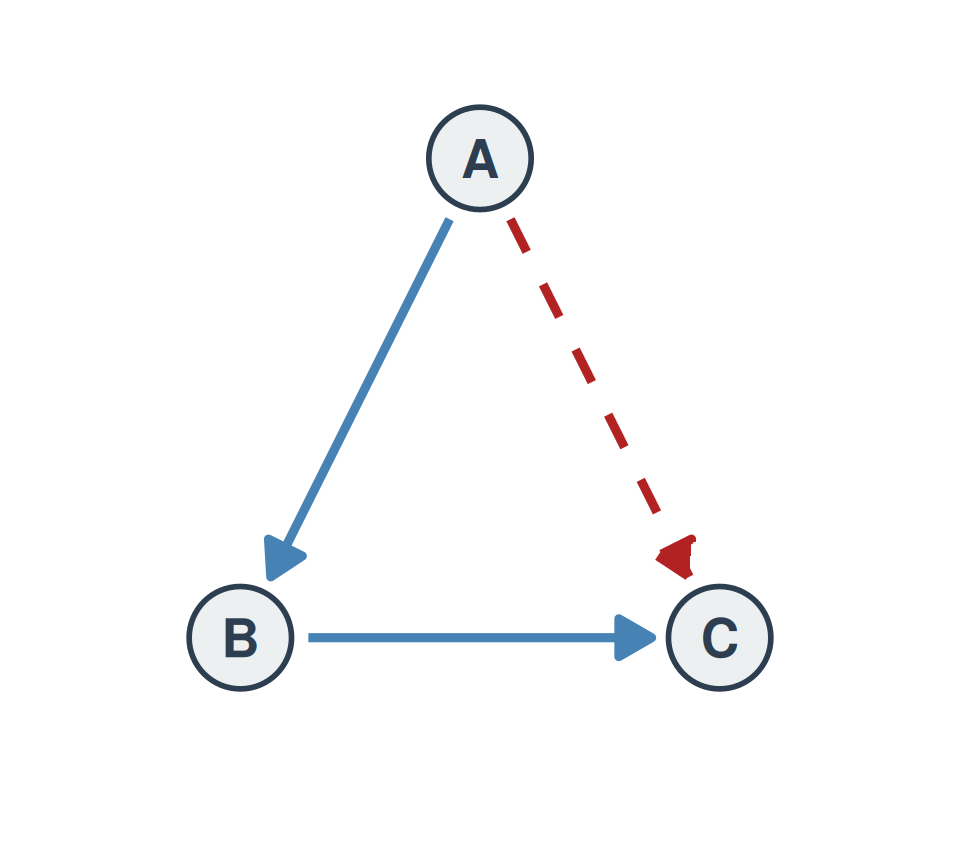
- A linear dominance order must be transitive — the A → C arc has to exist.
- An intransitive triad has the full chain A → B → C but the A → C tie reversed (C → A) — the closure is contradicted, not merely absent.
- A merely absent A → C tie is a different case, the pass-along triad, which we return to below.
Vacuous Transitivity
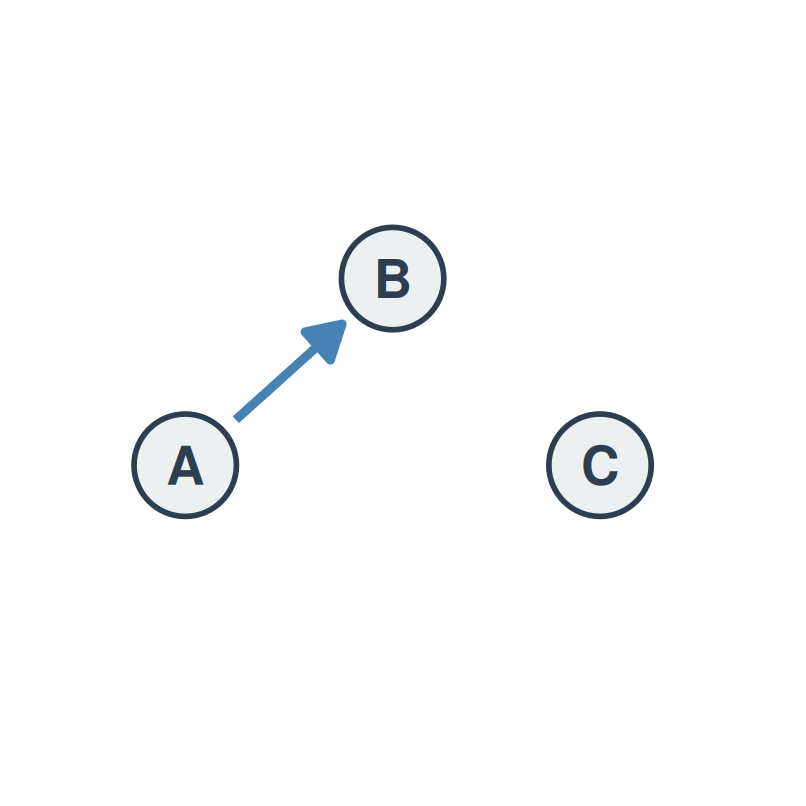
- What if A → B, but B does not direct a tie to C?
- The precondition for transitivity — A → B and B → C — is not met.
- The triad cannot violate transitivity, because the necessary chain does not exist.
- This configuration is vacuously transitive:
- It does not actively demonstrate transitivity…
- …but it does not violate it either.
- Only triads with a full chain A → B → C can be transitive or intransitive.
Perfectly Linear Hierarchies: The Pecking Order
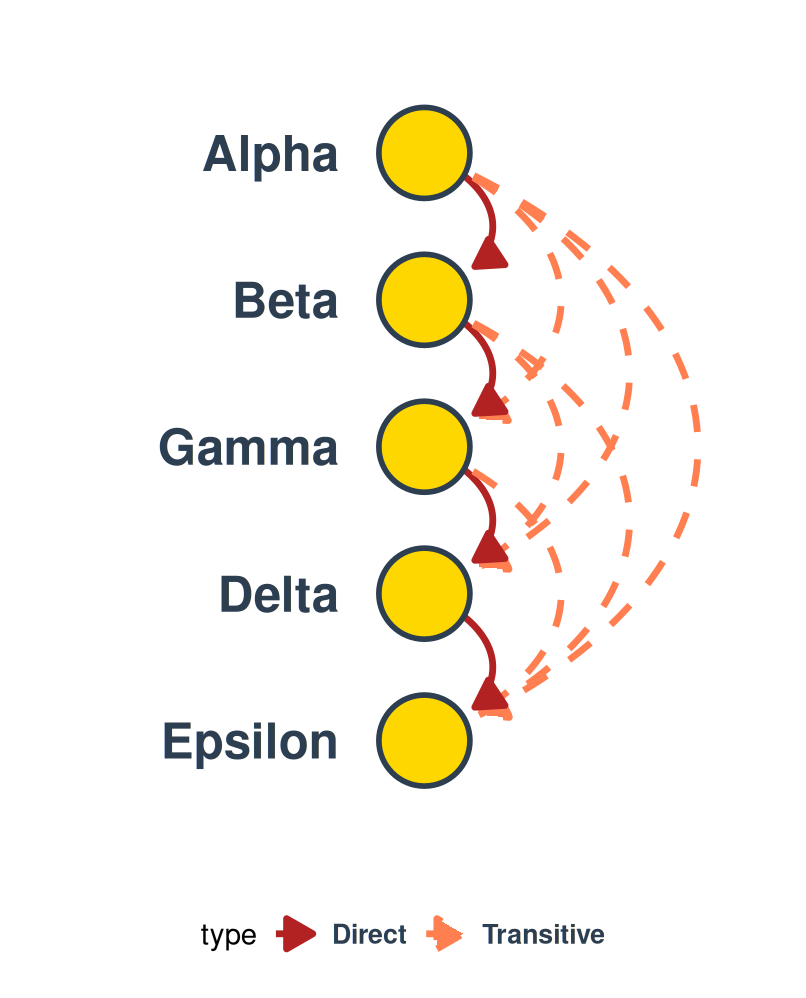
- Chickens placed in a new environment scuffle until a clear pecking order emerges.
- The winner asserts dominance; this continues until every chicken knows its place.
- Alpha dominates Beta and everyone below; Beta dominates Gamma and everyone below, and so on.
- The hierarchy is ritually reinforced: the higher-status chicken pecks, the lower-status one assents.
- A classic perfectly transitive dominance order.
The Seven Triads at a Glance
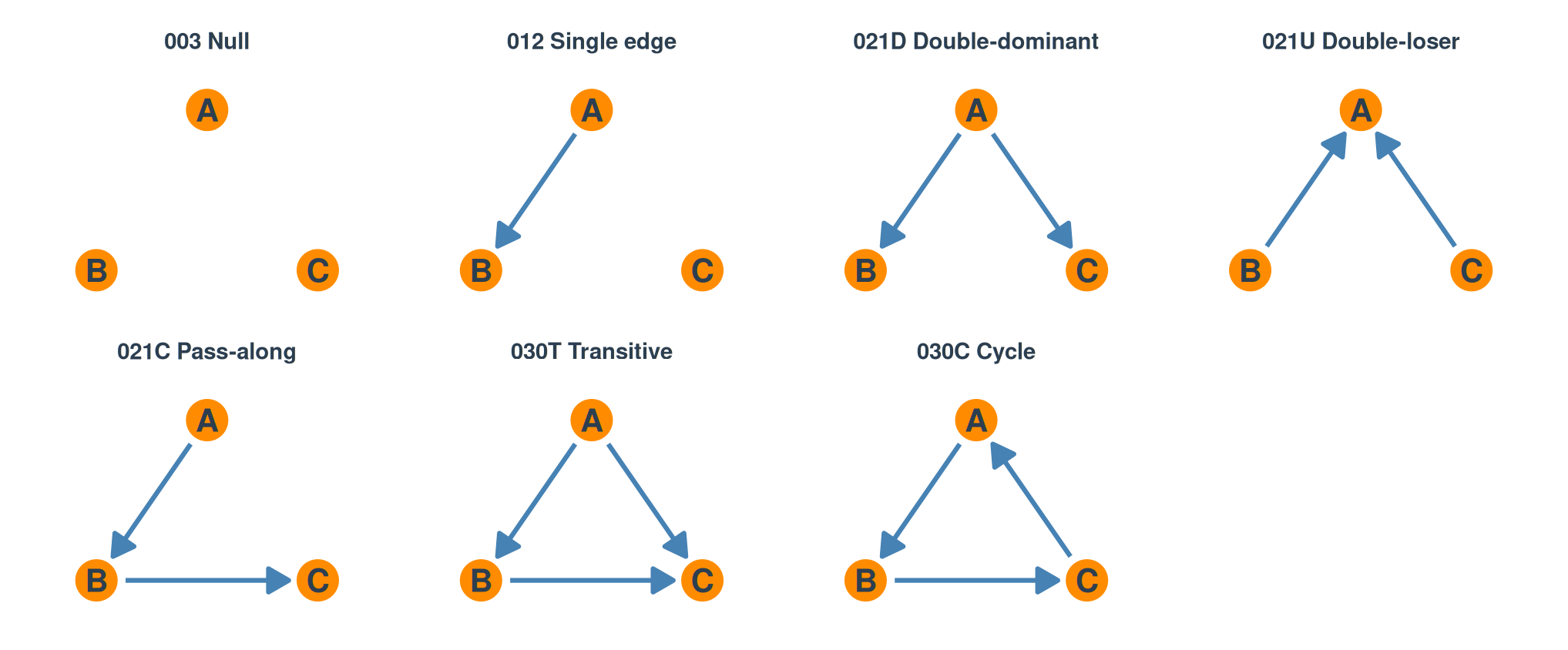
- A dominance network can contain seven possible triadic configurations built entirely of asymmetric or null ties.
- For a linear order to exist, it must be transitive and contain no cyclical triads.
- Everything except the cycle is compatible with a linear order; the pass-along triad simply has not yet resolved its A–C tie.
The Interaction-Based Model: Agonistic Competition
- Interaction-based model (Chase 1982): hierarchies emerge from the sequence and outcomes of past agonistic encounters — not only from attributes.
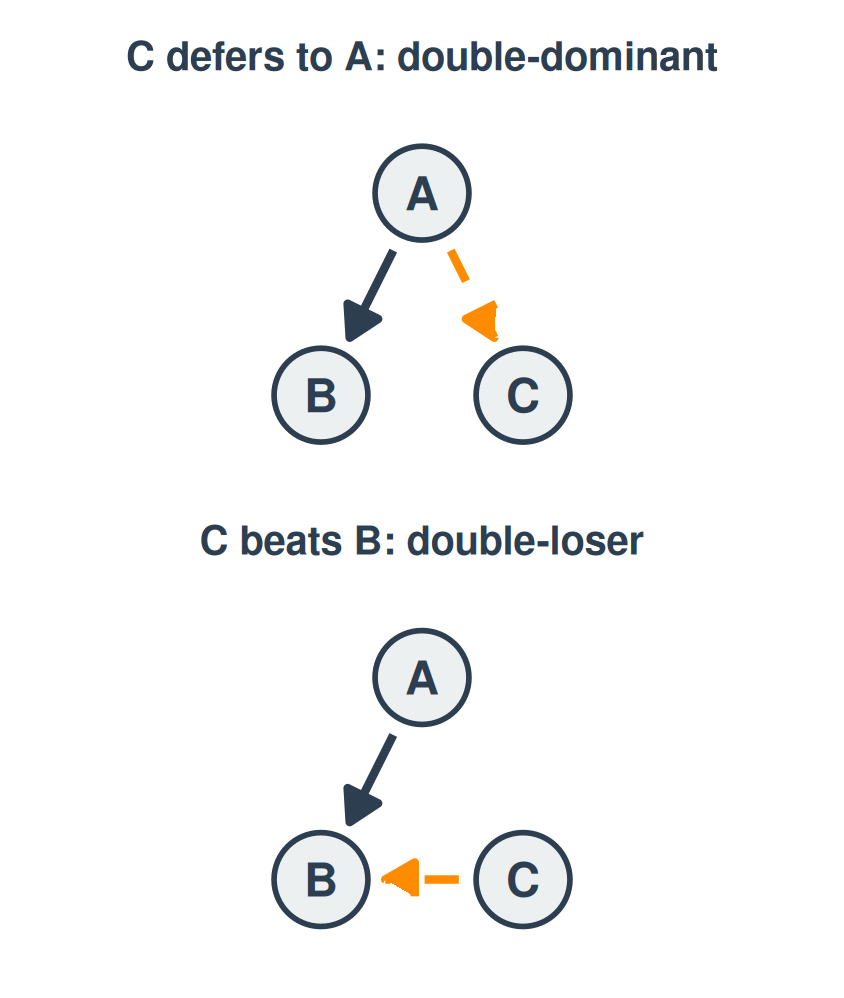
- Winner effects: winning brings confidence, experience, testosterone — winners dominate again (double-dominant triads).
- Loser effects: losing brings lowered confidence and injury — losers lose again (double-loser triads).
- Bystander effects: observers update from watching:
- A bystander defers to the winner and rarely dominates them.
- But a bystander becomes stronger relative to the loser, and rarely gets dominated by them.
Bystander Effects: A Worked Example
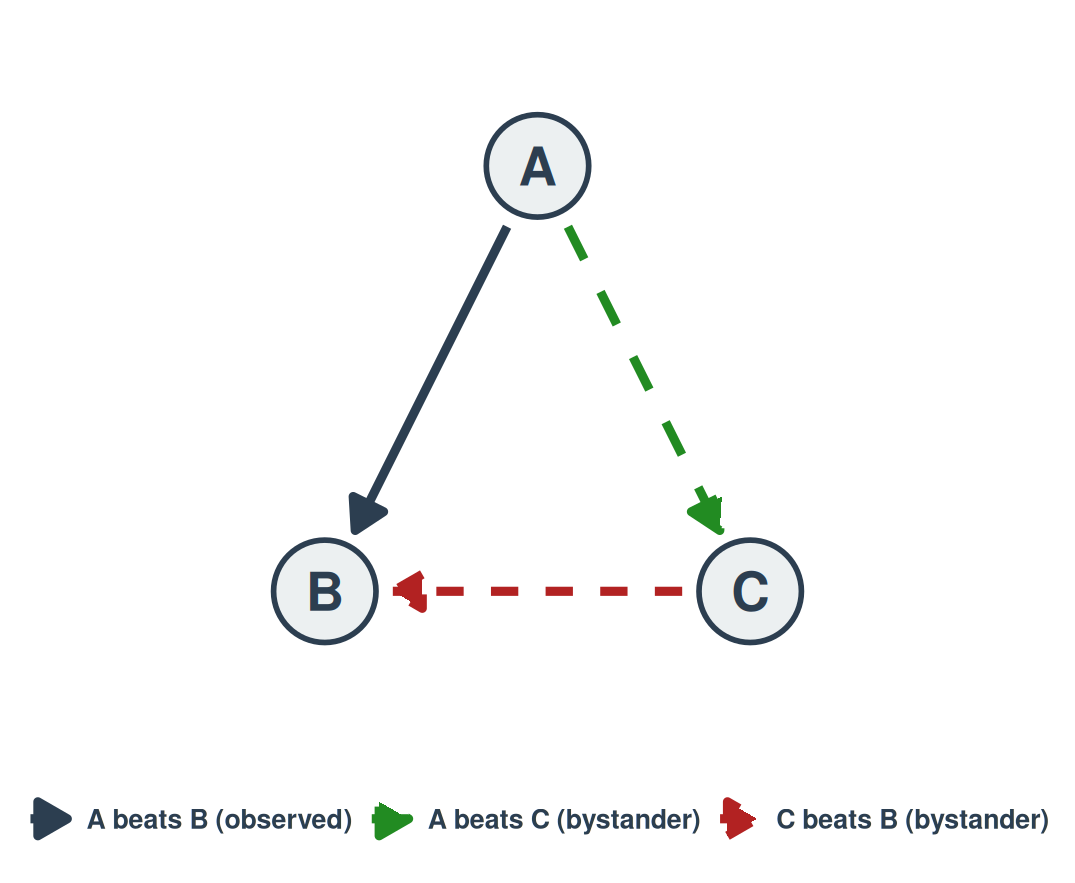
- Three chickens: A is strong, B is moderately strong, C is weak.
- A fights and defeats B — which suffers injury and lost confidence.
- C only watched. Yet it can now defeat B, something it could not do before.
- C’s new tie is a bystander update. It never fought A, and it never beat B before.
- The final hierarchy is not a readout of abilities alone; it is shaped by the order in which contests occur.
Co-Evolution of Valenced Networks: A Combined Model
- In real-world sentiment networks, these three principles do not act in isolation; they interact and co-evolve:
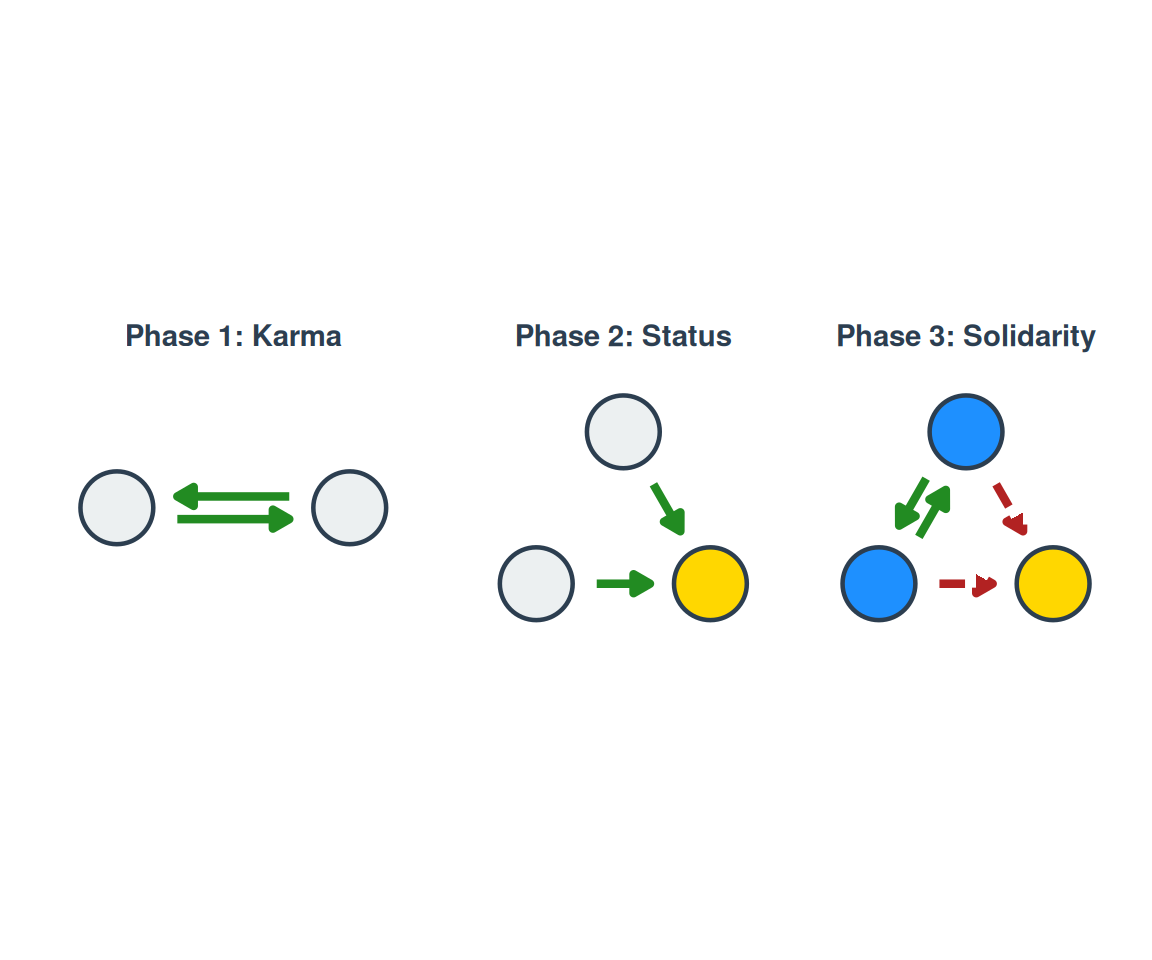
- Phase 1: Raw Interaction: Initial encounters are governed by Karma (direct reciprocity loops).
- Phase 2: Hierarchy Emergence: As actors seek status and prestige, Status seeking creates centralized deference paths.
- Phase 3: Factional Stratification: Sharing the same status position triggers Solidarity, freezing actors into cohesive horizontal classes.
- Dominance (Part 4) adds a fourth dynamic, agonistic competition, on top of these — an illustrative synthesis, not a chapter claim.