1 What Are Networks?
These days, talk about “social networks” is everywhere. It was not always so; the discipline of social network analysis (SNA) developed quietly during the 1960s and 1970s out of scattered lines of work in anthropology, sociology, psychology, mathematics, and communication. It wasn’t until the 1970s that a formal group was founded to study social networks (the International Network of Social Network Analysis or INSNA).
Today, network science is an interdisciplinary field that unites physics, computer science, biology, brain science, sociology, anthropology, economics, and other fields. All come together around the idea of a “network.” There is now a formal group that includes all scientists, from sociologists to psychologists to physicists, computer scientists, and data scientists interested in the study of networks of all kinds. It is called the Network Science Society (NetSci).
1.1 What is a Network?
So what is a network? At a minimum, a network is composed of a set of units or entities. These are sometimes called nodes or vertices; however, what makes these units into a network is the fact that at least some pairs of them are joined by a set of links or ties. These are also sometimes called edges. Usually, these ties represent the interactions or connections of the unit in a system. For instance, on a social media website, the users are the nodes and their interactions (following, commenting, liking) are the links.
Accordingly, a network is essentially a set of nodes, some of which are linked together, usually because the units interact in some ways, and then come to be connected via some kind of relationship. In social networks, the nodes can be people and the connections can be any type of social tie (e.g., friendship, enmity, co-working), whether positive or negative, between them.
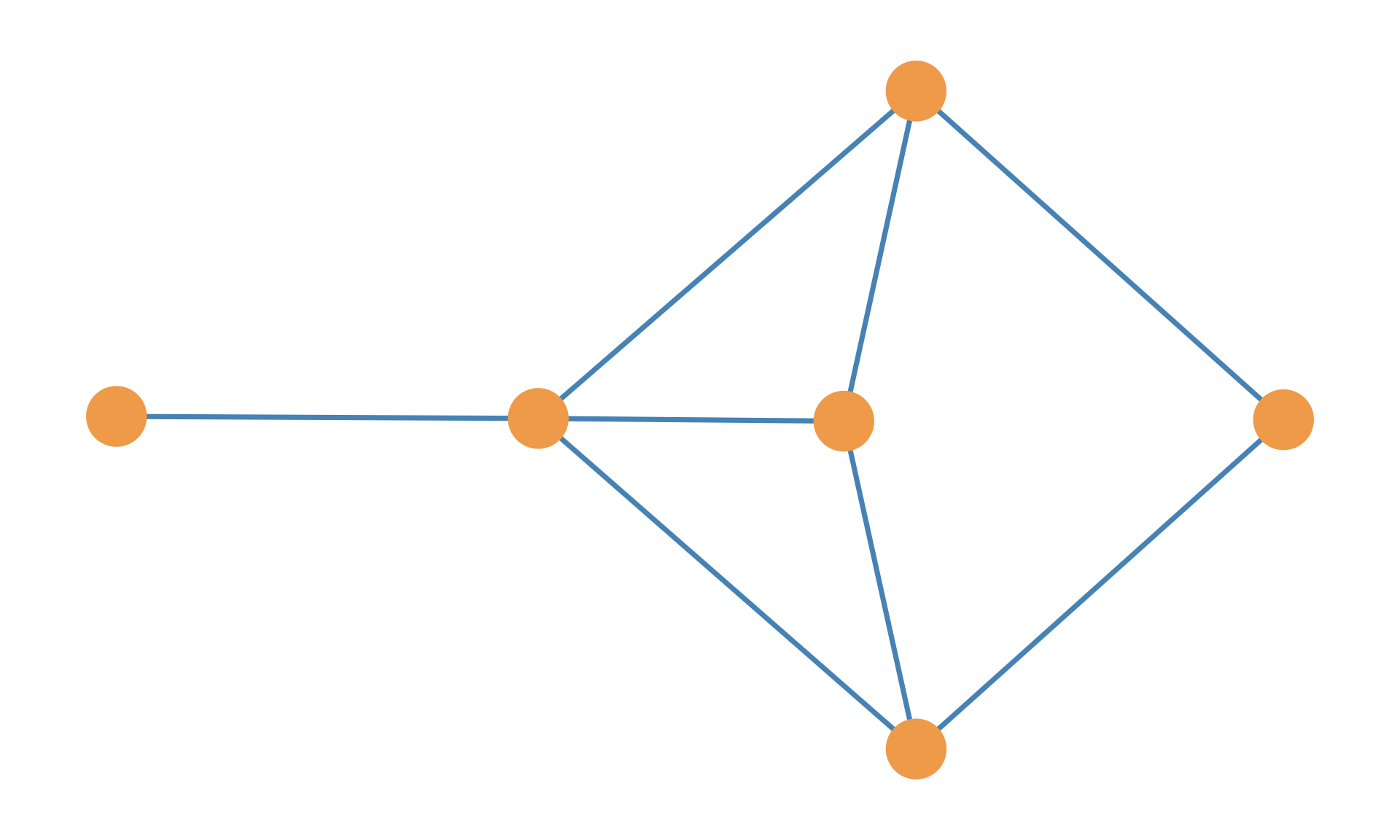
In a point-and-line plot such as the one shown in Figure fig-point-and-line, networks are represented as images. These kinds of pictures are sometimes also called sociograms or network diagrams (people who don’t like them call them “hairballs”). The convention in these kinds of pictures of networks is that the nodes (e.g., people) are drawn as circles (or some other polygon, such as a triangle or square) and the connections, ties, or links between people are drawn as lines or sometimes, if some kind of direction is implied, as arrows.
This way of representing networks is occasionally called a “graph”, although we will see that the idea of a graph is a little more abstract than just a picture. So in this class, we will make a strong differentiation between pictorial network representations and the mathematical concept of a graph. When referring to the former, we will use the term plot or network diagram, reserving the term graph for the abstract mathematical object.
1.2 Types of Networks
Given the very broad definition of networks in the preceding, it should be starting to dawn on you why people think networks are everywhere. And, come to think of it, they kind of are! Any system of interacting parts or entities can be depicted and analyzed as a network. That is why the idea of a network cuts across the information (e.g., networks of words in a text), social (networks of students in a school), physical (networks of servers on the internet), biological (networks of neurons in the brain), and psychological (networks of symptoms of mental disorders) sciences. The diagram in Figure fig-network-types gives you an idea of the different types of networked systems that exist in the world.
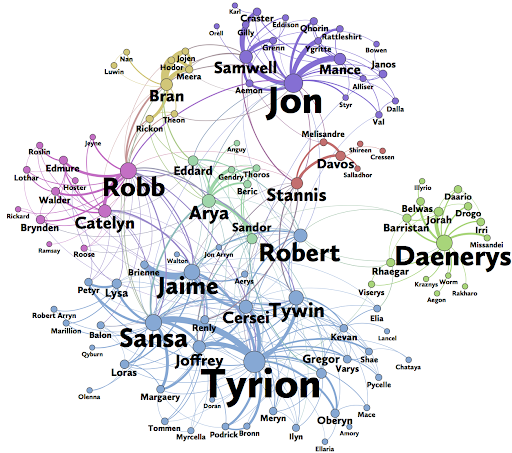
For instance, some social networks do not even have to be made up of real people! In fictional worlds, such as the Game of Thrones HBO series created from the books written by George R. R. Martin, some characters meet and get to know one another, but others never meet, or more likely in this show, (spoiler!) die in some kind of gruesome fashion before they get to meet. So we can construct a social network of acquaintance relations among the characters (who ended up meeting whom), as depicted in Figure fig-got. This is a social network because the links are composed of a psychological or emotional relation between people. The emerging fields of the digital_humanities studies these kinds of networks, which are often constructed from historical or literary sources.
In the case of GoT, the relation “knowing somebody” in Martin’s fictional world is an example of a symmetric tie between people. In Figure fig-got, the size of the name of each character is proportional to the centrality of the actor in the network. As we will see in sec-bigthree, centrality is an index of how important a given actor is in a network. So, even if you’ve never watched the show, you’ll know that Tyrion, Daenerys, and Jon are pretty important people in this show!
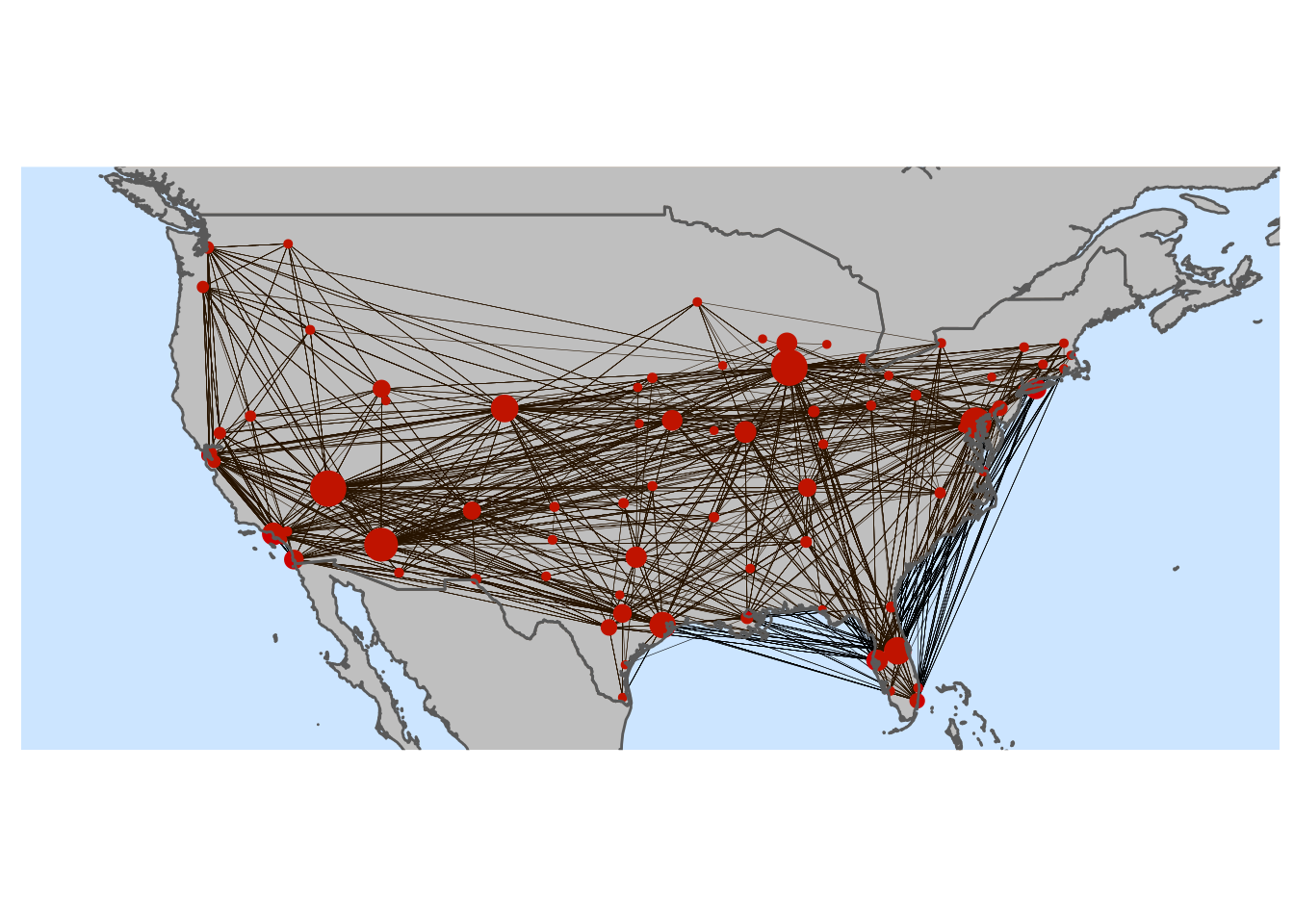
Other networks are composed of links between physical technological systems, not people. Take, for instance, the various airports (large and small, international and regional) in the United States. Every day, a number of flights depart from one airport and land at another. This means that airports in the US are linked via directed (e.g., from/to) ties in a socio-Technical network. This tie is directed because it goes from one airport (where the flight departs) to another airport (where the flight lands). The network of airports in the US, corresponding to the local carrier Southwest, is shown in Figure fig-airport, with the direction of the lines of omitted. Like in GoT the size of the nodes is scaled to the centrality of the airport in the network. The larger the node, the more central the airport is in the network. Which gives you a sense of where Southwest “hubs” are located (hint a lot of them are in the Southwest!).
This network is a socio-technical network because it involves both social and technological links built from flights that connect airports (see Figure fig-airport). The network is social because it is composed of people traveling. The network is also technological because its links are made possible by a complex web of air-flight technology, including planes, radars, in-flight computer systems, and so forth. As we will see in sec-ties, the directed links between airports are an example of an asymmetric tie; some airports fly frequently to other airports (e.g., Small Regional to LAX), but other airports (e.g., LAX) only schedule flights to major airports.
All of us carry around a very complex and staggeringly large network, composed of millions of nodes and billions of connections. The network is called the brain (see Figure fig-brain). The nodes are a special type of biological cell called a neuron. Neurons are special because they have these filaments called dendrites and a long body called an axon. The axon of one neuron links up to the dendrites of another one, generating a large-scale complex network that allows you to breathe, eat, drink, think, see, smell and read these pages. Surprisingly, for a long time people did not know that the brain was a network, because they didn’t know neurons existed (they thought it was all a big blob). It wasn’t until the Spanish neuroscientist Santiago Ramón y Cajal (1852-1934) used a special staining technique to visualize neurons that people realized the brain was a network!
But the brain is not the only network you carry around. In fact, YOU, your whole body, can be thought of as a network, at least according to network biologists (Lehnertz et al. 2020). For instance, as you can see in Figure fig-body, we can think of the body as a network, with organs as nodes and physiological connections as connections. It turns out that the song about all the bones being connected to one another wasn’t that far off from reality.
Lehnertz, Klaus, Timo Bröhl, and Thorsten Rings. 2020. “The Human Organism as an Integrated Interaction Network: Recent Conceptual and Methodological Challenges.” Frontiers in Physiology 11: 598694.
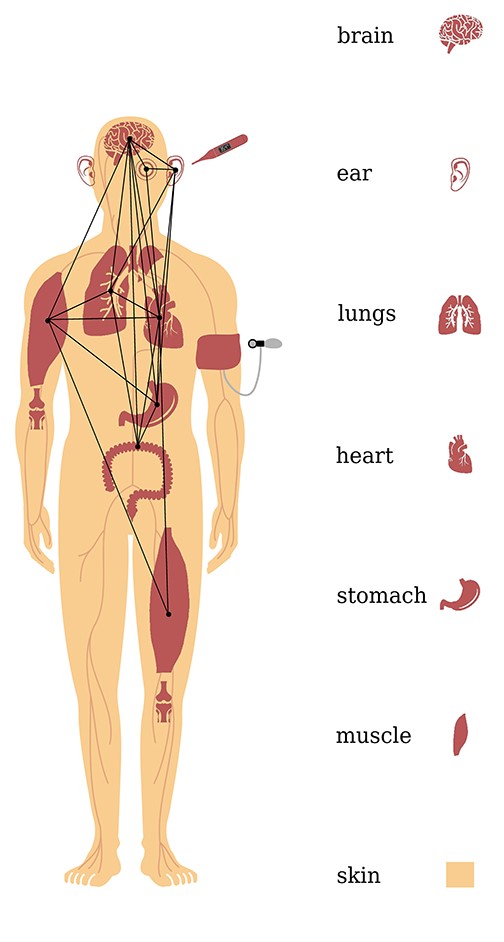
The brain is a biological network because its nodes are biological units (neurons), as are its connections. And the same goes for the various organs and physiological systems that compose your body. Other biological networks include ecosystems, in which the nodes are species, and the links represent various relationships between them, some antagonistic (e.g., predator/prey) and others mutualistic.
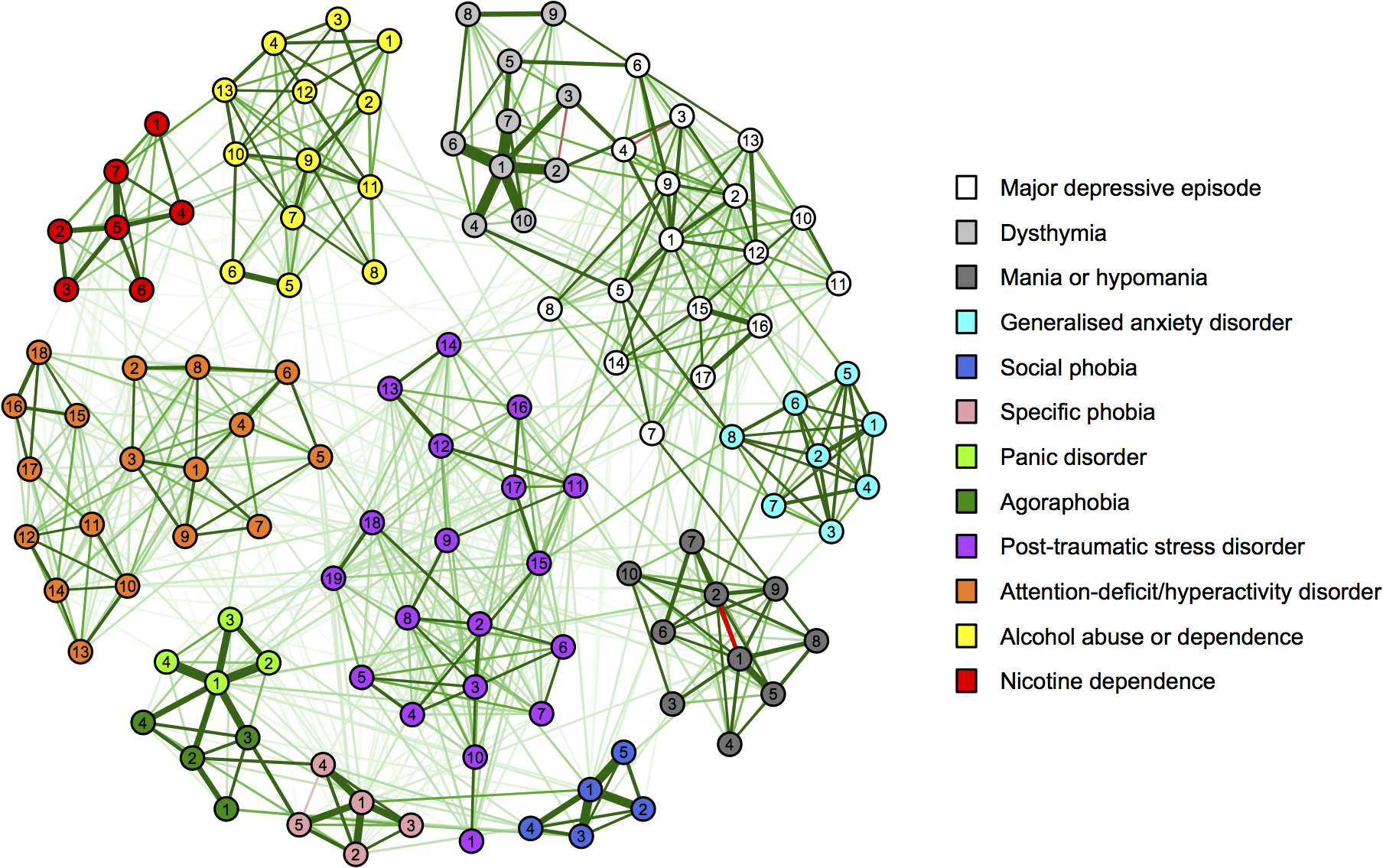
The nodes in a network can also be composed of psychological entities like attitudes, feelings, norms, types of thoughts, or emotions. In these psychological networks, two entities are connected if they tend to occur in the same people. For instance, people who have social anxiety also experience loneliness, which is linked to depression.
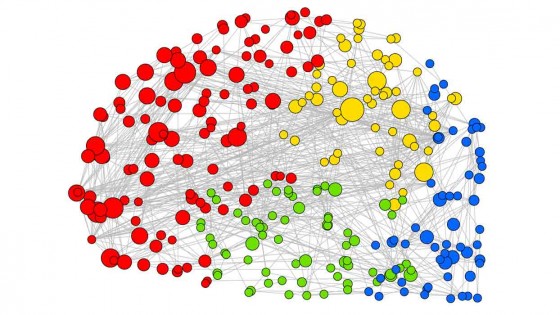
Figure fig-symptoms shows a psychological network of symptoms, taken from Diagnostic and Statistical Manual of Mental Disorders (DSM for short), created by psychological scientists who study psychopathology. In these networks, the symptoms that cluster together (shown as nodes of different colors) come to define specific types of mental disorders, like “Social Phobia” or “Panic Disorders.”
1.3 Summary
As we have seen, the concept of a network is incredibly versatile. Whether we are looking at the neurons in our brains, the airports that connect our cities, or the psychological symptoms that cluster together in mental health, the fundamental architecture of nodes and links remains the same. This universal structure is what makes network science such a powerful and interdisciplinary field. In the next lesson, we will narrow our focus from networks in general to the specific subset that forms the core of this book: social networks.