Social Networks

45  Homework I: Graph Theory

  • Welcome
  • Introduction to Networks
    • 1  What Are Networks?
    • 2  What is A Social Network?
  • Graph Theory: The Basics
    • 3  Introduction to Graphs
    • 4  Graphs and their Subgraphs
    • 5  Types of Ties in Social Networks
    • 6  Types of Ties and Their Graphs
    • 7  Basic Graph Metrics
    • 8  Nodes and their Neighborhoods
    • 9  Nodes and their Degrees
    • 10  Degree-Based Graph Metrics
    • 11  Indirect Connections
    • 12  Directed Indirect Connections
    • 13  Graph Connectivity
    • 14  Tree Graphs
  • Matrices: The Basics
    • 15  Introduction to Matrices
    • 16  The Adjacency Matrix
    • 17  Matrix Operations: Row and Column Sums
    • 18  Basic Matrix Operations
    • 19  Matrix Multiplication
  • Motifs
    • 20  Triads
  • Centrality
    • 21  Centralities based on Degree
    • 22  Centralities based on the Geodesic Distance
    • 23  Centralities based on Shortest Paths
    • 24  The “Big Three” Centrality Metrics
    • 25  Getting Centrality from Others
  • Two-Mode Networks
    • 26  Affiliation Networks
  • Ego Networks
    • 27  Ego Network Metrics
    • 28  Collecting Ego-Network Data
    • 29  Theories of Ego Network Homogeneity and Diversity
  • Subgroups and Blocks
    • 30  Clique Analysis
    • 31  Cohesive Subsets
    • 32  Equivalence and Similarity
    • 33  Local Node Similarities
  • Network Theory
    • 34  Dunbar’s Theory of Social Circles
    • 35  The Strength of Weak Ties
    • 36  Structural Holes and Brokerage
    • 37  Simmelian Tie Theory
    • 38  Dyadic Balance
    • 39  Triadic Balance
    • 40  Structural Balance
    • 41  Theories of Valenced Interactions
    • 42  Dominance Hierarchies
    • 43  The Diffusion of Innovations
    • 44  The Small World
  • Exercises
    • 45  Homework I: Graph Theory

Table of contents

  • 45.1 Vertex and edge sets
  • 45.2 Node Neighborhoods
  • 45.3 Graph Metrics
  • 45.4 Subgraphs

View source

45  Homework I: Graph Theory

45.1 Vertex and edge sets

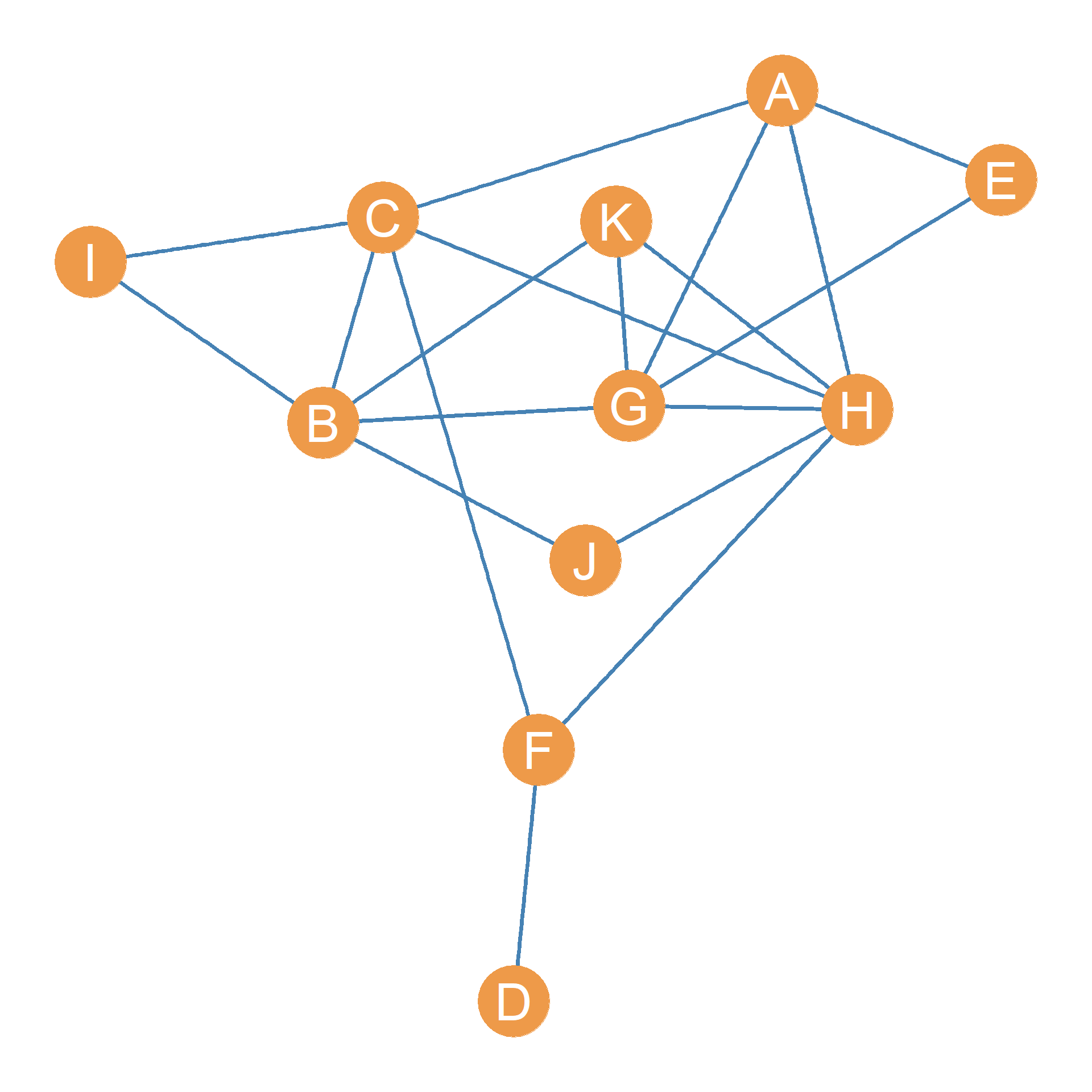
Figure 45.1: A simple graph.

Consider the graph shown in Figure 45.1:

  1. Write down the vertex set of the graph:


  2. Write down the edge set of the graph:


45.2 Node Neighborhoods

  1. Write down the neighborhood of node C


  2. Write down the neighborhood of node K


  3. What is the intersection of the neighborhoods of nodes C and K?


  4. What is the intersection of the neighborhoods of nodes G and H?


  5. What is the union of the neighborhoods of nodes F and A?


45.3 Graph Metrics

  1. What is the order of the graph?


  2. What is the size of the graph?


  3. Write down the graph’s degree sequence:


  4. Write down the graph’s maximum Degree:


  5. Write down the graph’s minimum degree:


  6. What is the graph’s degree range?


  7. What is the graph’s sum of degrees?


  8. What is the graph’s average degree?


  9. What is the graph’s maximum size?


  10. Compute the density of the graph:


45.4 Subgraphs

  1. Go back to Figure 45.1. Draw the node-deleted subgraph of this graph that excludes nodes F, and H.


  2. List the isolate nodes in the node-deleted subgraph you obtained in the previous step.


44  The Small World
Copyright 2023, Omar Lizardo & Isaac Jilbert